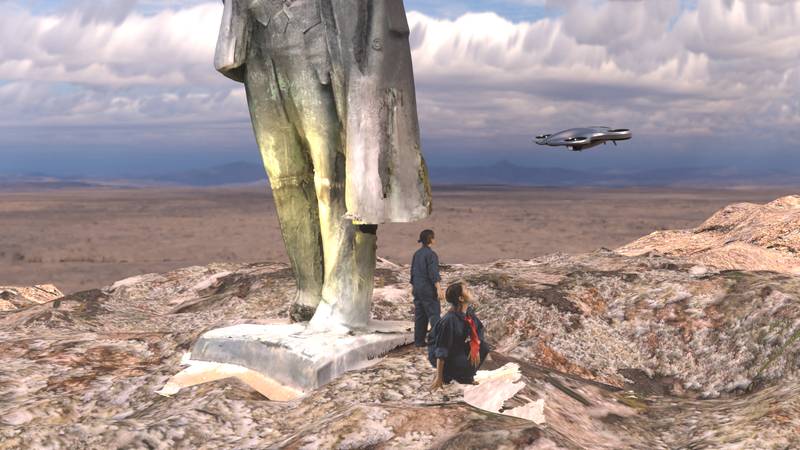
Ngọc Nâu, Virtual Reverie: Echoes of a Forgotten Utopia, 2023 (still). Courtesy of the artist.
Hung Duong writes and curates independently. His reflection on contemporary art is founded on exchanges with artmakers about art’s versatile roles in society. He runs his own website sea-through.net as a reservoir for his sprawling thoughts, while actively contributing to Artforum, Frieze, Art Review Asia, ArtAsiaPacific, and other platforms.
A concealed hand is always worth more in points than an open one. This is a foundational lesson newcomers to mahjong learn. For those working in the contemporary art scene in Saigon (the colloquial, more endearing title for Ho Chi Minh City) since 2016, every encounter between art workers and the state mirrors the intense dynamics of mahjong. As a strategic game of patience, observation, and calculation, mahjong creates a stimulating environment in which players have to plan two steps ahead, calculate points so they can build a better hand, and anticipate which tiles might lead them to glory – all while watching out for their opponents’ every move. Which tile to discard becomes the most important question that every mahjong player has to ask themselves as the game’s wind continues circulating. In a mahjong game, players can choose to keep an open hand by picking up discarded tiles or a closed one by picking solely from tiles in the walls. A rule of thumb remains that a closed hand offers more options while protecting players’ tiles from prying eyes.
Under the Vietnam government’s Decree 23/2019/ND-CP on Exhibition Activities, all fine art and photographic exhibitions must apply for a license. To acquire an exhibition license from the Department of Culture, Sports, and Tourism, the artworks must adhere to the guidelines under Clause 8 of Decree 23/2019/NĐ-CP for Exhibition Activities, namely they cannot advocate against the government, instigate war and conflict amongst ethnicities, falsify historical facts, disclose an organisation’s secret without having its consent, or violate civilized lifestyles1. This restrictive yoke is implemented under the guise of maintaining national unity and civic order, further pressuring artists, curators, and organizers in the country to strategize just to secure an opening. From leaving unlicensed artworks covered but still on display as a statement against censorship to editing the artist and exhibition statements to appear neutral while embedded with hints about sociopolitical issues, ambiguity becomes blended into the lingua artis in Vietnam as a method of speaking without vocalizing, thus safeguarding its actors from the state’s scrutinizing gaze.
Consequently, practitioners, even those new to the scene, develop a fluency in the language of subtle subversion. When saying ‘human rights’ or ‘land conflict’ places you in direct confrontation with an authoritative state, a euphemism of ‘humanistic values’ and ‘debate over land usage’ retains the essence of intention while adding a layer of lexical insulation. This framework does not promote ambiguity as senselessness, namely grandiose jargonistic texts or conceptually fumbling artworks. In these cases, ambiguity camouflages a lack of criticality. It proposes intentional and generative ambiguity. Instead of lamenting that which cannot be openly said, it encourages creating artworks founded on metaphorical textures, where suggestive hints and ephemeral gestures activate imagination while lending themselves to multiple readings. Similar to how a concealed hand in mahjong allows players to shift their tile combinations as circumstances change, an intentionally ambiguous artwork or exhibition ushers in interpretative multiplicity and elusive presentation – arguably what keeps the audiences returning and the authorities confused.
Within contemporary art practices, moving images offer a powerful medium to explore intentional ambiguity. Moving images offer a method to transcend one set of logic to create another one. Video art was transplanted to Vietnamese contemporary art circa the late 90s and early 2000s from eclectic sources. Haunting the liminal realms where documentary, Internet kitsch, and experimental short film converge, moving images continue to be embraced by contemporary artists in Vietnam for their metaphorical proclivity and the desistance of immediate access. Experimenting with ambiguity has enriched the visual language of moving image artists in Vietnam, where stories are told through coded language, social commentaries delivered through dream logic, and collective memories reconstructed through cryptic choreography.
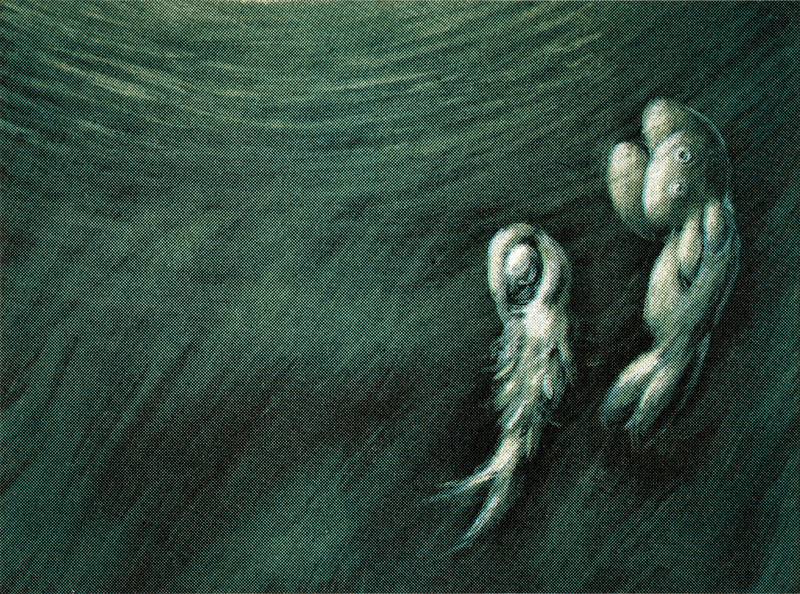
Hachul Le Do, The Tale of Trần Thanh Dương, 2025 (still). Courtesy of the artist.
“Being clear gets us in trouble,” wrote artist Hachul Le Do. “We become fluent in metaphor, gesture, implication, atmosphere. […] Indirectness becomes an experimental way of pushing the limits of what can be touched upon, while also carving a way for us to avoid confronting reality.”2A design graduate from RMIT University Ho Chi Minh City, Hachul has always found design discourse too direct, fast-paced, and solution-focused. He yearned for a creative language where storytelling could unfold slowly, without a straightforward agenda, and where subtle poetics could serve as a means of dialogue with the public. As a person living with queer identities, Hachul also finds the social climate in Vietnam stifling toward open discussions about bodily autonomy, sexual expressions, and reparative healthcare. He thus turns to animation as a haven not only to experiment with more innocent ways of seeing but also to speak indirectly about his reality of living in a queer body.
In his animated work The Tale of Trần Thanh Dương, 2025, Hachul queer-tells the language of folktale to convey his desires to transcend restrictive circumstances. Two amorphous creatures wiggle against the current: one crustacean with feathery scales, while the other piscine with a bent face. As they swim concurrently toward the glimmering sun, the 2D animation style switches seamlessly to 3D, where a sequence of symbols materializes to invoke a popular Vietnamese folktale called Thánh Gióng3: a giant footprint shaped like a bedazzled well, a woman, whose bulbous body seems to invoke intestinal texture, steps into the footprint and becomes instantly pregnant, a blind fortuneteller pressing on her naval and predicting her unborn child’s fate. The visuals unravel as the shrimp-and-fish-like creatures continue dancing in a frenzied whirl, propelling toward the foreground before swishing back into the depth of this aquatic realm. Accompanying the video is a sonic mixture of otherworldly vocals and traditional instruments, orchestrating a two-string moon lute, clappers, and drum. As the ambiguous voice narrates the storyline through poetic verses, the woman gives birth to her son, whom she names Trần Thanh Dương. The scene then switches to a mélange of water sprites dancing, visceral forms gesticulating, and the woman’s whispering prayers for her child.
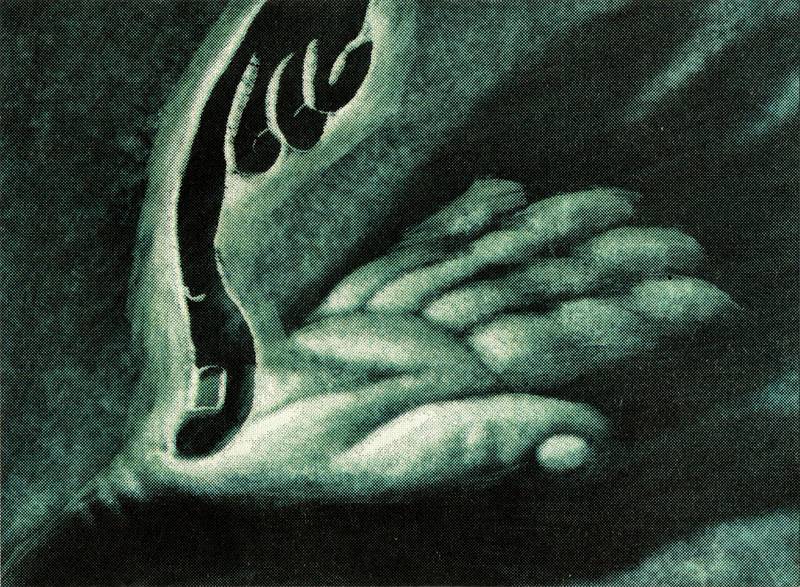
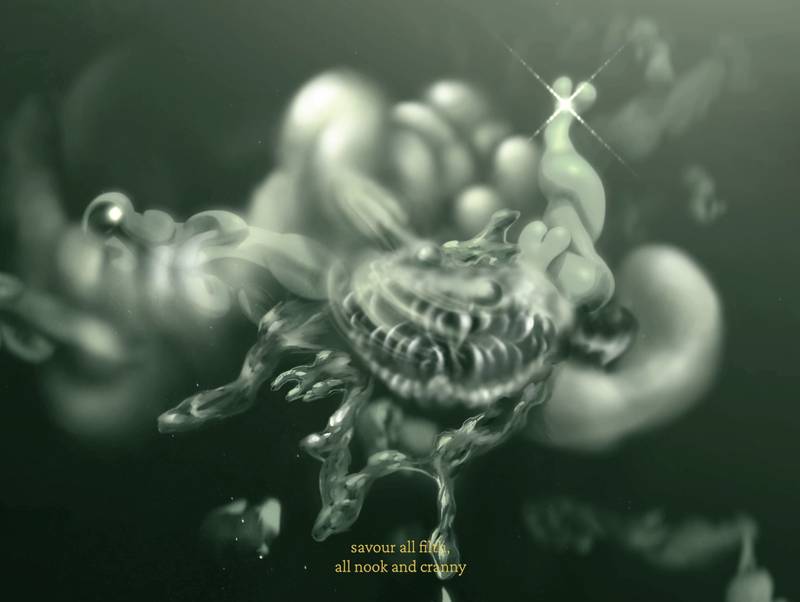
Hachul Le Do, The Tale of Trần Thanh Dương, 2025 (still). Courtesy of the artist.
Queerness seeps through Hachul’s figuration of his characters and their imaginary sphere. The animated creatures bear no gender marking, thus blurring society’s imposed norms that silently plague the artist and his communities. Their water realm is also fluid, allowing them to gather, disperse, and transform at will. Borrowing the mythological tale of Thánh Gióng, where a heroic figure undergoes bodily transformation to reach his optimal self, Hachul seems to ask multiple questions. One question can focus on this deity’s transitional process, which bears resemblance to the reality facing many people in trans communities. Another one might veer away from the gender lens and question the validity of a nationalistic myth, as Thánh Gióng is now incorporated into Vietnam’s elementary school curriculum to teach young students to love and readily defend their country. Are we still expected to commit our body to a nation that may not have our best interests at heart? Should we continue upholding this state-propagated version of Thánh Gióng that foregrounds unchecked nationalism, or should we seek out alternative versions of this oral folktale? How can we reexamine traditions that are taken for granted? The fluid world inside Hachul’s work provides a quiet space where these questions are coded into animation figures.
The music adds further nuance to The Tale of Trần Thanh Dương’s quiet subversion. Hachul collaborated with Tăng Ngọc Châu Nhi, a vocalist friend, to deliver the sung poetry-script in a style that can be described as experimental ca trù. A traditional form of chamber music in North Vietnam, composed of sung poetry, rhythmic percussion, and string instrumentation, ca trù began flourishing in the 15th century and was appreciated by scholars and royalty. During the French colonial period, it became associated with brothels and sex work, which resulted in its ban after 1975, when Vietnam emerged as a modern nation post-war. Today, ca trù has regained its status as a traditional art form and, after being recognised by UNESCO as intangible heritage, has been enlisted in Vietnam’s pantheon of nationalistic symbols. This once-censored music now mellifluously narrates, in coded poems, unspoken taboos and the intricate internal world of queerness. The juxtaposition between ca trù’s unabashed femininity and Hachul’s queering masculinity through Thánh Gióng becomes an anchor with which the work subverts social norms and revered traditions to gesture toward state-controlled mandates and nationalistic agendas. Through playful experimentation with coded lyrics and screen-based engagement with seemingly traditional storytelling, Hachul’s animated work intimately expresses his hope to see things with innocence, to transcend his social circumstances, and to emerge as a more holistic version of himself.
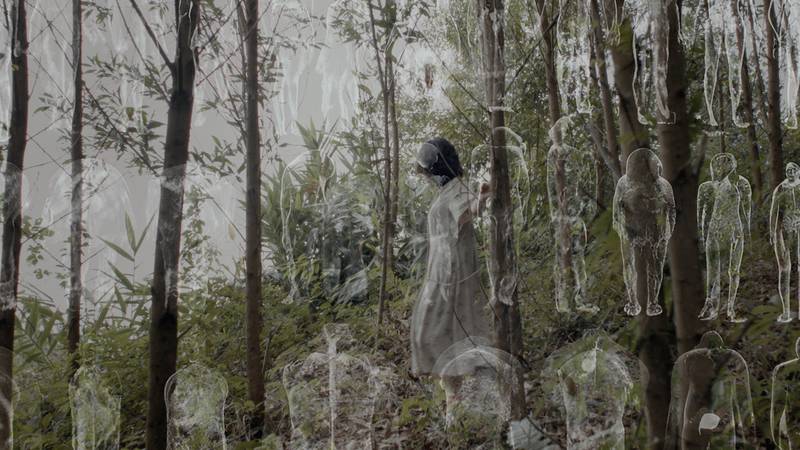
Lêna Bùi, dream(machine, human), 2025 (still). Courtesy of the artist and Galerie Urs Meile.
If Hachul skews mythological motifs to speak about personal desires that are socially stigmatized, then artist Lêna Bùi deploys moving images to speculate on the profound effects of rapid development on human relationships with nature and the environment. A graduate of East Asian Studies at Wesleyan University in 2007, Lêna’s practice encompasses a myriad of medium choices from silk painting to video and performance. While fluctuating between amusing anecdotes and in-depth articulations, her questions remain articulate: How do we rely on and separate ourselves from nature? How does history shape the present, and what of the present foreshadows the future?
Asking these questions is no easy feat in a social atmosphere where any form of critical discourse is discouraged at best and silenced at worst. It forces artists to become savvy with formal experimentation and novel storytelling to balance integrity with safety. Where the traditional documentary format risks exposure, Lêna’s experimental moving images retreat into the in-between realm of dream, while still retaining the real-life aesthetics of documentary. “I like the word dream. It opens up all possibilities,” Lêna shared. “It can jump from one logic to another, or follow no logic at all, and yet it also holds the potential for a cross-over, a promised meeting point against all reasons, even if only in our sleep.”4 For her works to embody a oneiric ethos, they allow both the artist and the audience to suspend their disbelief and accept certain fantastic premises. Yet, Lêna doesn’t wallow in escapism: She wants “to be free but not plunge into senselessness. To dream with a sense of direction, to be absurd with purpose, and then to depart from purpose, taking flight using intuition as fuel […].”5
dream(machine, human), 2025, is Lêna’s latest pondering on contemporary anxieties through surreal symbols, intimate conversations, and technological inference. A collage of slice-of-life footage, as if flipping through a forlorn album: a young girl carefully placing a lotus lantern on a pond, hands of children clawing into the ground in search of a magical rock, bald chicks peeking from behind a netted coop. Within this nexus of seemingly random memories, patterns slowly emerge. Footage of people in slumber (either a sleeping child wrapped in fishing nets or a mother-daughter’s pillow talk about their relative’s battle with cancer) is spliced with AI-generated and CGI scenes that project a post-apocalyptic, subterranean habitat, where humans seek refuge after the Earth has reached an unbearable temperature, heightening the sense of surrealism and boundary-crossing. Lullabies and conversations between nameless characters are peppered with hints about the inevitability of death. And water, as banal and mysterious as life itself, continues murmuring into our ears about hopes that remain.
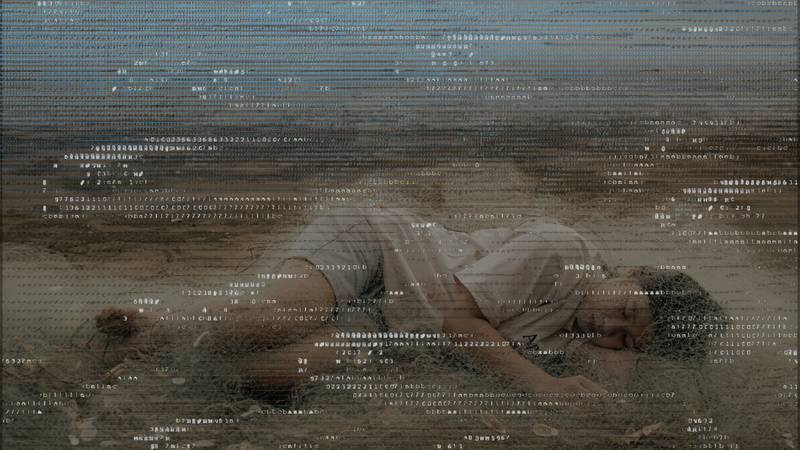
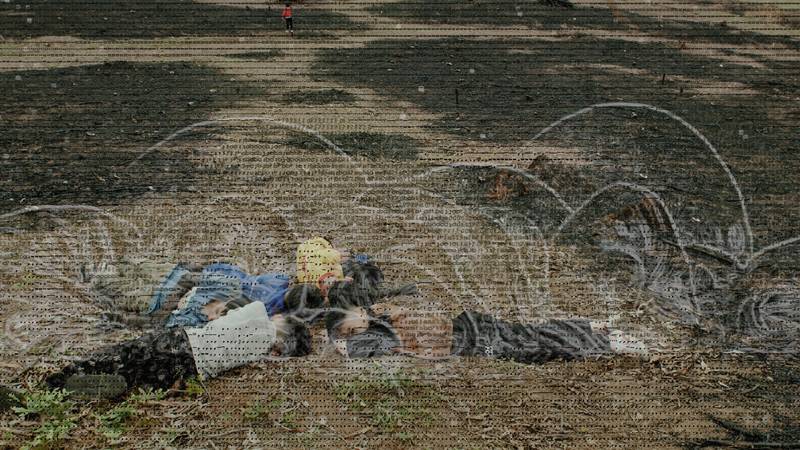
Lêna Bùi, dream(machine, human), 2025 (still). Courtesy of the artist and Galerie Urs Meile.
Lêna’s dream logic reveals itself in both the rhythmic alternation of footage and the fragmented narrations. An undulating cadence permeates how she sequences the scenes, fluctuating between slow, extended shots (the inside of a termite mound, snails crawling on top of one another) and rapid captures (traditional bamboo dances, a flash of a child riding a bicycle at night), between surreal nature and mundane activities. The work’s rhythm reaches a crescendo with a collage of AI-generated scenes, then sinks into a diminuendo with subaquatic shots, lulling the audience into a push-and-pull between dream and wakefulness. Yet, underneath this pendular tempo lie questions uttered in bated breath: What does it mean to be alive? How much innocence needs to be sacrificed before we realize that life is as much about returning as it is about progressing? The questions are built into the singing voice, the raspy sharing, the whispered conversations––fragments of an intergenerational anxiety told through the circular logic of dream and the sci-fi premise of a dystopian future.
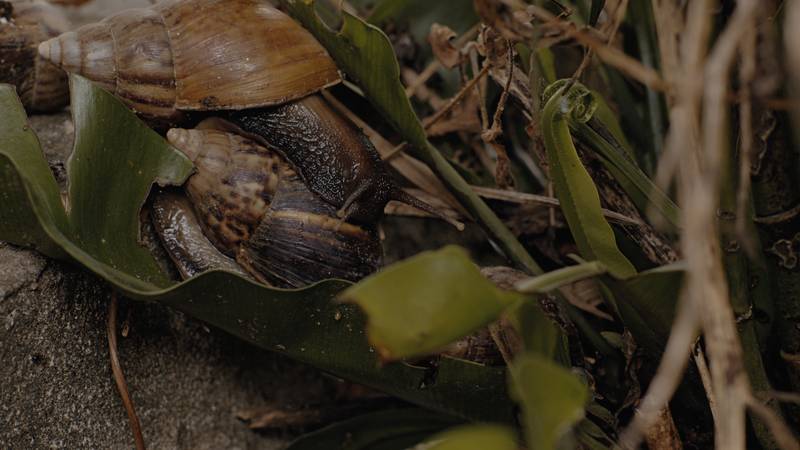
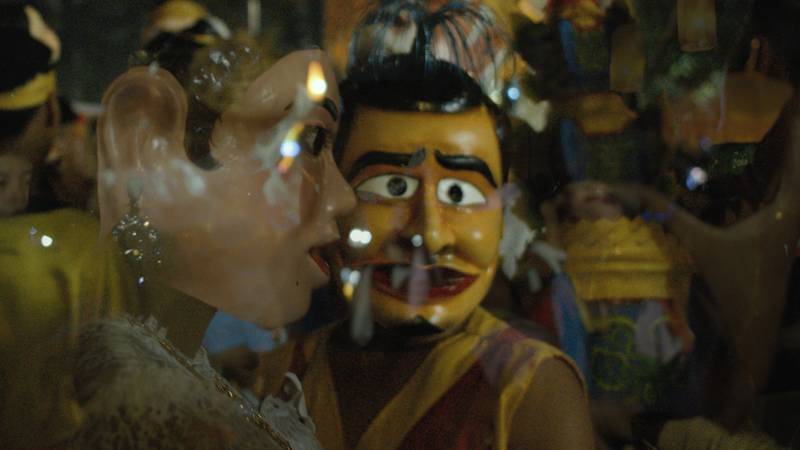
Lêna Bùi, dream(machine, human), 2025 (still). Courtesy of the artist and Galerie Urs Meile.
The title dream(machine, human) also alludes to the looming presence of technology and its impact on collective anxiety. Incorporating AI-generated images and CGI into her moving images for the first time, Lêna deploys this technology to paint a post-apocalyptic narrative while also blurring the boundaries between what is “real” and what is imagined by machines. Fantasy and fact dissolve into one another, and the rhythmic montage of scenes (with the occasional glitches from AI) seems to suggest that Lêna’s work is a fraction of a machine’s dream about the end of humanity, or of humanity’s imagination about what machines can potentially realize. Visuals crumble like data, collapsing linear macro-narratives to make place for micro storytelling, and machines infiltrate, intensifying the loneliness of existence. Lêna’s dream logic manifests as a boundary-crossing algorithm, generating countless interconnected images, subtle hints about the impending collapse of our natural and spiritual life. As Vietnam and the world become fixated on progress, inflamed by the promises of AI and blockchain empires, Lêna’s inclusion of this technology here is a gentle poke, a side-cast glance toward slogans of consumerist future-building: Can we still have hope in a world where our data is mined for profit, and nature is being sacrificed for development? The answers, perhaps, reside within our dreams.
While Lêna’s adoption of AI generation errs on the side of caution, artist Ngọc Nâu has embraced virtual reality as a language to evade restrictive censorship and respond to our increasingly technocratic world. Nâu’s upbringing in a long lineage that practices the worship of Đạo Mẫu (Mother Goddess)6 in Thai Nguyen Province (North Vietnam) has left indelible marks on her mixed-media practice. Her works, particularly moving images, blend mythology, memories, and VR technology to conjure a metaphoric world made of fragments, where blind faith and unquestioned monuments are broken down and reconstituted to birth new perspectives. “The deconstruction of symbols of worship is how we desacralize them, reminding ourselves that they too originate from mundane materials, susceptible to physical and virtual demolition,” she shared. “This is what excites me when making works: I see the fragmentation of symbols as a poetic ambiguity that not only liberates my creativity but also diversifies the portals through which the public can access my works.”7
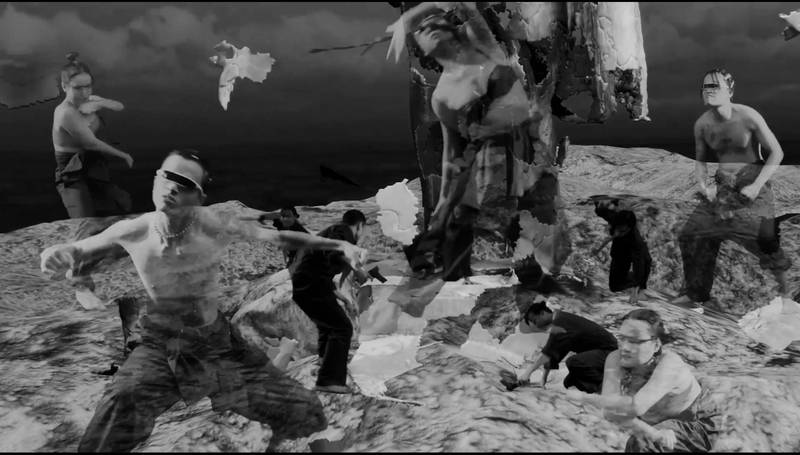
Ngọc Nâu, Virtual Reverie: Echoes of a Forgotten Utopia, 2023 (still). Courtesy of the artist.
Virtual Reveries: Echoes of a Forgotten Utopia, 2023, tackles the remnants of socialist symbols in Lithuania and Vietnam through hip-hop dance and virtual worlding to rethink their relevance to future generations. During her 2023 residency at Rupert (Lithuania), Nâu encountered the abandoned Vilnius Palace of Concerts and Sports (Vilniaus koncertų ir sporto rūmai)––a central landmark for Lithuania’s anti-Soviet independence movement in the 90s. She was struck by the architectural and ideological resemblance between this building and the Vietnam–Soviet Friendship Palace of Culture and Labour in Hanoi––where Nâu spent her teenage years rehearsing hip hop dance moves with her friends. At the same time, she discovered a once-toppled Lenin statue at Grūtas Park, a castaway from Lithuania’s Soviet era, which prompts her to think about its counterpart in Hanoi, still proudly erected in a bustling public park. This parallelism of ideological relics and their continued presence in two countries historically colored by socialism results in a video piece where a group of hip-hop dancers––dressed in attires that echo communist youths’ ideologies––explore a collapsed civilization, collaged from 3D-scanned fragments of architectural elements, museum objects from the socialist era, and Leninist memorabilia.
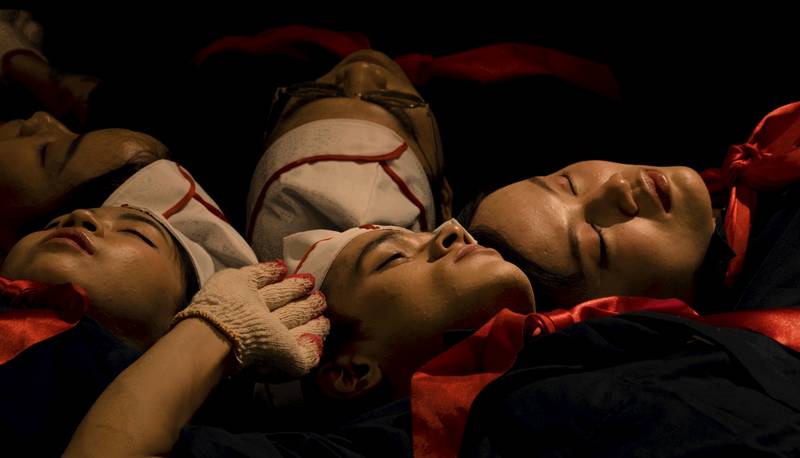
Still from Virtual Reverie: Echoes of a Forgotten Utopia, 2023 (still). Courtesy of the artist.
Can a monument make a myth of a man? In Vietnam, symbols associated with the communist state and its ideologies remain untouchable and irrevocable. Any attempt to engage with them through a critical lens will be met with heavy repercussions. Figures like the Lenin statue or the Vietnam-Soviet Palace continue standing as reminders of the state’s omnipresence and the everlasting impacts of socialism over the country. The reconstruction of the Palaces in the work through 3D scanning and rendering was also a direct result of censorship: Facing authoritative restrictions against on-site filming in both Vilnius and Hanoi, Nâu decided to forego real-life footage and reincarnate the monuments through virtual reality. Her musings on the validity and symbolism of these monuments thus migrate to the digital realm, where the Palace dissolves, leaving behind its disjointed granite-slabbed columns, sloped roof, and red-carpeted stages. They become the infrastructure to build Nâu’s virtual realm, interwoven with memories of her youth spent at the Palace practising freestyle moves. To whom does the Vietnam-Soviet Palace belong then, the government that ordained it or the public who use it daily? Can a monument serve as a vessel for both collective memories and state adages? How can we unpack the legacy of monuments without reiterating nationalist ideologies?
Virtual Reverie has no narration or script. The dancers remain silent, their gaze neutral. Instead, their bodies speak for them. As they hammer the relics with a gun, each fist pounding the ground with fierce intention, one can sense an undercurrent of passion, and perhaps frustration. Towards the video’s end, they consolidate into a group, each member performing a freestyle flow, letting their wavy arms and gyrating hips feel the beat. Hip-hop has long been associated with the search for freedom of self-expression, layered with anti-establishment philosophies. For Nâu’s generation growing up in conservative Hanoi, hip-hop was a welcoming platform where individual expressions commingled with community spirit. As Vietnam tightens its control over public space and gatherings, the ethos of hip-hop in Nâu’s video reminds us of these forgotten values. As the dancers choreograph their way through virtual ruins, scenes of demonstrations in Vilnius appear briefly before overlapping with snippets of youths skateboarding at Hanoi’s Lenin Park and state-organized musicals promoting national loyalty at the Vietnam-Soviet Palace. The juxtaposition thus foregrounds the tension between the state and the public, between socialist visions and their complex implementation. Can freedom truly exist within ideological boundaries?
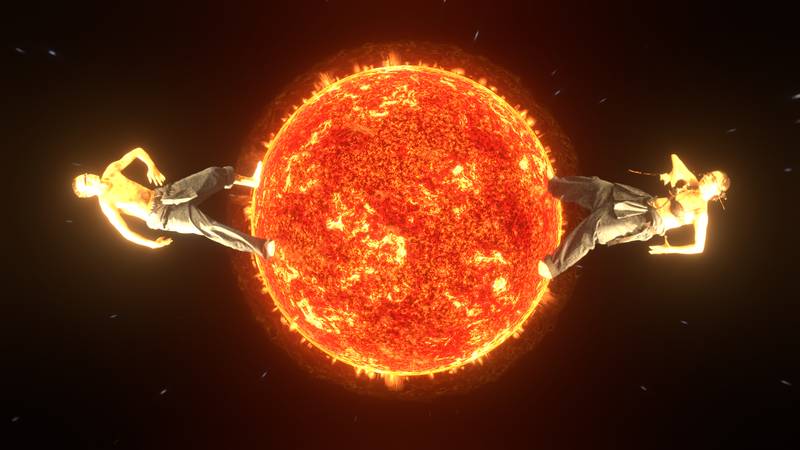
Still from Virtual Reverie: Echoes of a Forgotten Utopia, 2023 (still). Courtesy of the artist.
Do you hear the people sing?
Some sing in the coded language of a censored art form.
Some carry the notes through lullabies and whispered unease.
Some reverberate through hip hop music and freestyle dance.
In a world where we are told to accelerate healing to the point of exhaustion, slowing down is already an act of embracing ambiguity. For works that revel in ambiguity and draw strength from it, the meditative quiet of listening is even more important, as they demand patience, repetition, and a sense of devotion. Engaging with such work requires comfort with chaos, submerging into coded languages without losing breath, and dreaming logic and cryptic choreography with the intention of reemerging with fresh eyes and new knowledge. It often demands direct conversations with the artists, to listen to them with the desire to learn and not just to frame. Where things get unbearably polite and policed, how can artists carve out a space for critical discourse?
In the context of Vietnam, where ambiguity can act as a counteractive method to conceal intentions and suggest different perspectives on the same ideologies, beliefs, or traditions that we are brought up to follow, the medium of moving image becomes a vessel for artists who have to speak without vocalization, to convey through gestures, and to sing in metaphors. This ‘genre’ of ambiguity desists rigid interpretation that hinges entirely upon research practice. It instead demands a certain withholding from audiences and writers, to present ourselves to it as it reveals itself to us, to look for what is hidden or missing, and to follow a single jolt beneath the surface’s tempo. To taste the poetics and not grimace, to accept that art can, and will always, mean more than one deduction.
Viewed from a transnational lens, intentional ambiguity does not just serve the purpose of navigating state-imposed restrictions. Too often, people walk through an exhibition, an art fair, or a studio visit and expect a clip-note version of the artists and their works – a solid narrative, built on buzzwords that ring hollow from exhausting repetition. The contemporary art ecosystem (markets, institutions, galleries, and arguably the artists themselves) demands a linear, even reductive, interpretation and presentation of artworks that fits neatly into a label or a catalogue. Working intentionally with ambiguity can disrupt this cycle. Visual metaphors that can be read from multiple angles, coded languages that invite immersion instead of analysis, and the intuitive use of silence/voicelessness can all become subtle methods through which artists add interpretative textures to their works. Artworks that can be read through nuanced layers will lend themselves to more environments and attract a larger scope of audiences, thus expanding the discourses generated through them. Choosing ambiguity as a language is challenging, something akin to walking a tightrope between chaos and control, yet the fluid narratives and perspectives that it generates might just be worth the pain.