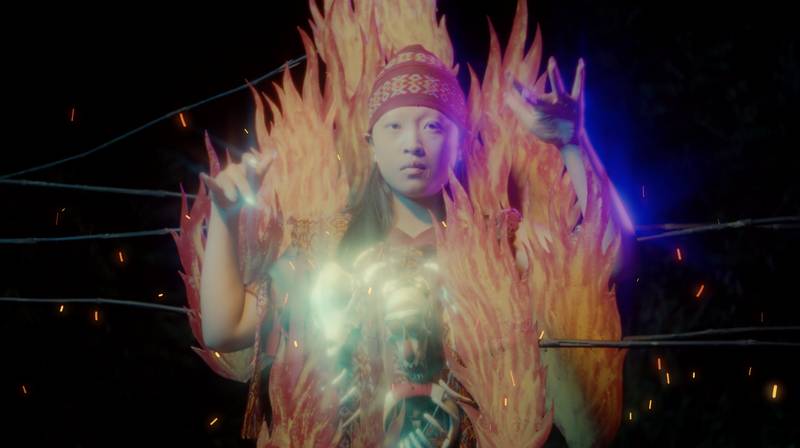
Natasha Tontey, film still from Garden Amidst the Flame (2022)
A. X. is a London-based curator, artist, and writer.
“I’d like to learn some of your magic” – so begins Natasha Tontey’s Garden Amidst the Flame (2022), in which a young Minahasan girl is visited by the spirits, turning away from the path charted for her to join the Indonesian Armed Forces, and instead becomes a rebel spiritual initiate. This trajectory can almost be read as mirroring the artist’s own journey to think through Minahasan cosmologies towards the imagination of a post-Humanist, located and communal framework of liberation – against the background of the violence of European and Japanese colonisation, the Permesta rebellion of 1957-58, the CIA-supported mass killings from 1965-661, and the continued erasure and impoverishment of indigenous lifeworlds in Indonesia.
This essay attempts to theorise the concept of a dissident cosmopoetics, tracing this mode through the universe of Natasha Tontey. I propose the term “dissident cosmopoetics” to refer to acts of world-making that sit at odds with both ‘Western humanist’ frameworks as well as those of the traditional knowledge and value systems of the communities that an artist emerges from, charting out political projects that enact gestures of enfolding. Dissident cosmopoetics is concerned with the role of artistic practice in metabolising historical catastrophe into new conditions of inhabitable life.
Theoretically, I situate this concept between the enormous contributions of Isabelle Stengers2 to the idea of cosmopolitics within knowledge practice, and the diplomacy between worlds; the path blazed by Sylvia Wynter3 in her imagination of a horizon no longer bound to a humanism formed through empire, and the inventive, eruptive ‘Jester function’ of cultural practice; the work of Cora Diamond4 read through David Scott5, who reformulates her notion of the “loss of concepts” to understand repair after the unimaginable or the inconceivable – the horizon upon which concepts are dashed; Lauren Berlant’s6 grounding of acts of queer world making in the intimate, the minute and the incidental.
Scott, though concerned primarily with the aftermath of Trans-Atlantic slavery, provides a useful framework to understand and diagnose the condition of repair following the devastation of life worlds and forms of life in the Minahasan context – and more broadly for ethnic minority indigenous peoples in the colonised world – in the wake of colonisation and post-colonial state formation and dictatorships. This devastation transformed societies, and their worlds, in a multitude of ways. To conceive thus of radical repair requires us to understand repair not as a gesture towards the neutral restoration of a lost original, of a fallen whole. It is to accept that there is no original to which to return, nor will there ever have been, no pieces to collect and suture back together – repair is a process of enfolding. It is, and must always be, with and in relation to the very violence that necessitates the turn to repair. It registers each break, and thus the constitutive gesture – rather than a “re-constitutive” gesture – is necessarily one of invention.
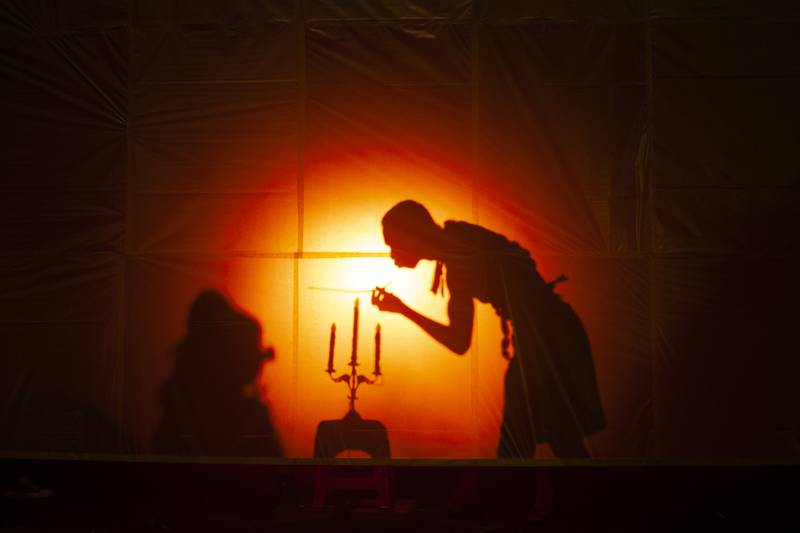
Natasha Tontey, film still from Of Others Tomorrows Never Known (2023)
At the same time, as Wynter points out – it substituted the “concepts” of the colonised with those of the coloniser, wrangling them into a Humanist horizon, which foreclosed – or exhausted – their ability to possibilitate, to imagine a liberation beyond the framework of the ‘human’ (human rights, human dignity, as distinct from the dignity of the life world of the human – ie, the human as a figure in a landscape), pointing out to us that this horizon may be glimpsed by a study of the Humanities (such as they are) – but that they may only be enacted by means of what she terms “ceremonies” – acts of conjunction beyond the human that disrupt the imposition of the category. The ceremony then, as I understand it here, is literally an insurgent form of world-building – a dissident form that articulates itself in opposition, yes, to the human as well as the recasting of traditional hegemonies in the mould of the human, that then exceed the horizon of Humanism.
To understand the interaction between these worlds, and on one hand the knowledge practices and the other ontological frameworks, Stenger’s view of the role of contingency in interaction between worlds (where knowledge and worlding are spatial and spatialised practices) and the possibility of a non-heirarchical diplomacy between fields presents a useful orientation away from the universal that follows the human to rush in to fill the void of authority. Through this, and in conversation with Berlant’s project of world-making as contingent, fragile modalities, dissident cosmopoetics – ie contingent, eruptive forms of world-building through cultural practice and form – resists this foreclosure and allows for the formulation of other forms of life and life worlds. It is thus that I turn from a concern with cosmopolitics to working through and with cosmopoetics, and of making with wounded worlds. Decoloniality is, after all, more than an act of stripping away the apparatus of Empire to reveal a pristine immanent (radical) de/pre-colonial reality. Rather, it too enfolds, contending with history and inventing possible presents. It is an act of imagination, of poësis, of phagia, and towards the production of a plural cosmopoetic position.
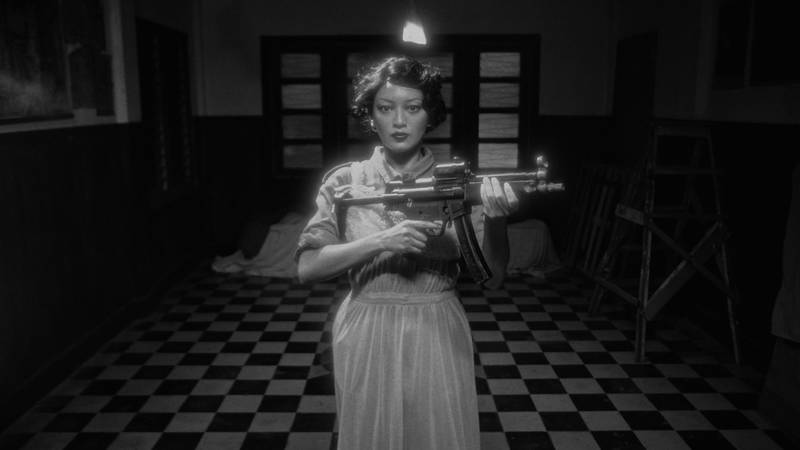
Natasha Tontey, film still from Macho Mystic Meltdown Chapter 2: Monster; She Wrote (2026)
Tontey’s world making – her manner of formulating a dissident cosmopoetics - is a metabolic, phagic one – one that might be held in conceptual dialogue with the anthropophagic imaginaries of de Andrade – read always through the lens of the work of Eduardo Vivieros de Castro7 and Isadora Neves Marques8: this imagination allows us to answer the Spaniard’s response of “This gold, we eat”9 with, “This Human, we eat”. Eating – and eating the H/human – recurs through her work – as we will revisit later, but it produces another powerful vision of world-making that metabolises, that does not reject the human outright, but accepts, eats and reconstitutes, via a precise, embodied, dissident imagination.
Dissident cosmopoetics is an orientation within an arrangement of relations that is not the same across two sites: an artist may produce a cosmopoetic vision that serves the needs of empire, for example – a Han Chinese artist choreographing a disparate Southeast Asian performers, juxtaposed with images from colonial archives of Tibetan ritual dances, all somehow aligned with an idea of “Asianness” (one need only recall the deployment of “Asianness” as an instrument of Japanese imperial ambitions) produces a cosmopoetic vision, certainly. But hardly a dissident one – if we read these actions against both the backdrop of continued Han Chinese-chauvinistic claims on Tibet and Tibetan Buddhism, as well as Chinese imperial ambitions on Southeast Asia. The same might be said of a Han Chinese artist ventriloquising/minstreling Southeast Asian cultures in CGI videos of themselves/their avatar dancing in an ambiguous landscape – an artist beloved of Western curators and institutions. Here, cosmopoetics serves Empire as its vanguard - how will these cultures be absorbed into an imperial image? By producing images of the imperial body cosplaying the native, or as the architect for how cultures may interact, juxtaposed with images of a culture it has already committed genocide against. To propose instead a dissident cosmopoetic position is to be sensitive to the ever-chimeric nature of power and empire, and to radically transform the relationship between image and power, orienting oneself not only towards one’s own liberation, but towards the liberation of all. Empire is no longer a singular point in the distance - but all around us, wearing many faces – even faces that look just like ours.
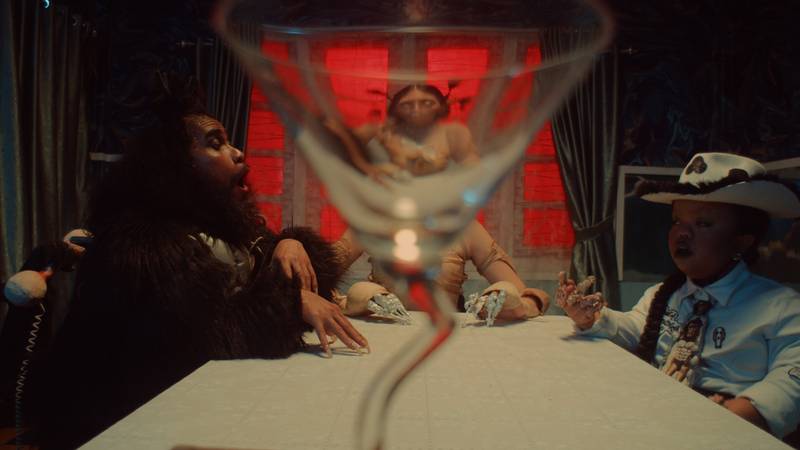
Natasha Tontey, film still from Primate Visions: Macaque Macabre, film still (2024)
Cosmopoetics has long been the prerogative of rulers – of kingdoms, Empires or contemporary nation-states: capital cities that produce itineraries of seeing and becoming a citizen through architecture – boulevards, monuments and edifices are but a quasi-secular (this, too, is debatable) form of a cosmopoetic mode. The debates over the souls of indigenous people in the Americas, too, were acts of cosmopoetics, resulting in the (re)establishment of a white supremacist global order in which we still live. The rituals of kingship, of coronation – ราชาภิเษก (rachaphisek), abhishek – reset the relationship between heaven and earth with the body of the monarch in the centre, and thus, when the monarch dies, the heavens are ablaze until the next coronation. Dissident cosmopoetics attempts to wrangle this ability to produce worlds, to set worldly alignments, out of the hands of power, and into the hands of those dreaming of liberation. It is an ethics – towards worldmaking for collective liberation, through rituals that we invent. A Ceremony Must Be Found, as Wynter says! This essay focuses on key artistic choices, and their consequences, through which a dissident cosmopoetic position is expounded upon in Tontey’s work.
Natasha Tontey, film still from Primate Visions: Macaque Macabre (2024)
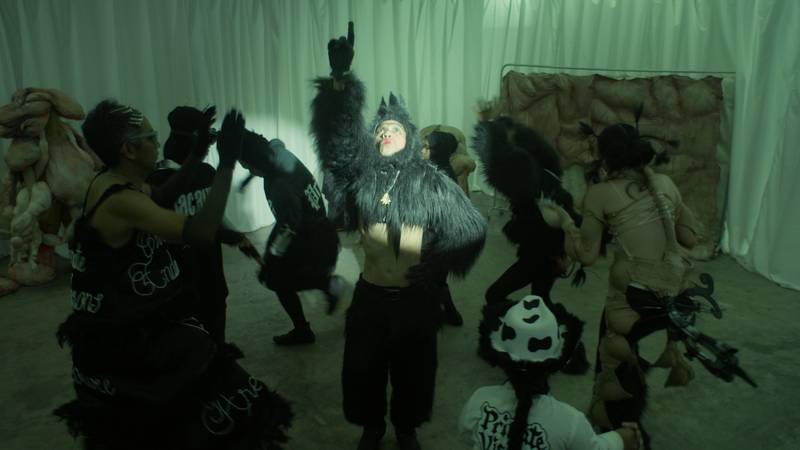
Drag is a central instrument of Tontey’s critical cosmopoetic vision – she references John Waters as a major influence – occupying what Wynter describes as the Jester function. Equally, she draws on the aesthetics of the traditional Figura Festival – an annual carnivalesque ritual in Manado, with influences from Spanish colonial and Catholic form – where cross-dressing and gender-based performance play a key part. At a present moment when to speak of drag is consonant with speaking of RuPaul’s Drag Race, we know that drag does not inherently occupy this function, but may also be used as an instrument of a liberal imperialism, of a franchised model of the faggot around a single glittering (Western) image. Tontey takes drag back to its roots, baby! - of a critical mode not only of gender-based performance (that too!) but also in relation to power and to history. For Wynter, every symbolic order requires figures who expose its contingency. The jester occupies precisely this position. Existing both inside and outside the dominant order, the jester reveals that the categories through which society understands itself are neither natural nor inevitable, but performed, reiterated and therefore transformable. Wynter’s jester names a figure who inhabits the threshold of symbolic orders, exposing their contingency not through negation but through disruption. Rather than simply critiquing the dominant order, the jester rehearses another one, making perceptible alternative genres of the human before they become socially recognisable. Read in this way, drag is not merely the performance of gender but a cosmopoietic practice: a dissident ceremony that reveals humanity itself to be contingent, while composing provisional forms of life that exceed the Human. Tontey collaborates not only with drag artists from Indonesia’s queer performance scene, but also produces characters through exaggeration and the deployment of a camp aesthetic that occupy a critical relation to power both within her films and outside of them. Here, I will speak to three of them - Makatana from Of Other Tomorrows Never Known (2023); the macaque from Primate Visions Macaque Macabre (2024); and the figure of Len Karamoy from Monster; She Wrote (2026) and Phantom Combatant and The Metabolism of Disobedient Organs (2026).
Natasha Tontey, film still from Of Others Tomorrows Never Known (2023)
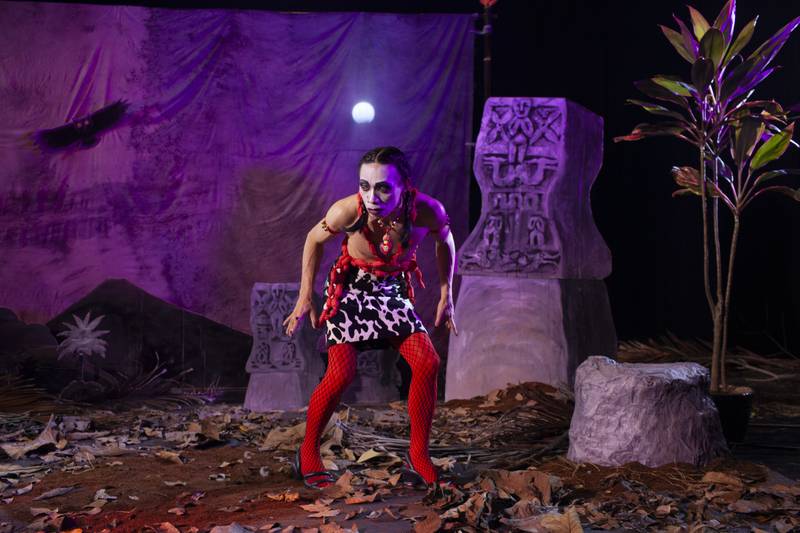
In Of Other Tomorrows Never Known, a film about time, Tontey recruits a Minahasan elder to step into the role of Makatana - a transcendental deity within their shared cosmology. By casting an elder in this role, Tontey also challenges patriarchal ideas about how masculinity is performed in the community. Clad in a cow-print skirt belonging to the artist’s mother and a pair of kitten heels, the vision of Makatana here is at once sacred and tender, yet irreverent. Believed to be a being outside of time, the ungendered treatment of her subject evokes a deeper sense of ethereality, making even the campness of the character appear no less sacred. She leverages the ambiguity of gendered performance in drag - drag not as the performance of “another gender”, but rather thought of as the pure form of the expression of gender itself, and its performance - ie, the work of artifice is not only to produce an illusion of ‘passing’, but rather that the craft of drag allows one to leave behind the binary – and the human – altogether. In a poetic gesture, she rhymes this leaving-behind of gender with the leaving-behind of time, attuning us to the atemporal space that Makatana occupies. Thus, she charts a course to the suspended all-time-but-no-time, the space of the concatenated past, present and future through a constellated, exploded idea of gender through the figure of Makatana. This notion of the atemporal, or rather the temporal-otherwise, is a key idea, a building block, within Tontey’s configuration of a speculative Minahasan cosmology – her cosmopoetics – as it renders contingent the linearity of time and teleological temporality that the “Human” presupposes as its background, featureless “homogeneous, empty time”. In doing so, she proposes a to-come temporality that simultaneously always is. Through this, and through the figure of Makatana in drag, she formulates a proposition for a Minahasan cybernetics, or a cybernetic view of Minahasan cosmology.
Natasha Tontey, film still from Primate Visions: Macaque Macabre (2024)
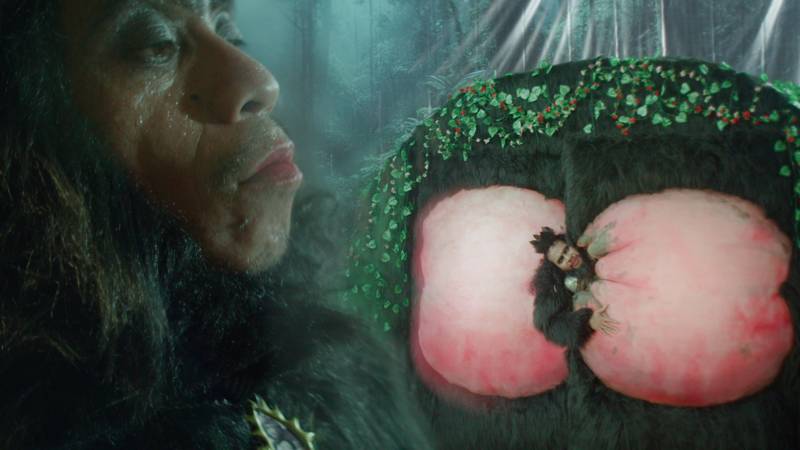
The human-macaque, or the animal in drag - or perhaps the human as animal-in-drag – of Primate Visions: Macaque Macabre becomes the fulcrum of Tontey’s vision of the diplomacy of the sciences. The video centres around the figure of an anthropologist/primatologist in the jungles of Sulawesi studying the evolutionary history of the macaque. Played by Aditya Pradhan, the character of the macaque opens up a multi-naturalist viewpoint, displacing the human as the unitary figure against the background of a mute Nature, but rather repositions the more-than-human world as one which the human - particularly the human scientist – is in society with. The film expounds on evolutionary theories of consciousness – from the “Stoned Ape” theory10, to the idea that consciousness arrives from the gut - focusing on the drag-macaque’s iconic heart-shaped rump, rendered as a portal in the film. Consciousness begins in the ass, the macaque contends - proposing a non-dualist, embodied theory of the mind, a central proposition of the artist’s dissident cosmopoetic vision, which undoes the mind-body hierarchy of Humanism, and leads us to a different conceptual diagram of thought. If the gut is the origin of consciousness, then the phagic is its motor: the film begins with the uncaging of the macaque, who is then brought to a banquet attended by the anthropologist, the macaque, and other more-than-human figures. Here, the “human” - that most human figure of the scientist-coloniser - is in society with the native, the spirit, the animal, all gathered around a dinner table, bringing to mind Isadora Neves Marques’s study of Brazilian antropofagia entitled Where To Sit At The Dinner Table? - eating brain-like jellies, while being served by a Japanese-speaking hybrid figure, referencing the occupation of Indonesia by imperial Japan as another layer within the colonial history of the islands. The relation between eating, the human, the body and social transformation has been a key theme running through Tontey’s work: in a 2017 performance in collaboration with Elia Nurvista entitled Makan Mayit, she staged a dinner where courses were served in plastic baby dolls (eat your heart out Arakawa-Nash!) while the two artists discussed the taboo of cannibalism - central also to the vision of antropofagia. This led to a series of performances titled The Order of Anthropophagia, which prefigured the artist’s reformulation of Minahasan cosmopoetics. Anthropophagia, therefore, repositions us within a world of relations under the order of predation, where the human is no longer the privileged subject, but rather, part of a network with an animated nature. This animated nature - which we inhabit with our embodied/bodily consciousness - is precisely what the figure of the human-as-macaque-as-human-animal via drag allows us to access. The political force of drag as method lies not only in its capacity for critique, but in its ability to compose temporary worlds in which different forms of life become experientially available, allowing for the rehearsal of being in the more-than-human worlds she proposes.
Natasha Tontey, film still from Macho Mystic Meltdown Chapter 2: Monster; She Wrote (2026)
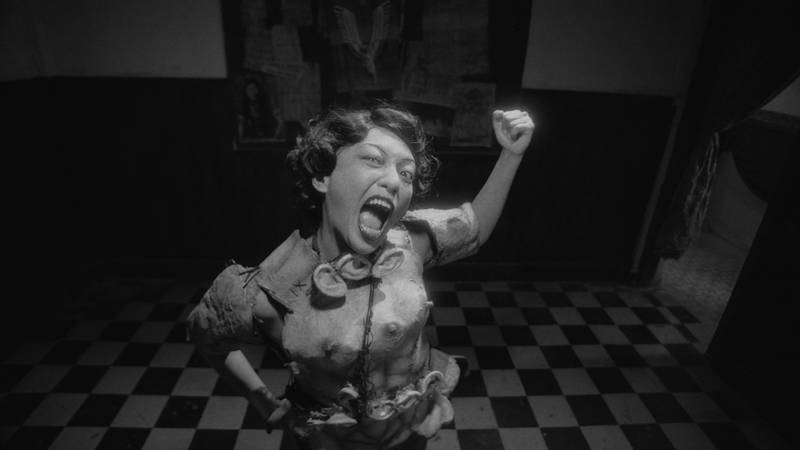
Finally, Tontey’s most recent work - Monster; She Wrote (2026) and Phantom Combatants and The Metabolism of Disobedient Organs - is also her most directly political. Here she revisits the 1957 Permesta Rebellion (Piagam Perjuangan Semesta), where Minahasa played a key role, becoming a centre of the rebellion against the central government of Indonesia and what was viewed as an overly centralised national system that neglected the country’s ethnic minorities. Permesta occupies a complex place in both the nation’s history as well as that of the community: the CIA was heavily involved in arming and providing supplies to the rebel groups led by regional commanders of the Armed Forces of Indonesia who defected, spurred on by the fear that then-President Sukarno was becoming too close to the Indonesian Communist Party (PKI). The CIA supplied the rebels through the Clark Air Base in the Philippines, and helped set up the air force of the movement, providing them with refurbished World War II aircraft. Thus, while complicated, the Permesta Rebellion remains a source of pride in the community, especially among male elders, the artist says, as a moment when the Minahasan people stood up for their own autonomy. While the rebellion is largely remembered in connection to the male commanders of the movement, Tontey repositions Len Karamoy – played by Asamara Abigail – as a central figure in the movement. Using black-and-white images of the forest, the artist sets the stage for a non-linear retelling of Permesta’s history. In doing so, she challenges the visual language of propaganda films, such as Pengkhianatan G30S/PKI (1984), that she grew up with, gesturing instead to the rich world of Indonesian B-movies. In Monster; She Wrote, Karamoy moves through the jungle before eventually stripping off her uniform to reveal a Frankenstein-esque monstrous form, before cavorting with a life-sized bullet in a psychedelic room. This stitched-together body stands in for a national imagination marred by continuous foreign intervention and earth-shattering internal conflict that has marked the country’s history since independence.
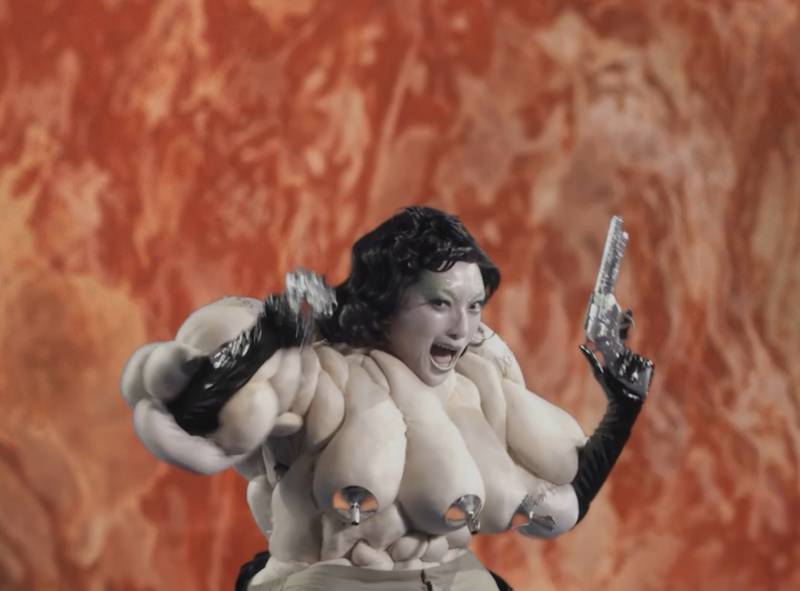
Natasha Tontey, film still from Macho Mystic Meltdown Chapter 3: The Phantom Combatant and the Metabolism of Disobedient Organs (2026)
Phantom Combatants is set against the backdrop of computer-generated images of forested landscapes and thermal imaging, rooted in military imaging processes, and in the theatrical sets that are central to Tontey’s production of the in-between space (in-between time, in-between realities, in-between histories). Here, Karamoy’s transformation is complete - she metamorphoses into an unreally muscled monster with three breasts. In this, she references the monsters of B-movies that she grew up with - both Indonesian and particularly from Japan. The muscle suit that the main character wears continues the artist’s critique of hyper-masculinity - mocking it through exaggerated gender performance, i.e. drag. This Karamoy is joined by a troupe of equally muscled young women, one of whom has the star of the Permesta flag carved on her cheek, many of whom are played by the same actors from Garden Amidst The Flame. In inventing this drag-monster version of Karamoy, Tontey takes an anti-monumental approach - not smoothing out the complex, nor resurrecting to ventriloquise, as nation-states are wont to do, not producing a linear heroic narrative, but rather asking what happens when we place the monstrous at the heart of our historical imaginations, upsetting historical narration as a teleological endeavour, in consonance with her critique of temporality: Hindi IDOL naman, LODI siya bitchesssssss. By using drag as a method to tackle this subject, Tontey renders this history alive and contestable - passing it on to her compatriots who appear in the film, to inhabit as they so choose, to approach with respect but not reverence, as if to say, the past, the present, the future is ours, in all our monstrousness.
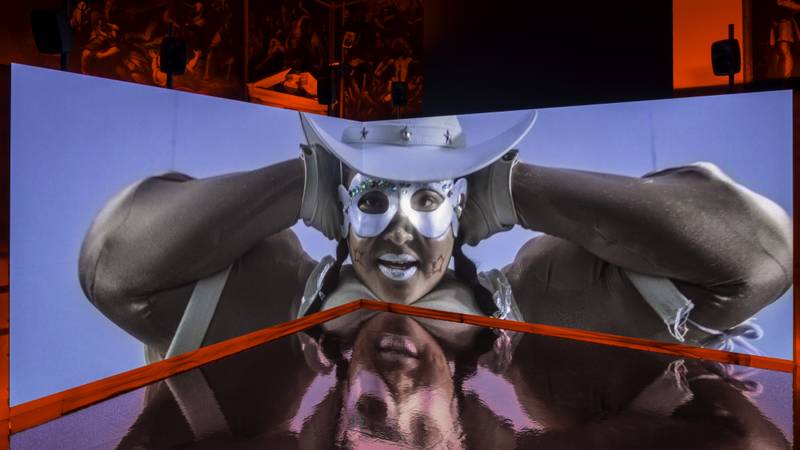
Natasha Tontey, installation view of Macho Mystic Meltdown Chapter 3: The Phantom Combatant and the Metabolism of Disobedient Organs (2026)
The use of the aesthetics of Indonesian B-cinema, inflected by a late-internet style, is hardly coincidental: as filmmaker Riar Rizaldi11 points out, this genre of cinema was precisely the one to which the denizens of the country’s folkloric narratives – such as kuyangs – were relegated. In his poetic study of horror in Indonesian cinema, he points out how, during the dictatorship and after, these entities appear in B-movies as demonic figures that are symbolic of a pre-Islamic heathen culture that is then tamed by the power of collective belief – faith, nation. The exorcising of the “malevolent spirits” thus stands in for the production of a new unified national spiritual consciousness that turns away from the “superstitions” of old, and towards the modernising influence of a singular, hegemonic religion. The banishing of the spirits thus lays the ground for the moral, the modern, the pure of the male-centred nation-state – for of course, in these movies the spirits plaguing the village are most often in the guise of beautiful women, who use their beauty to entrap hapless men, and the (often white-clad) modernising man saves the day by resisting and overturning temptation. It is telling that the kuyang - who also appears in other Southeast Asian folklore as the krasue in Thailand or the manananggal in the Philippines – is often represented as a female head trailing intestines. A stomach: the embodiment of female appetite, understood as corrupting and disruptive, forever preying and leading the adherents of a patriarchal moral order astray. Beware the appetite of women – this genre warns.
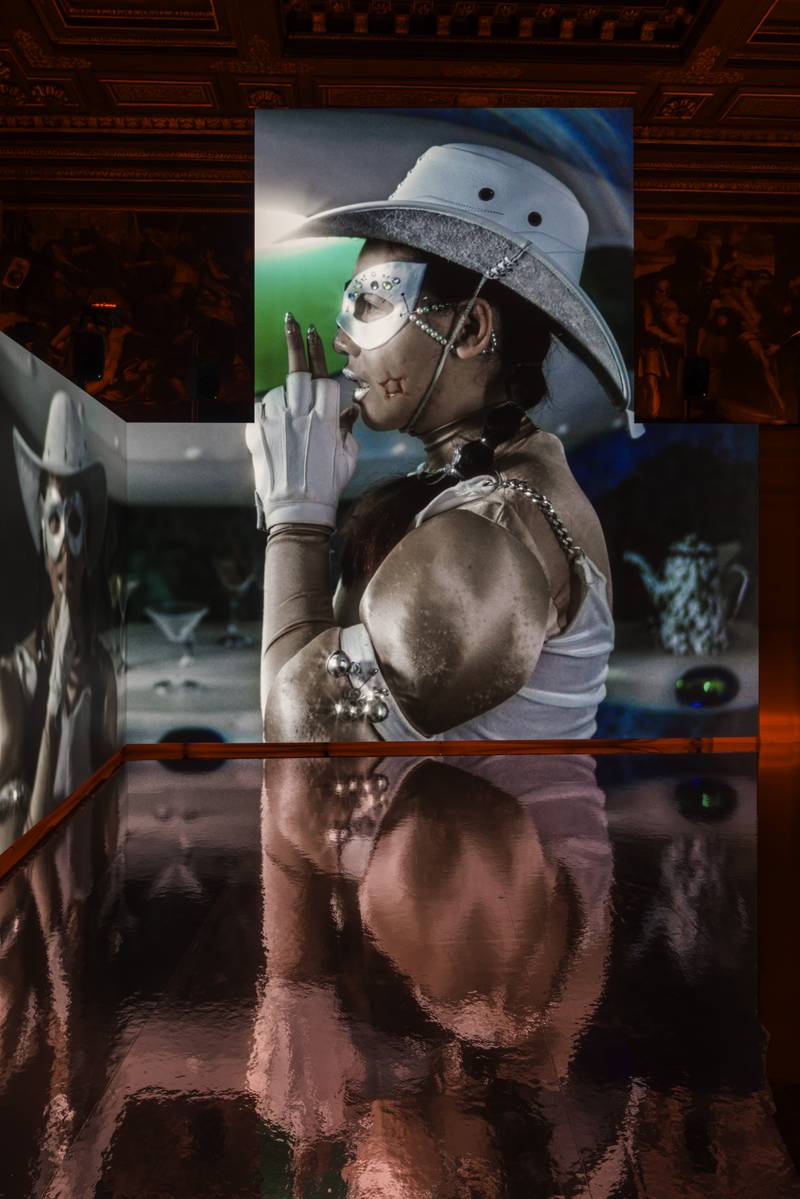
Natasha Tontey, installation view of Macho Mystic Meltdown Chapter 3: The Phantom Combatant and the Metabolism of Disobedient Organs (2026)
Accessing, and perhaps disentangling, the folkloric from the entrapments of morality imposed on it through this cinematic order, and producing a new image requires a dive into its aesthetics. Tontey does not arrive on this mission unarmed, however – the post-Internet inflection in her work points to the use of social media, TikTok in particular, to produce a different image of the folkloric, one that may be produced by indigenous and non-urban subjects themselves, rather than through the approval of a hegemonic order. TikTok dances in traditional costumes, elders sharing stories and recipes directly with an audience, unperturbed by the need for approval from studios, also allow for something else: young people, often queer young people, staking claim on these narratives and practices, deciding that they want to style their traditional dress with anime merchandise or a face beat for the GODS honey. And for the gods, the many gods, they are – and through them the spirits find new life, transformed – adorned now with fake eyelashes and a cunty set of nails – it is no wonder then that the symbol of recent anti-government protests in the country has been Monkey de Luffy’s pirate flag. It’s giving subaltern expression of a creolization of a folkloric/indigenous form – the folk is yassified, producing space for a new anti-establishment image of the folkloric.
It is precisely this space that Tontey’s work rushes in to occupy - a new cinematic world that is pulled, as if through a churning of the seas of images: the post-Internet yassified image, the mountain, the old patriarchal moral order, the sea, her cinema, the snake and the irresistible pull of a dissident political imagination setting in motion a great act of churning and upheaval. What emerges from that is, of course, the pharmakon - as Tontey warns in Of Other Tomorrows Never Known - holding within it the seeds for both corruption and liberation, for this new image is as easily co-opted by a new identitarianism that re-establishes a hegemonic order that replaces the state with male elder, maintaining, and perhaps re-invigorating the orders of hegemony under the guise of an anti-establishment politics, a folkloric politics that is inflected by totalitarianism justified by its opposition to cultural genocide. It is in fact the preciseness of Tontey’s vision, aesthetic and political, that refuses this possibility: at once she challenges both the state that denies the rights and culture of her community, and the vestiges of patriarchy in the community itself, refusing a static, conservative idea of culture, while at the same time refusing a singular image (Western, developmentalist, KPI-driven) of cultural transformation - which for those still clinging to an idea of linearity or teleology, you might know as progress. Because fuck that.
Holding the poison in her throat, she produces an ultimately restrained, pared-back cinema – pulling from the sea of images a new modality of political form that is at once tender and irreverent: a modality of critical inheritance. Here, to inherit is no longer a passive act, but rather a radical space of refusal, yes, but also of an acceptance that is not acquiescence: setting concepts – as Diamond formulates – in motion towards new alignments. This mode of critical inheritance no longer gestures to established or long-forgotten mores in culture as the basis for the fight for liberation – read, “look at our ancient temples, we too have faggots/women with appetite/trans* people/other marginalised identities in our glorious pre-colonial culture!” No, instead it stakes the claim for human dignity here and now, not only because of, but also – when necessary – despite cultural diktats, and that the hegemony of what is, or was, cannot rule over what could be. It’s less – “look here’s some faggots/women with appetite/trans* people/other marginalised identity in our epics/medieval texts/cultural object of significance” and more “faggots/women with appetite/trans* people/other marginalised identity are here, and whether you historically respected them or not does not matter – we are here now, and we will be respected, and be equal claimants to this culture, shaping its worlds as we move forth”. To make worlds, then, is not a pseudo-conservative, conservationist gesture, but rather – as it is to critically inherit empathetically – a radical openness to new imaginations such as they are.
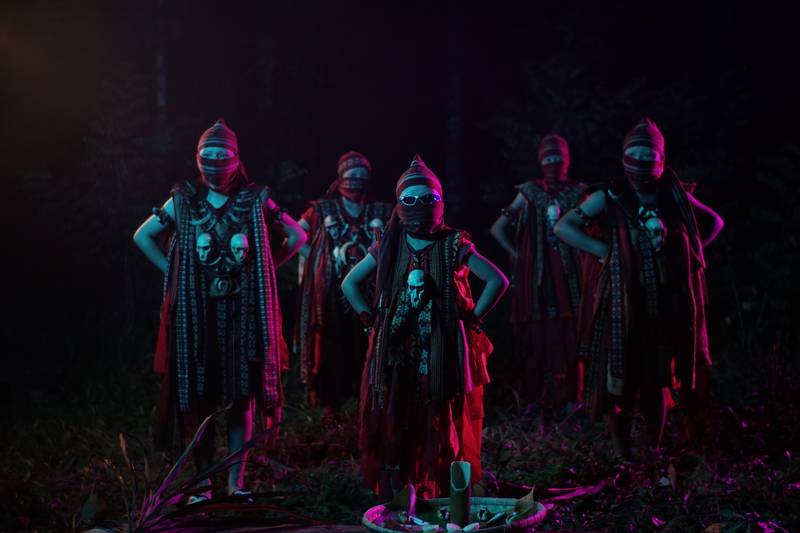
Natasha Tontey, film still from Garden Amidst the Flame (2022)
Cinema, here, is both ritual – the act of churning – and also infrastructure (following Vishmidt’s12 formulation) - the ground upon which this vast, cosmic act of re-orientation towards liberation - occurs, not only on screen, but also in the lives of the young Minahasan girls that are her close collaborators, in the experience of the conservative Minahasan elder who appears in drag as a mythical being, setting in motion the possibility of collapsing the distinction between image and life. Cinema here, then, is dual use – transforming dynamics of power both within the immediate community that Tontey is a part of, but also across a discursive horizon - of the nation-state, but also of a Western liberal understanding of a “post-colonial, indigenous subject”. I borrow the notion of “dual use” from David Price’s13 study of anthropology from the United States during the Cold War - which constituted genuine academic study that had a secondary use for US intelligence agencies such as the CIA in gathering data and analysis to support counter-insurgencies/insurgencies in countries around the world. Thus, anthropology, which has its disciplinary foundations firmly at the root of Empire, was once again conscripted, sometimes unwittingly through secondary funding bodies such as the Ford Foundation or chains of subsidiaries, into the service of American imperialist mechanics. A glaring example is the work of James C. Scott, a pre-eminent anthropologist of Southeast Asia, particularly Indonesia, who theorised anti-state resistance and anarchism in the region, was himself funded by the CIA, and whose involvement in Southeast Asian leftist politics contributed directly to anti-insurgency efforts. Dual use cinema flips this dynamic, through an act of studying up: using the resources of the international art world – itself a product of this same Cold War system of funding, study and meaning-making – Tontey produces genuine brilliant cinematic work, whose dual use is to create situations of transformation at the communal level, thus proposing it as an instrument in the insurgency against Empire and hegemony. This is cinema in a dissident cosmopoetic mode. Tontey leads us through a world shaped materially by European, Japanese and American imperial interests, and intellectually by a Humanism that underpins it, and eats it whole: no part is left out, and everything is reconstituted.