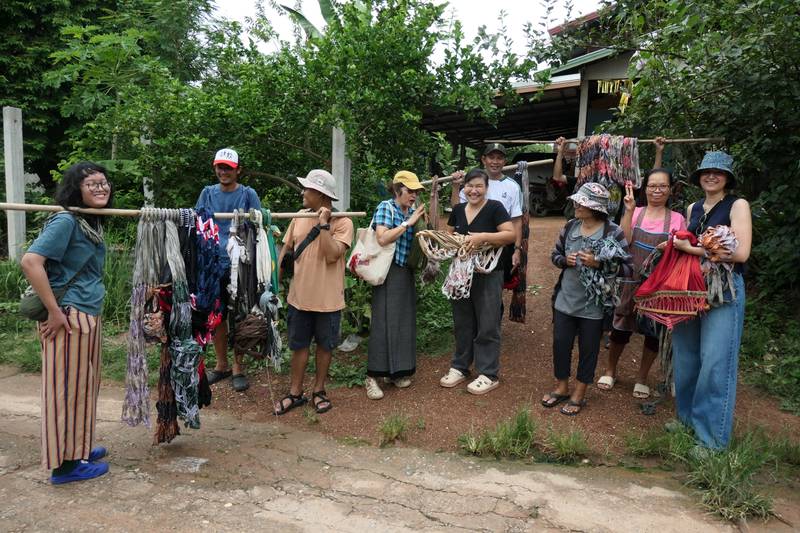
Old hammocks for new. Hammock exchange in Baan Phue village for Saan Sense, Womanifesto 2026. Photo by: Lena Eriksson
Nitaya Ueareeworakul (b. 1966, Udon Thani, Thailand) is a multidisciplinary artist whose practice explores women’s experiences, social realities, and environmental concerns.
Jamilah Preenan Nana first joined Womanifesto in 2001 as a cultural manager for Womanifesto Workshop 2001, held on Boon Bandarn farm in Sisaket province, Northeast Thailand. With a strong interest in art-making, she has continued working with the collective ever since, both as a member of the organising team and as an artist.
Varsha Nair lived in Thailand from 1995 to 2019, and as one of the key co-organisers of Womanifesto since its inception, she has been instrumental in conceptualising projects that stretch beyond the traditional model of biennial exhibition-making to produce intergenerational and cross-disciplinary workshops and collaborations.
Ananya Patel is an interdisciplinary artist, designer, and curator with an interest in exploring the pluralistic perspectives that drive change.
Womanifesto is a feminist artist collective founded in 1997 in Thailand. Since then, it has operated as a non-hierarchical network of women artists, prioritising friendship, care, and community-based projects over institutional demands.
Varsha: Right at the beginning, when I got to know Nitaya, and we became friends, and then we were working on Womanifesto together, she said – we remain independent, not let any institution dictate to us – and I thought to myself, Yes, I love this girl!
Nitaya: We have our own way. If we work with institutions, they have to really understand what we are doing and give us that space.
Varsha: Womanifesto has kept going since 1997. We have, in one way or another, through thick and thin, through simple gestures based on friendship, care, and connection, and without playing the art world game, created a space where we can care for each other as artists.
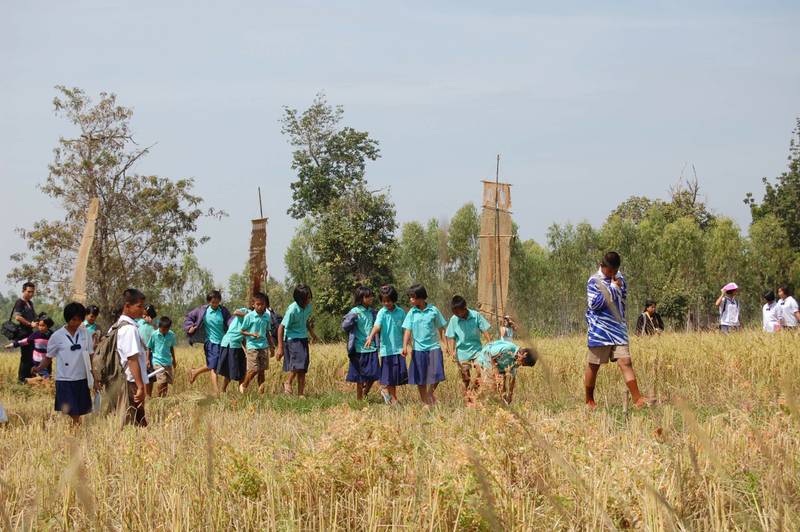
School students visit Naruemon Padsamran’s installation in the rice field on open day for 2008 Womanifesto Residency at Boon Bandarn Farm, NE Thailand. Photo courtesy of the Womanifesto archive.
No One Way
Varsha: “What is the Womanifesto Way?” We say the Womanifesto way is that there is no one way. Every project or gathering we do becomes a stepping stone or a cauldron of ideas in development.
We have gathered now for Saan Sense. In Thai, saan means to weave, to intertwine. Sense is a play on the word, combining “sen” and “sense”. In Thai, sen is a long line, rope, or thread. Sense talks of our senses as well as of making sense – of feeling and of making meaning. The gathering brings together two artist collectives based in Isaan (Northeast of Thailand), one of which is us, Baan Womanifesto in Kumphawapi in Udon Thani province, and Mahasarakham Mid-field Artspace in Mahasarakham province, to collaborate with communities in Ban Phue and Ban Khi villages. We are making new hammocks and lending out their old, used ones. We have set up workshops to weave with fabric offcuts. Some new hammocks are sourced from local weavers and suppliers as well as small enterprises run by women and people with disabilities, and these weavers teach their techniques at the workshop.
This gathering of around 10 artists, including international members, art and media students, and lecturers, allows us the time to reflect on a project we did in January, Sonic Clay, which was a collaborative, process-oriented art and research project exploring how nature, material earth, and acoustic environments interact and shape one another using Womanifesto’s signature “maintenance work”. Some of the artists involved in Sonic Clay are back here for Saan Sense.
Jamilah: We were casually discussing that the used hammocks we are exchanging need to be washed, which is typically a tedious, boring task, but gosh! We turned it into a party. We put on boots and were stomping, washing, playing local music, and dancing. It was a performance. In a way, these actions reflect how Womanifesto works – everyone contributes, and we don’t set exact expectations. We find a way to thread everything together, and things keep flowing.
Ananya: There’s a generative potential when people from distinct backgrounds and age groups, with different creative practices, spend time together and see what comes of it.
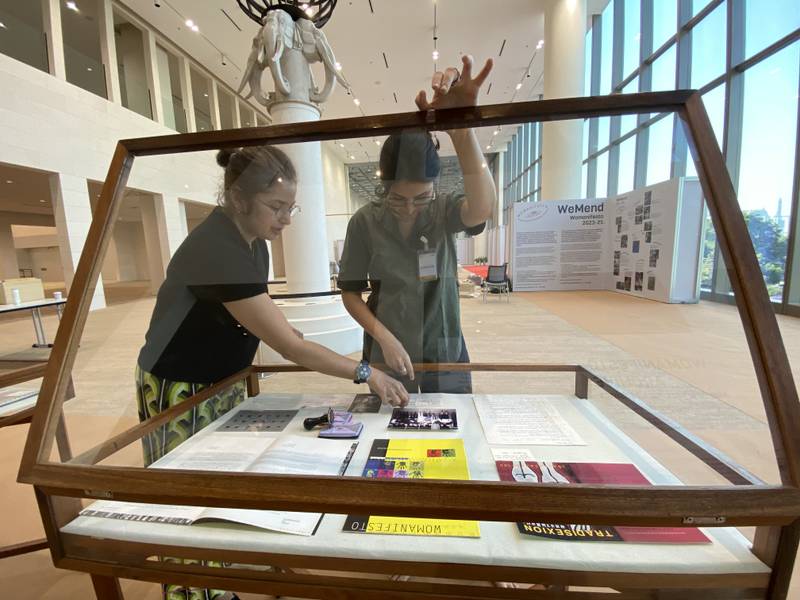
Jamilah Preenun Nana and Ananya Patel install the Womanifesto archive at AWID – 15th Association for Women’s Rights in Development International Forum, Bangkok, 2024. Photo: Varsha Nair
Maintenance as the Work
Jamilah: When women artists gather, they engage in a profound form of creative housekeeping, transforming the messy realities of life into a shared resistance.
Varsha: Nitaya and I have been at the core of Womanifesto organising since the beginning, and we have been documenting our work by making albums with our analogue photograph prints and filing slides, negatives, and any documents related to Womanifesto since 1997. We didn’t think we were archiving. In our minds, we never used the word ‘archive’. We were just documenting as we went along. We thought that if we didn’t document, we’d lose all this. I remember saying at the time that 10 years down the line, this would be really valuable for the next generation or whoever is interested in studying women’s art practices in the late 90s emerging in this part of the world. And so it was like keeping every single piece of paper, literally, in boxes that moved from place to place.
Nitaya: I was living on the farm, and the weather conditions didn’t help store things, so Varsha kept the boxes with her in Bangkok.
Varsha: I lived in Bangkok for close to 25 years, and the boxes moved with my husband and I whenever we moved houses. I’d keep the boxes in his office, where the air conditioner would be on during the hot, humid days. We used all these methods to care for this material.
Nitaya: Our archive consisted mainly of photo albums, with everything tagged and filed. I chose the images to tell the story of a project. Our filing process was like everybody arriving: we sat down for a meal, and artists were introduced to each other, to the environment, to the materials, and to the community.
Varsha: Nitaya made wonderful hand-stitched covers for the albums through her sewing, bookmaking, and publishing practice. So all that also came into the archive. You can look at the albums as work or as just part of the archive – they are all very much a “Womanifesto” practice.
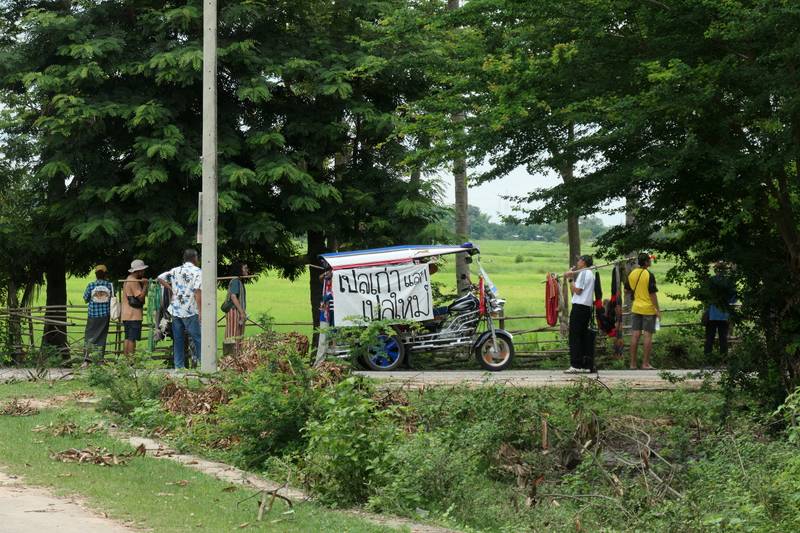
Participants with local transport known as ‘skylab’, for hammock exchange in Baan Phue village. Saan Sense, Womanifesto 2026. Photo: Ananya Patel
Between Doing and Being Seen
Varsha: We wrote about ourselves from the get-go and spoke about Womanifesto at every opportunity. People in the international scene, the feminist scene, became aware of Womanifesto through the first article I wrote titled “Womanifesto II – jogging ahead” for n.paradoxa: international feminist art journal in July 1999, highlighting the development of the Thai-based feminist art collective. The text reviewed the Womanifesto II exhibition and emphasised organic network building, aimed at documenting and preventing the erasure of regional women’s art practices from mainstream discourse. Katy Deepwell is the editor-in-chief, publisher. Despite this early international recognition, we remained largely ignored in conversations about community-based practices or women’s art in the local and Southeast Asian art worlds. In fact, up until 2019, we were not invited to any significant space or art event, even here in Thailand.
A major turning point came when Asia Art Archive digitised Womanifesto’s archive in 2019, and it contains our activities from 1997 to 2008. The moment the archive was digitised and made available online, in what I refer to as the second phase of Womanifesto, we were suddenly “discovered” by the wider world.
Asia Art Archive first approached us maybe in 2010 or 2011 with a view to digitising the material, which materialised when they approached us again in 2019 as they had the funding, specifically for archiving women’s art practices and collectives in the region*.*
Jamilah: In March 2019, Chulalongkorn University’s Communication Design program had hosted the Archive Womanifesto exhibition curated by Varsha and Nitaya, held in conjunction with the University of Sydney’s program on Gender in Southeast Asian Art Histories led by Dr Yvonne Low, Clare Veal and Dr Roger Nelson. The exhibition made decades of Womanifesto’s ephemera, photographs, and videos publicly available for the first time. After the exhibition, we moved the archive to my house, where we worked with John Tain for a couple of days, then sent the remaining material to Hong Kong.
In 2023, the Bangkok Art and Culture Centre (BACC) collaborated with us to host a major retrospective exhibition titled “Womanifesto: Flowing Connections” from September 12 to December 29, 2023. BACC approached us to feature our work in their Master Series. Until then, the Master Series was limited, as it typically invited a master, such as a male artist. In previous years, they hosted an exhibition by a single major male artist, either a painter or a sculptor. But the new director, Adulaya Hoontrakul, came with a new vision and wanted a collective, that too, a women’s collective. Even the way the show came together was different from their usual template. Normally, they want a curator involved. Now that we’ve worked with over 120 artists, we wanted to present Womanifesto’s 26-year history in our way. We invited artists we were in contact with to bring a work they wanted to show. We set up a workshop in a large part of the space, and presented the whole archive, installing it as an artwork, alongside works from previous Womanifestos and contemporary work by the same artists.
Varsha: Managing this newfound visibility has brought its own challenges. Through Eileen Legaspi Ramirez and ‘The O Home Collective’, we wanted to set up an online space to collaborate and reflect on our activities, but time is a challenge amid running our homes, our lives, and all the work and reflection. We hope to take that idea further soon.
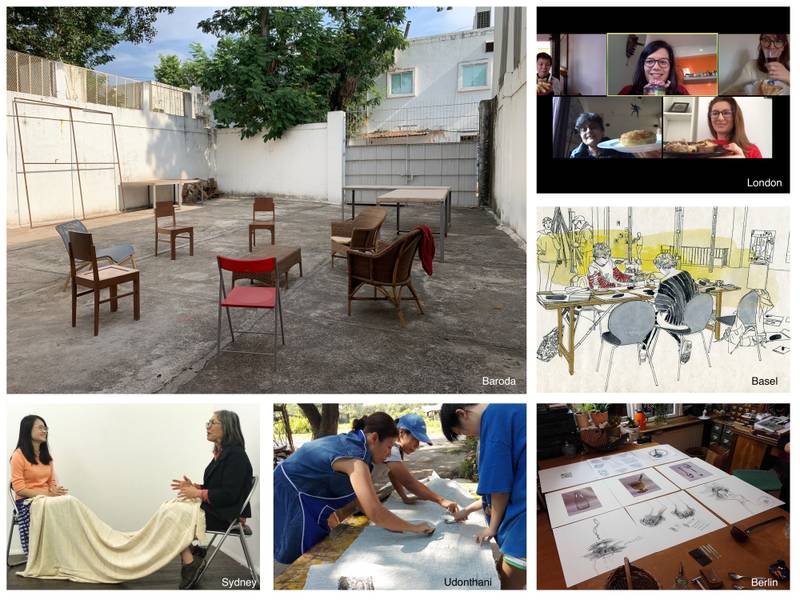
Womanifesto: Gatherings 2020. https://blog.womanifesto.com/about/
“Even If We Don’t Get Funding, We Meet”
Varsha: We have been in situations where we had no funding and wanted to hold a gathering. We’d apply for funding and get turned down. When we discussed it among ourselves, we said, Well, even if we don’t get funding, we meet.
In 2020, we wanted to have a gathering after a long time, but then COVID hit. So we shifted to a hybrid approach. We invited other members of the collective, such as Phaptawan Suwannakudt in Sydney, Karla Sachse in Berlin, Lena Eriksson in Basel, Nilofar Akhmut in London, along with Nitaya here in Kumphawapi and me in Baroda. We asked each of them to organise a gathering where they were, in line with their social distancing guidelines. It would be a gathering, even if it were just two people meeting across the road. If it’s a group of you sitting far apart, that’s your gathering. In Baroda, we put chairs around the open courtyard of my studio and had a gathering throughout the day. It was a fascinating experiment to strategise, with the situation in mind, on how to connect during social distancing. Each member shared the material on the Womenifesto blog, connecting us in the digital sphere.
Jamilah: We are organic, adaptive, and flexible. Not compliant, but adaptive.
Varsha: Funding applications are famously time-consuming. Nitaya handles much of the paperwork, bookkeeping, and writing to the Thai government’s cultural body, and in the past I handled applications to international foundations.
Nitaya: I deal a lot with the Thai government in the art and culture authority. In recent times, the Thai government has begun funding many art initiatives, especially independent art projects, which is an encouraging development for art, artists, and art activities.
Varsha: It’s a healthy and welcome initiative. Earlier, the fund was centralised, but now they not only fund smaller initiatives but also have a decentralised fund for regional art spaces outside big cities. For example, for SAAN SENSE, we receive some funding, and we manage the remainder through savings because we never get the full funding we request.
Jamilah: We will do the work anyway.
Nitaya: We do what we want to do.
Jamilah: But we are also getting smarter about asking for larger project budgets.
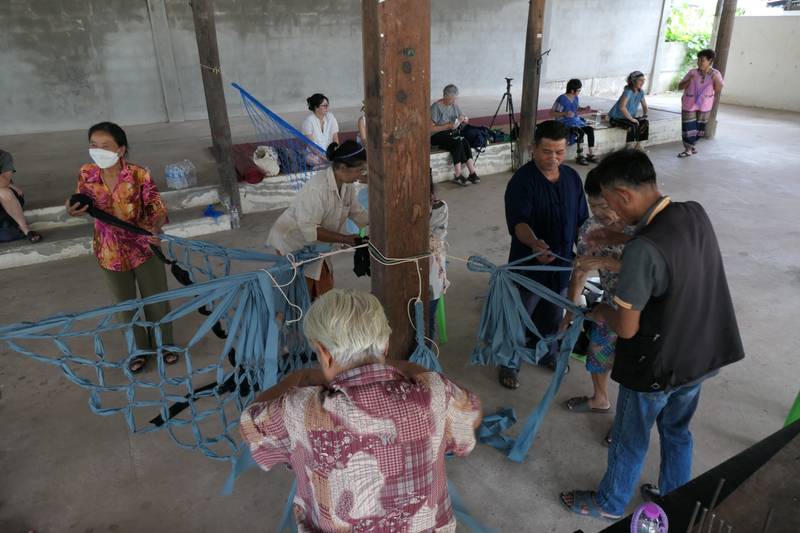
Hammock-making workshops in Baan Phue village community center. Saan Sense, Womanifesto 2026. Photo: Ananya Patel
What Doesn’t Get Reported
Varsha: It is enriching to bypass centralised, rigid institutional art spaces. With Mahasarakham Mid-field Artspace and Adisak Phupa (Kai), we are directly co-creating art in rural environments with villages, blending contemporary practice with generations of local ways of life.
Jamilah: At Womanifesto, we organise work in layers. For example, right now, Nitaya, Varsha, and I are the main organisers; if Nitaya has another commitment, Varsha and I would step in. Womanifesto doesn’t have a stiff structure or hierarchy. We value our time together, the gathering, and what emerges from it. One key part of “the Womanifesto way” is that it is process-driven rather than outcome-focused. We’re not working together in service or in pursuit of a specific goal; instead, we’re holding that space of care, sharing, connection, and hosting.
Ananya: When you are not chasing visibility in a specific way or wanting to be associated with certain names, the work aligns with one’s values, which attracts people, intrigues them, and connects us with them. There is, perhaps, a sense of authenticity that I think people are looking for, that they don’t often see when they interact with some aspects of the art world.
Varsha: For women artists, art gets imbued in different parts of your life, where it’s not just about a statement that you’re trying to make. It is about how you live through these experiences together, working, gathering, and joining and not letting difficult things stop you from bringing joy to each other’s lives, connecting with other artists and the local environment.
Ananya: Womanifesto gatherings and projects have always been inherently socially, politically, and culturally embedded, responding to events and changes without pigeonholing them. It is, in a way, a form of resistance: finding a way to keep gathering, creating, documenting, and putting work out there, even when external forces make it harder. These gatherings should take place more often because they bring together people from different backgrounds, living and working environments, specific government policies, challenges, realities, and the overall scenario that we’re all impacted by.
Varsha: Interviews during the hammock exchange in Ban Phue village reveal that rising costs of basic necessities and extreme weather are creating economic hardships and affecting everyday life. In this area there is just one rice planting season, and a bad rice harvest can have serious repercussions on families who tend to the fields. These critical environmental and policy issues emerge more clearly through storytelling and spending time together than through academic or formal framing. These nuances of working and living conditions don’t get reported often, but artists can make them visible.
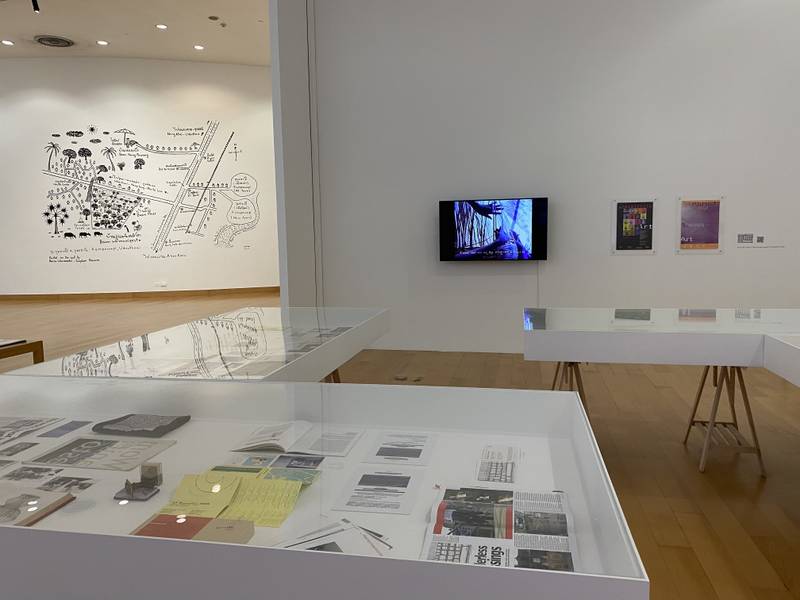
View of archive room, with hand-painted map of Baan Womanifesto on the back wall, installed at the exhibition Womanifesto: Flowing Connections, Bangkok Art and Culture Center, 2023. Photo: Varsha Nair
Archiving as Art-Making
Varsha: We recently held a workshop with Asia Art Archive in New Delhi on artists who archive and how archiving is part of the art-making process. Our documentation has layers that continue to be integrated into how the Womanifesto projects have evolved over the years, with analogue and digital technology as part of it.
Ananya: Seeing the older material that Womanifesto has put together, you realise that it is an artistic-practice approach to documenting projects that has endured over time through the various artists involved. When projects are process-driven, archiving, documenting, and recording are built into the art-making in interesting and multidimensional ways.
Varsha: Spearheaded by the Power Institute at the University of Sydney, we are also in the process of presenting The Womanifesto Way, an online anthology – a research, digital publication, that documents and visualises the 30-year history of Womanifesto.
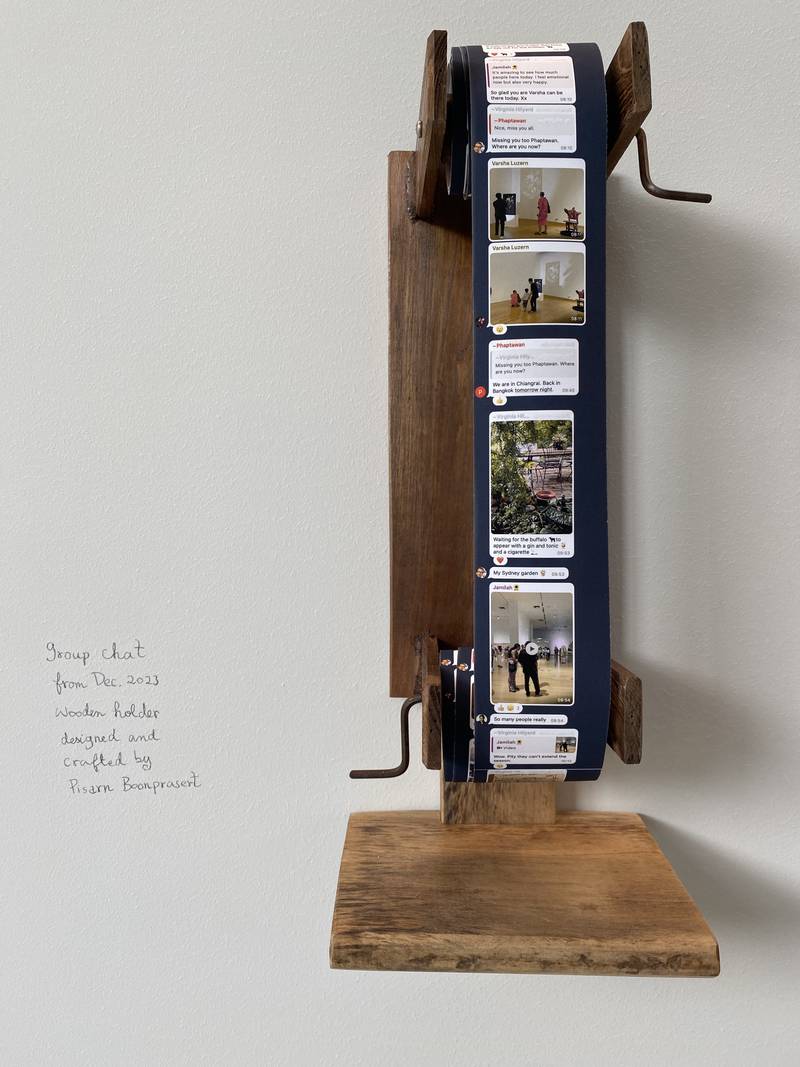
Group chat exchange related to Womanifesto: Flowing Connections exhibition and subsequent visit to Baan Womanifesto by artists, produced as a scroll by Lena Eriksson. Wooden holder designed and crafted by Pisarn Boonprasert. Installed at Sharjah Biennial 16. Photo: Varsha Nair
Working alongside Contemporary Art
Varsha: In a typical museum, curatorial planning and thinking have to be done beforehand, but when artists are working from the ground up on ongoing projects, we cannot always provide the logistical information to suit this process, such as space requirements and shipping dimensions…because we don’t know what the work will end up becoming.
Jamilah: In one of the biennales we participated in, we made a site visit while the project called WeMend, which we were planning to present, was still ongoing. Womanifesto artists from across the world led the project and set up workshops in their local communities. They contributed fabrics and stories, and patching fabric pieces became a space for conversation, slowness, and feminist solidarity. As pieces of patched fabric arrived from different locations, we sewed them all together. The project grew and grew until we found ourselves wondering, Okay, we have this – now how are we going to install it? When we arrived at the venue, the textile was nearly double the size of the allocated space because the workshops had continued, and the work just kept growing. We adapted and found a way to install it, which is how we present all our projects.
Varsha: Our way of working is driven by the process of a project coming together, which is not fully addressed at contemporary art events.
Jamilah: In November, we are presenting Saan Sense at the 2026 Asian Art Biennial in Taichung, Taiwan, at the National Taiwan Museum of Fine Arts (NTMoFA). Since the biennale is about community-based practice collectives, especially women’s collectives, we proposed this project and told them it would take place in June and July. We can’t say in advance what size the shipping boxes will be because, unlike in individual studio practice, we’re not thinking about resolved works.
Jamilah: When we were recognised by The Mirror magazine in Bangkok as one of the world’s 50 most influential groups, I was the only organiser available to go. Suddenly, I found myself in this high-stress, “mini-Oscar” environment. Sitting on a panel, I was questioned about our geopolitical role and about how we pressure governments to secure institutional support. I responded saying that our resistance has always been in the quiet, constant, and domestic maintenance, the daily act of caring and supporting one another. By staying true to this framework, I realised that sometimes, the most radical thing we can do is just keep showing up for each other.
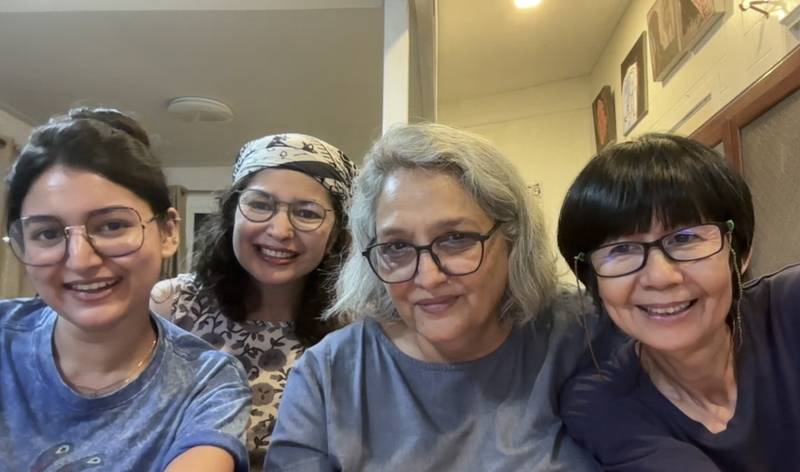
From left to right: Ananya Patel, Jamilah Preenan Nana, Varsha Nair, Nitaya Ueareeworakul
KAP is a copied publication that has been appearing since 2005, with 43 issues published to date. Number 43 edited by Varsha Nair and Lena Eriksson features Sonic Clay, and Number 44 will feature Saan Sense. KAP was initiated in collaboration with the graphic design studio Edit (Nicole Boillat) and the artist-run project space Lodypop (Lena Eriksson, Chris Regn, and Andrea Saemann) in Basel and with kasko.ch.
KAP #43 can be downloaded here and booklet can be downloaded here.