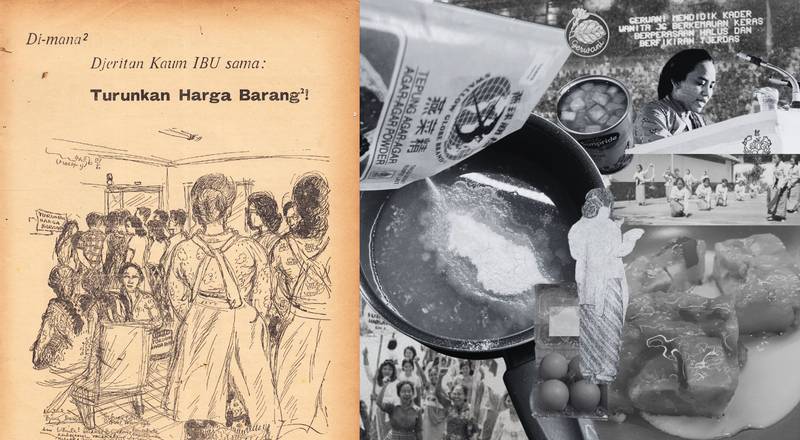
L to R: Collage from Rizqan Adhima’s essay in Memasak Harapan and illustration from Api Kartini issue from February 1960 – text in the image “Everywhere, You Hear The Same Roar From MOTHERS: “Lower The Price of Commodities!”
Ulan (Asri Pratiwi Wulandari) translates, writes, and edits, often drawing on research that connects feminist politics, knowledge production, and literature. She is an alumna of Sekolah Pemikiran Perempuan, a feminist, trans-archipelagic collective that intervenes in colonial, capitalist, and heteropatriarchal knowledge production, and has remained involved as part of its working committee.
“Didn’t you cook together in the community kitchen with those sukwati terlarang?”2 Mia Bustam spent 13 years in incarceration after the New Order (Orde Baru) government interrogated her with this question. In Indonesian political history, sukwati terlarang (loosely translated as “forbidden women”) refers directly to the systematic targeting, persecution, and social erasure of members of Gerwani (the Indonesian Women’s Movement) and any women associated with the left during Suharto’s New Order regime. Sukwati refers to sukarelawati (women volunteers), the term the first president used in his speeches as part of his socialist revolutionary rhetoric, intended to rally supporters against “imperialism,” “racialism,” and “capitalism,”3, and Terlarang (Forbidden) references how these women were blacklisted, criminalized, and completely erased from public life.
Last year my friends and I decided to learn how to cook from our feminist grandmothers. We read Api Kartini, the magazine of Gerwani, which was the largest women’s organisation in Indonesia before its suppression in 1965. What we learned, we put together into a collection of essays called Memasak Harapan. From these sukwati terlarang, we learned about the history of the feminist movement in Indonesia. Also, we recovered a way of thinking about cooking as the state’s grip on kitchens tightens once again.
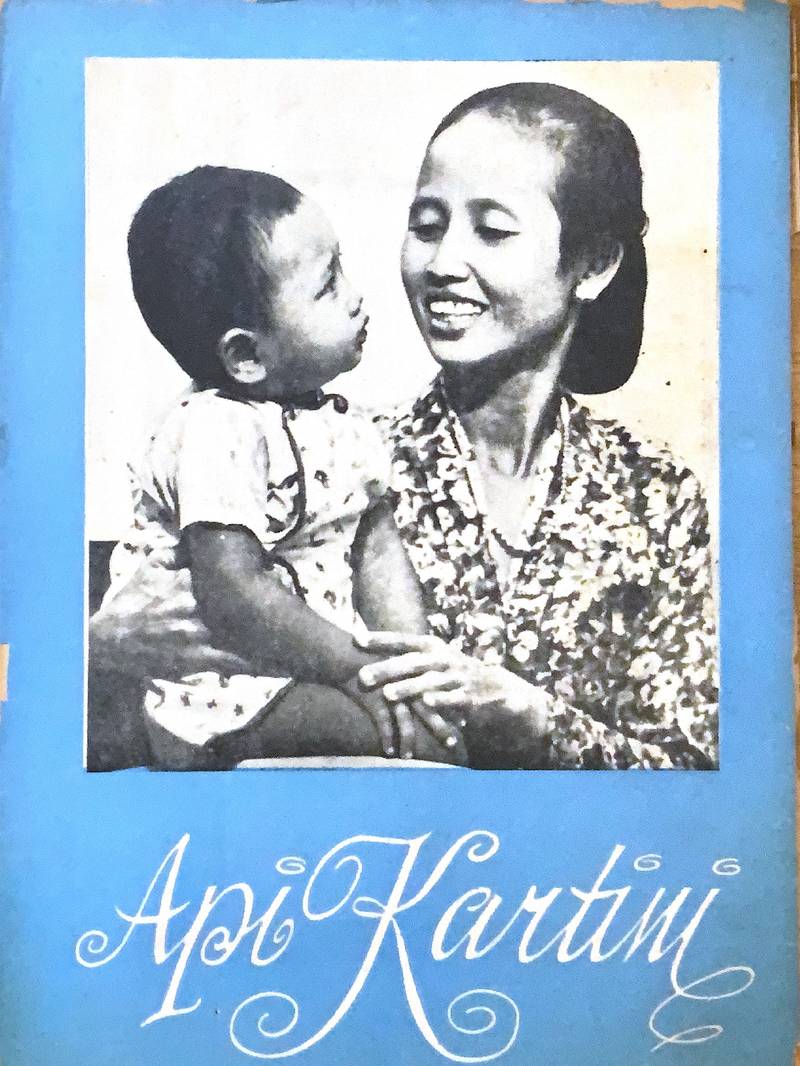
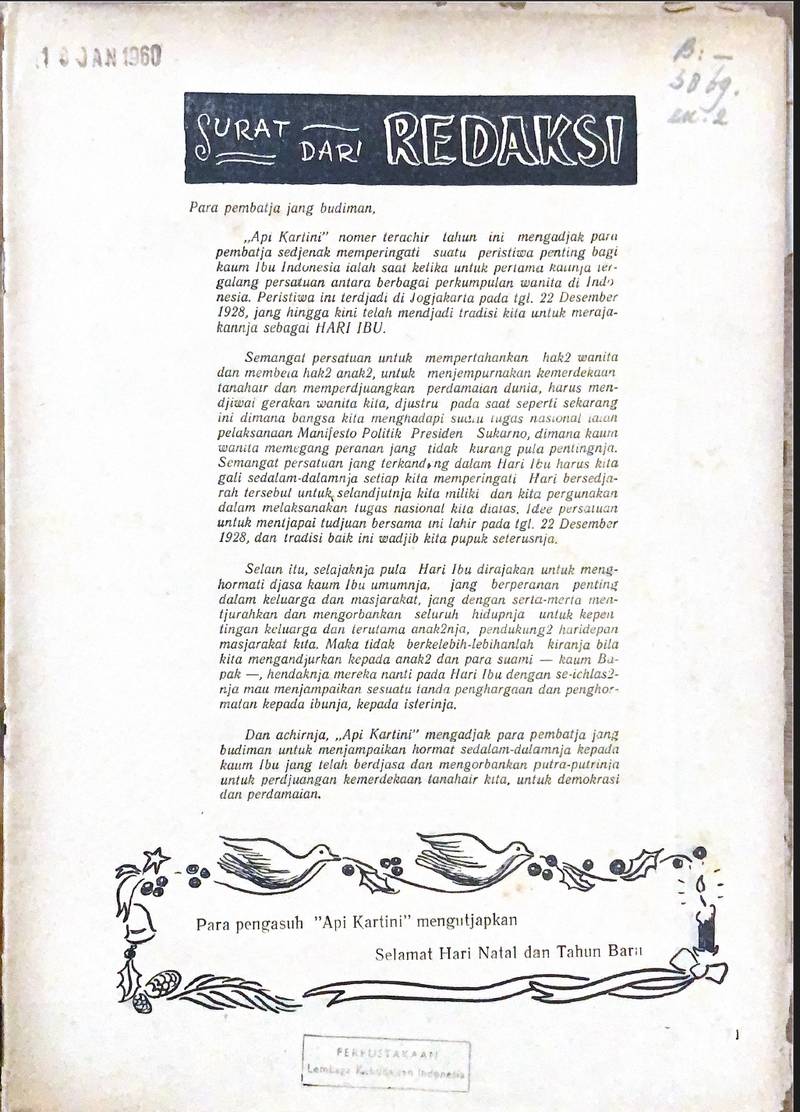
Editorial in Api Kartini issue from December 1959. Note: December 22 is Mother’s Day in Indonesia. The editors ask readers to remember that the day commemorated the first women’s congress in Indonesia in 1928. They reminded the readers that the spirit of Mother’s Day was “a unified spirit to defend women’s rights, to protect children’s rights, to finish the work for the country’s independence, and to fight for world peace.” In the New Order, the Mother’s Day celebration started to become more in line with state-ibuism
“Why we eat what we eat’’ has been a matter of state intervention, and I believe the suppression of Gerwani was a turning point in this history of the state’s control of the kitchen. In this essay, I return to what we – Areispine Dymussaga Miraviori, Dewi Kharisma Michellia, Maesy Ang, Bageur Al Ikhsan, Riz Adhima, Shinta Lay, Teddy W. Kusuma, Prihandini Nur Rahmah, and myself from the Memasak Harapan collective – recovered and learned from our grandmothers’ recipes to ask again what their practices can teach us about resisting the state’s growing control over what we eat.
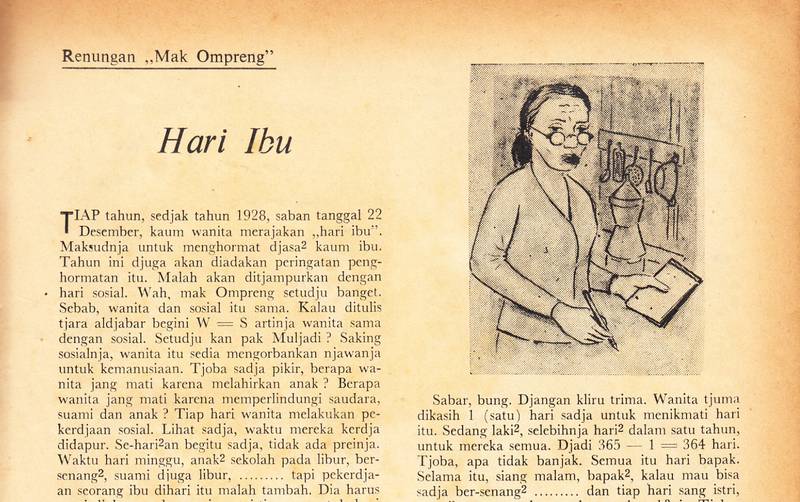
Mak Ompreng’s reflection in Api Kartini 1960 No. 11-12 (double issue). Note: “Mak Ompreng’s Reflections” and “From The Kitchen” columns are the same column. The editors initially alternated the column’s name, but “Mak Ompreng’s Reflections” still depicts a kitchen scene. Image sourced from the author’s personal archive via warungarsip.co
In early 2025, Indonesia’s newly appointed president launched a free school lunch program, soon followed by recurring incidents of food poisoning4, corruption cases5, and an expanding military presence in its kitchens and beyond6. The lunch program isn’t the current administration’s only intervention in kitchens, nor is it the first instance of the state prioritising control over what people eat. In both the current and the New Order administrations, forests and fields used by Indigenous communities for traditional foods have been cleared and reorganised in favour of crops mandated by national programs7.
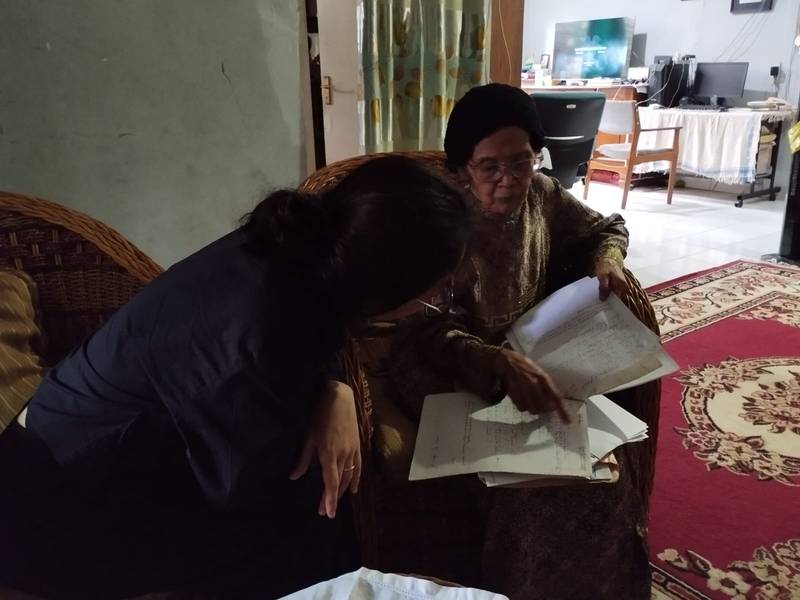
Utati Koesalah showing the author her personal archive at her home. Photo: Astrid Wasistyanti
Utati Koesalah, a ’65 woman, showed me her personal archives, memories of her life, especially the years she spent in several prisons with other ‘65 women8. In the political prisons, they composed songs and hid them, for they were not allowed to write, which is why, for years, Utati had to reconstruct these songs from memories. “The songs are all about surviving until we are released. They are about our lives in the prisons.”9
I soon listened to the song Utati reconstructed, sung by the Dialita Choir, when POST Bookshop held a discussion of Magdalena Sitorus’ latest book in her biography series about “65 women”10. Dialita Choir was founded in 2011 by the survivors of 1965 violence and their families so that they could help and support each other11. They have held concerts, served as key informants in documentaries, biographies, and many other works discussing “65 women” – passing on knowledge produced within and in defiance of the New Order’s prison system. Struck by the the lingering hope of the song, Memasak Harapan took shape. Guided by this hope, we prepared ourselves to summon the kitchen that the state apparatus sought to bury through unofficial and institutional means.
Cooking, Confines, Carcerality
In the aftermath of the 1965-1966 genocide in Indonesia12, the New Order regime redefined womanhood as a part of its military-led social order. The post-1965 kitchen was reorganised according to the New Order’s gender ideology, which Indonesian feminist scholar, journalist, and author Julia Suryakusuma coined as “state-ibuism”, the domestication of Indonesian women: “Domestication implies the taming, segregation, and de-politicisation of women. Women are tamed in the accumulation process, whereby the state works together with capitalist enterprises to induce the docility of female workers to buttress domestic light industries and sustain the practice of wage discrimination that makes female workers more desirable. This is, among others, advertised to foreign investors as a selling point.”13 This definition of the New Order’s gender arrangement shows how capitalism and patriarchy worked together to organise labour and reproduction. This gender mechanism could be seen in the PKK (Pemberdayaan Kesejahteraan Keluarga (Family Welfare Empowerment), which became one of the New Order’s major women’s organisations after Gerwani was suppressed. After destroying Gerwani and other autonomous women’s organisations, the New Order expanded a state-controlled model of housewives’ organisation. Women’s status within the organisation was determined by their husband’s rank in the military and governmental hierarchy, reproducing that hierarchy among women themselves. In the New Order’s PKK, women didn’t organise for themselves; their work was unpaid and organised according to their husbands’ positions. Elite women directed programmes towards rural and poorer women, who became targets of these programmes rather than equal peers in determining women’s roles. The kitchen thus became a space where women served their husbands, families, and the state, once again becoming a confine to women14.
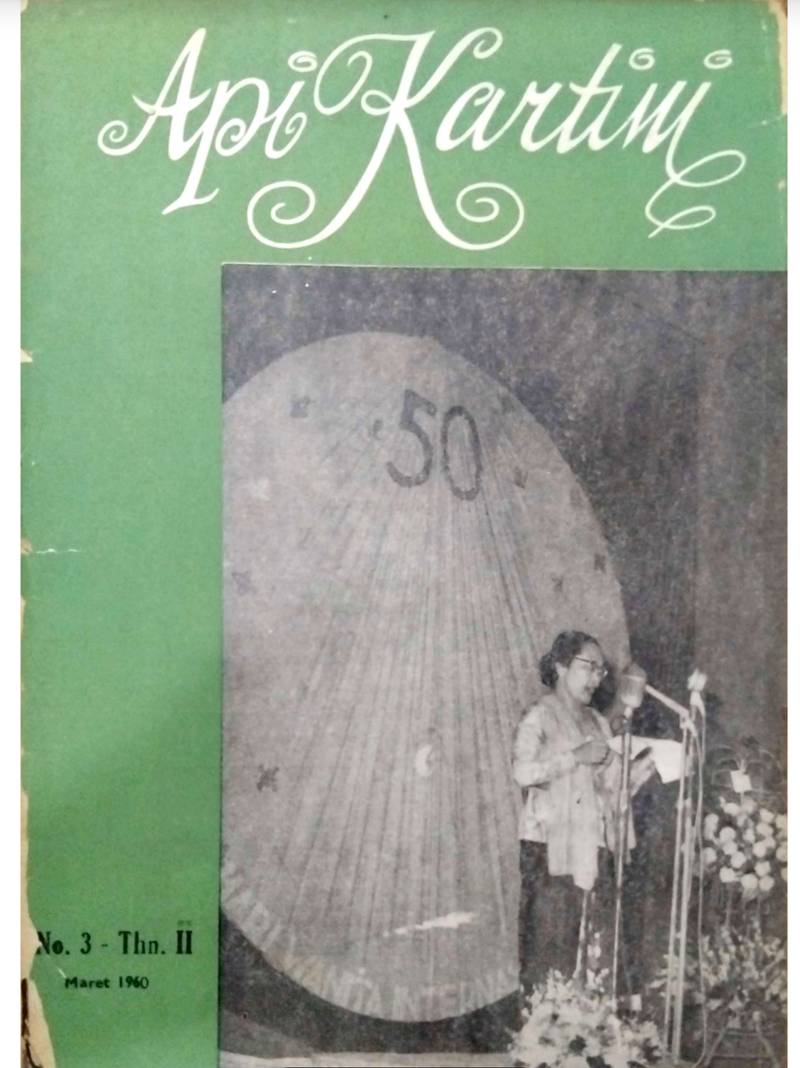
Api Kartini issue from March 1960. Image sourced from Ensiklopedia Gerwani by Logos ID https://gerwani.logosid.app/majalah
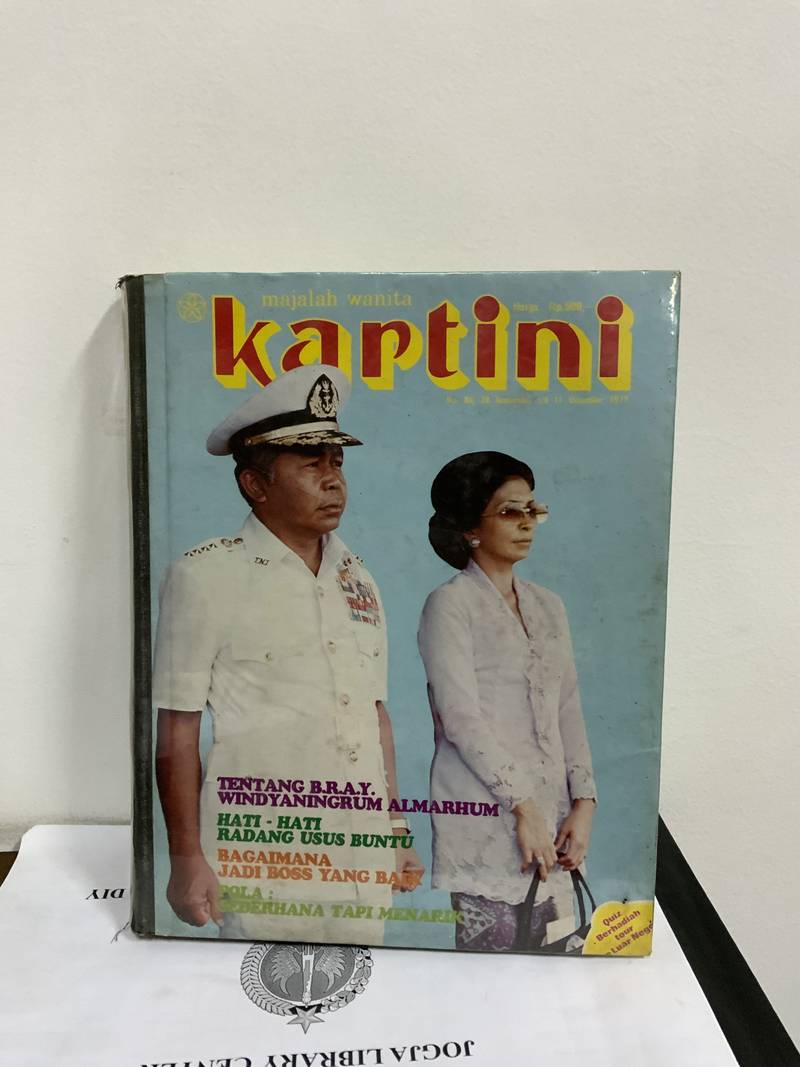
Kartini magazine. Note: A cover of a magazine called Kartini during the New Order (1977) after the suppression of Gerwani.
Gerwani’s conception of womanhood was the opposite of the New Order’s ideal woman, defined by her labour in service to men and the father of the nation. Purging Gerwani’s kitchen was a precondition for making invisible the New Order’s dependence on social reproduction carried out by obedient women. Gerwani’s kitchen was lintas-batas15 (intersectional), whereas the New Order reconstructed the kitchen as a boundary. This was only possible after they buried the women, the knowledge, and the legacy of Gerwani. I was reading Mia Bustam’s memoir, sharing with Sri Nasti16 and Maesy Ang from POST Bookshop that I didn’t expect her to write so much about food. She wrote about cooking as an activity practised and valued, a way of preserving what constitutes life: health, happiness, and hope, especially within a structure such as prison that invisibilises the power of social reproductive labour. When the provisions of life were systematically made barely sufficient, so that survival became the sole priority, Mia and her fellow ‘65 political prisoners chose to uphold the value of the activities that reproduce life – cooking, caring for what we already and still have – and thus showed us their obscured political power.
“Old cabbages (from what the market cleaner swept off)… we threw away the broth, cleaned the cabbage, and made it into stir-fry, urap, or pecel. The gerontol (corn) ration we turned into congee, or sweets, using the palm sugar sent by our family.” – pg. 12517
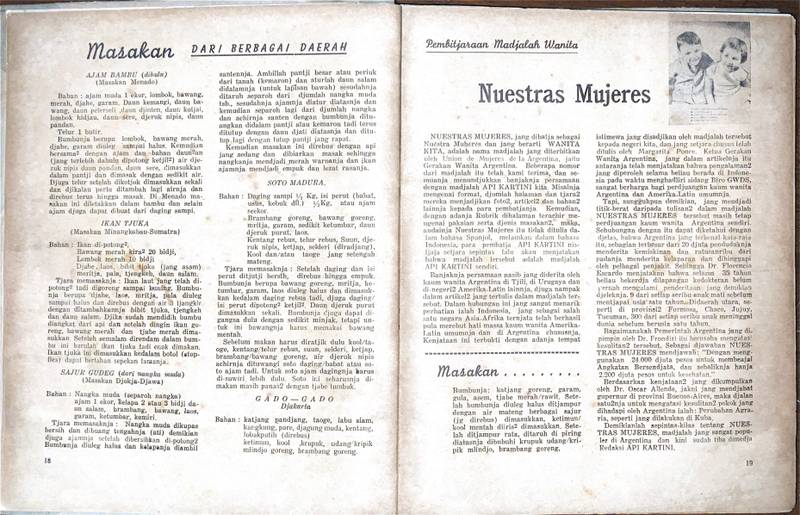
Api Kartini issue from January 1961. Note: On the left are recipes from various regions in Nusantara/Indonesia. On the right is an article on Nuestras Mujeres (Our Women), published by Union de Mujeres de la Argentina. The author used this page in a feminist class in Sekolah Pemikiran Perempuan.
Mia also wrote about the sunflower garden they had in one of the prisons: it provided them seeds to eat and beauty to behold, both of which she saw as equally constitutive of life and hope. One day a state official ordered the garden to be cut down completely because they didn’t want, in their exact words, “the communists to gather and have meetings under its shade.”18 The Dialita Choir has a song recording the memory of the prison flower garden, where the lyrics only talk about the beauty of the garden and the skilful hands of the carer, and the only mark of prison the song has is “Plantungan”, the name of the prison. By refusing to let the prison determine what was worth preserving, they made their appreciation of life, nature, and beauty an act of dignity and resistance that the prison failed to strip away.
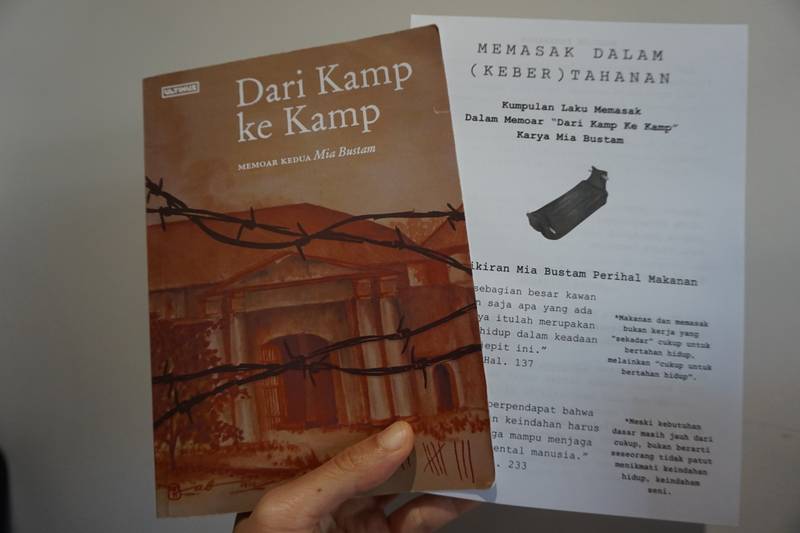
Mia Bustam’s prison memoir From Camp to Camp and the author’s Cooking in Prison/Survival (a collection of cooking activities from the memoir) were printed for the anthology’s writers. Coincidentally, the zine was printed at a photocopy station on the same street as Api Kartini’s former editorial office.
Mia Bustam’s memoir demonstrates how reproductive labour such as cooking can be directed towards resistance against carceral logic, a logic that extends beyond the prison and connects to the broader food system19. Recognising this connection between prison and food makes it possible to see how the everyday activities that sustain our capacity to live and work outside the prison can also become sites of resistance.
Summoning Gerwani’s Kitchen: Women and Reproductive Capacity Beyond Boundaries
You can meet Gerwani women in Api Kartini. You can go to their kitchen. In our collective process of cooking, writing, and drawing from the prison memoir in reading Api Kartini, we arrived at our own question: what does it mean when Gerwani women cook?
Entering Gerwani’s kitchen is to encounter a space where the borders between the domestic and the public, the productive and the reproductive, the household and the national are crossed, just as Api Kartini pages bring recipes alongside women’s thoughts on anti-imperialism, childcare, economic policy, sister organisations in other countries, etc. In the anthology, Shinta reassembled articles, images, and illustrations from Api Kartini into a visual collage that echoes how Gerwani understood womanhood and women’s roles.
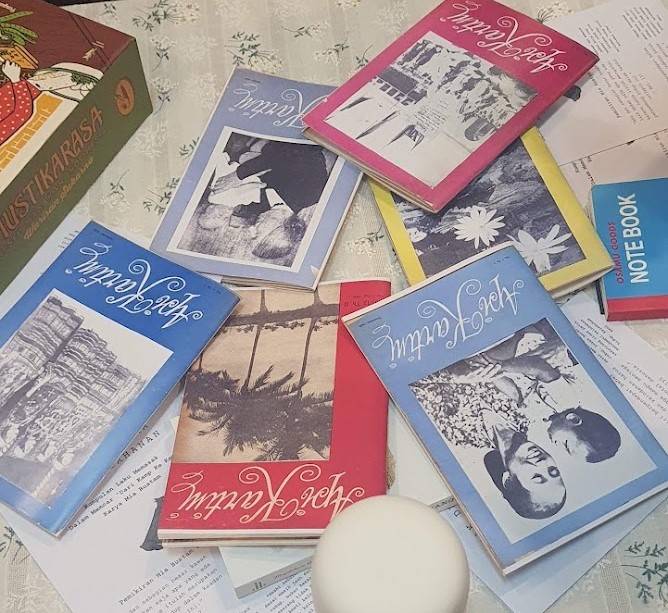
Note: Shinta Lay printed the Api Kartini archives that the author gathered from the National Library. Maesy Ang brought Mustika Rasa20, a national cookbook composed by Indonesia’s first president in 1964, halted in 1965, and printed in 1967. The author contributed a zine based on food and cooking in Mia Bustam’s memoir. These archives, among others, were ingredients in cooking up Memasak Harapan.
Women’s political life, as Gerwani documented and discussed in Api Kartini, extended beyond what would conventionally be considered women’s or domestic concerns, even today. They rallied readers to join the fight to free West Irian from colonialism and reported on women’s involvement in similar struggles in India and Laos (AK 1962 January). They condemned the government’s financial measures that ignored its promises to lower prices of basic necessities (AK 1960 January). They wrote an open letter in solidarity with the bloody revolution in Congo21. They sharply criticised the influence of American films widely circulated at the time, even before the Indonesian communist party started raising the issue of Western cultural imperialism22
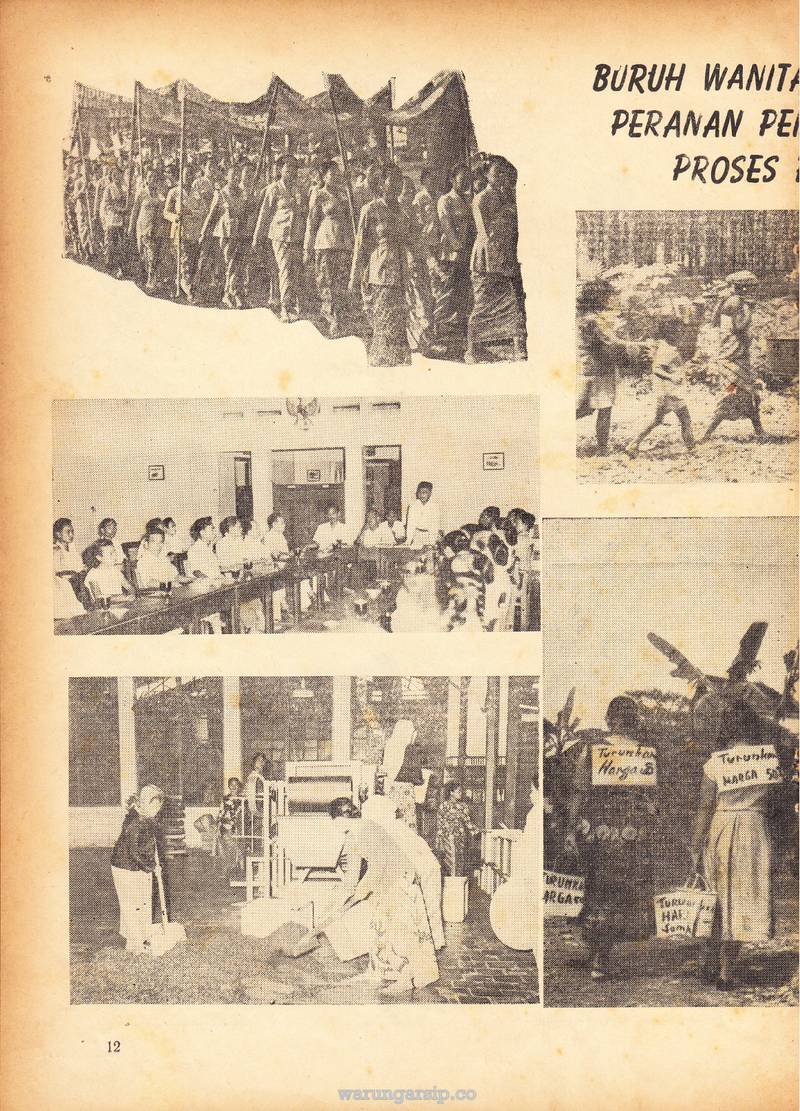
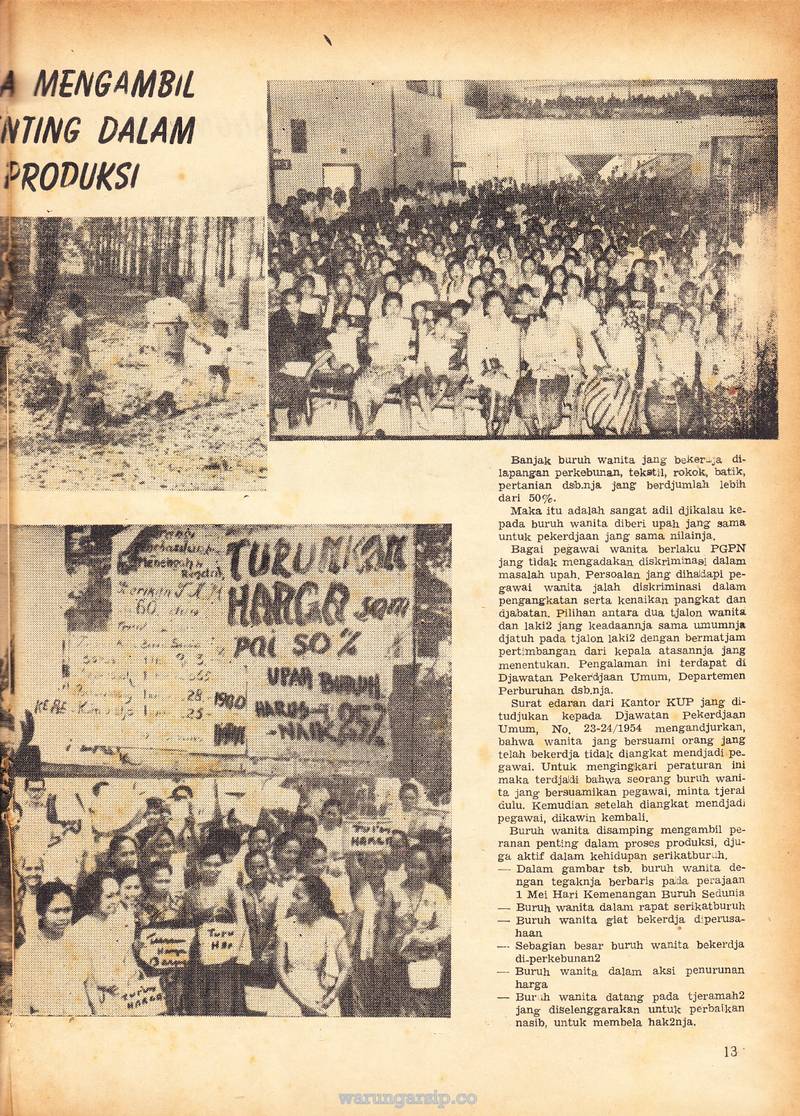
Api Kartini, May 1960, pp. 12-13, “Buruh Wanita…” (Women workers have important roles in the production process). Sourced from the author’s personal archive via warungarsip.co
They extensively developed ideas and discourses about womanhood, motherhood, and women’s labour. They say “the right to work has to be fully given to women if we truly want to achieve victory in the national independence struggle.”23 For Parjani Pradono, a socialist-feminist activist and high-ranking official within Gerwani24, this right to work elevates women’s status and liberates them from dependency, oppression, setback, and suffering. In the most extensive study of Gerwani and Api Kartini, Dutch sociologist and author Saskia Eleonora Wieringa viewed that despite their militancy, Gerwani women still accepted the traditional women’s role of caring for children and family25. This can be read not simply as retaining a “traditional” women’s role. In 1963, Gerwani members wrote: “The ideal girl to Kartini is a girl who heeds the call for revolution; she is not only characterised with narimo ing pandum (accepting whatever fate decides), but for her nimbleness, standing tall with her male peers in every field… Kartini’s spirit… she always rebels against all injustice, shackles of old customs, and the suffering of women and the populace26. In a previous issue, Mak Ompreng, the character of the column ‘From The Kitchen’, asks the readers to imagine what would happen if women went on strike from bearing children: “the world be just graveyards.”27 Wieringa is critical of Gerwani’s view on sexual division of labour, arguing that they merely expected husbands to help their wives instead of challenging the division itself28. Today, we can never know how far Gerwani women would embrace the notion and practice of a “revolutionary family” and a different division of labour within the household. However, within the context of the kitchen, it is clear that they didn’t view reproductive labour as a realm exclusive to women: men can and should enter, just as women could and should enter conventionally masculine realms.
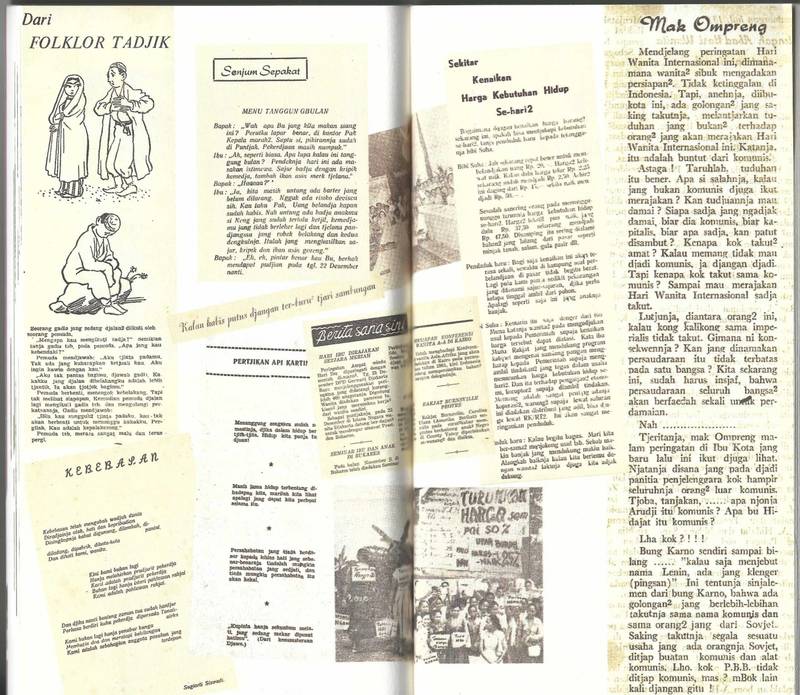
A collage made by Shinta Lay for the anthology, introducing some of the columns from Api Kartini. The collage communicates the lintas-batas roles, topics, point of views, and writing styles of Gerwani and the women of the era.
This understanding of the kitchen also shaped how Gerwani used it. Gerwani’s uses of “the kitchen” encompassed the multitude of their activities and roles as women in the post-WWII world: they held community kitchens, and they reminded Api Kartini readers that women played multiple roles in the battles for Indonesia’s independence, including cooking. Gerwani’s practices, including their editorial practices, could be understood as observations “from the kitchen”, the title of one of their regular columns.
Gerwani’s practices and writings show that they understood the kitchen as political: the labour that reproduces people, though undervalued, was essential to their ongoing struggles against imperialism, capitalism, and patriarchy. As Dewi Kharisma Michellia writes in the anthology Memasak Harapan, Gerwani’s progressive spirit also entered the kitchen, where they cared for others and the household as part of their political effort. ‘From the Kitchen’ thus offers a socialist-feminist lens through which to see reproductive labour not as separate but as what sustains political struggle.
Gathering in the Kitchen, Beyond the Carceral
During the mass demonstrations in Indonesia in 202529, we also witnessed the events “from the kitchen.” Dewi Kharisma Michellia, in her essay in Memasak Harapan, recorded that, as she wrote in August and September while the demonstrations were taking place, the price of rice could double, even triple.
Prihandini Nur Rahmah writes about how sharing food became an act of solidarity among political prisoners of that demonstration. It was from her as well that I learned about the prison denying food from outside, which I write in my essay “Ke Mana Hantu Pulang Setelah Bergentayang?” (Where Do Ghosts Go After They Wander?) in the anthology. I write about Fransisca Fanggidaej’s thoughts on home and national identity. She is also a ‘65 woman, a political exile. She was not a member of Gerwani. Maesy Ang and Teddy W. Kusuma write about failing to follow a recipe for a fermented drink as they watched movement after movement fail and the struggle continue.
In fermentation, the boundary between rot and life is blurred. Decay is, at the same time, something alive or even flourishing. They also write about the difficulty of following the recipes, showing how a way of thinking about food, care, and kitchen practices had been interrupted. The systematic forgetting of Gerwani’s food practices is part of a wider repression of knowledge. Riz Adhima writes, “We, 90s kids, grew up drinking the broth of propaganda… Gerwani, hammer and sickle, were ghosts we shouldn’t talk about at the dining table.” Growing up in the early 2000s, after the regime ended, Gerwani’s presence also seemed like ghosts to me. The stigmatisation of them as witches dancing around corpses of military generals effectively stripped their power as intellectuals. I still heard “it’s permissible to spill a communist’s blood” in the 2020s. In trying to reclaim this kitchen knowledge, we realised the extent of what had been silenced and lost; there is grief in discovering knowledge that survived violence.
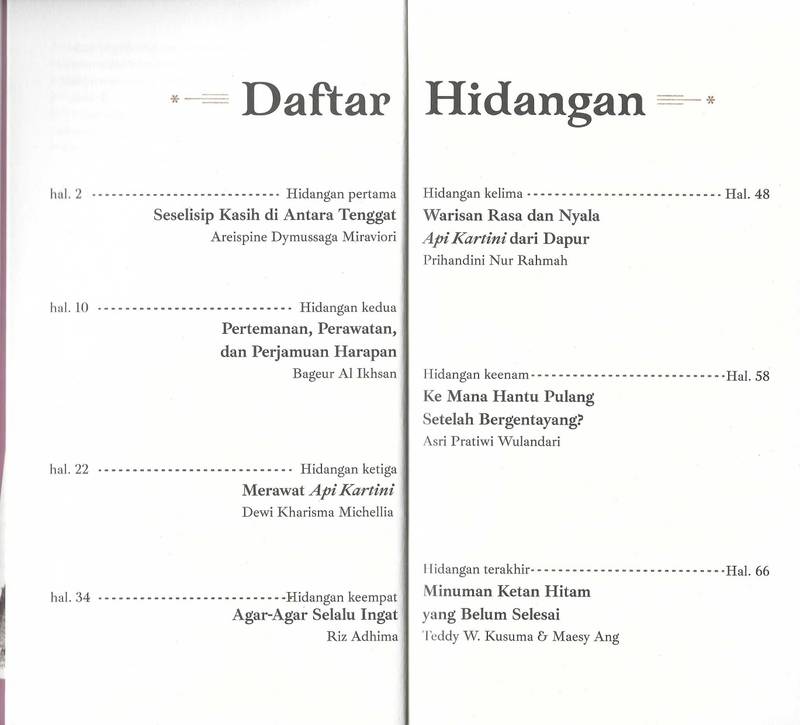
Table of contents from Memasak Harapan
Bageur Al Ikhsan writes about the friends who cooked for him when he was financially struggling, reflecting on the role of friendship in survival. Areispine Dymussaga Miraviori writes about the nutritious and quick scrambled egg her mother would make on busy days, and how she came to understand her mother’s attempts to keep her out of the kitchen as an act of love from a woman who had grown up under a regime that confined women to the kitchen. Bageur and Dymussaga both write about the kitchen as a space shaped by – and potentially resisting – the capitalist and patriarchal food system. In bringing these stories together with the kitchens of Gerwani and the ‘65 women, we chose to stage the politicality of what sustains our lives: caring for oneself and others. Reading my friends’ and co-authors’ essays, I realised that when we are confined by a time and space that limits our bodies and minds, knowledge needs to make sense for the past, present, and emerging – not a distant, unlikely future. Kitchen knowledge reminded us of this urgency. Knowledge must function like food: we gather it and use it, or save it for later, but it is perishable.
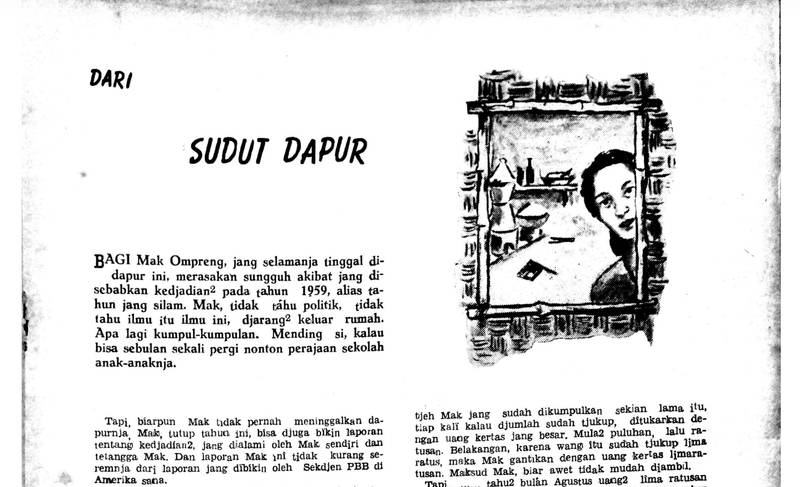
From ‘The Kitchen’ (Dari Sudut Dapur) column in Api Kartini, January 1960, p. 11. Note: “To me, Mak Ompreng, who forever dwells in this kitchen, I can truly feel the consequences of the events in 1959. I don’t understand politics; I don’t have knowledge of this and that; I hardly go out… But, even though I never leave my kitchen, I can make a report of the things I myself experienced and the things my neighbours experienced, and this report is no less scary than the report made by the Secretary General of the United Nations in faraway America.”
The regime had a strict instruction on being a woman: to be confined in the kitchen. “The outlawed women” were those who transgressed it. The kitchen was a lintas-batas space for Gerwani: they recognised the way it was imposed to confine women, while placing reproductive labour alongside what was considered productive labour, rather than beneath it.
The destruction of Gerwani was not separate from the reconstruction of the kitchen under the New Order. The genocide, imprisonment, and persecution of Gerwani and communist party members were part of how the New Order reorganised women and workers before its gender ideology was institutionalised through state-ibuism.
Gerwani’s kitchen showed us that the capitalistic and patriarchal regime operated through undervaluing the kitchen, while the kitchen of the ‘65 women showed us its power: in the prison structures constructed to suppress this knowledge, it was cooking and caring for lives that passed the knowledge on to us.
Based on this, I argue that the imprisonment of Gerwani members constituted a form of prescriptive enforcement within the New Order’s food system: the operation of the New Order’s kitchen was fundamentally carceral.
Six decades after Mia Bustam was questioned about whether she was ever involved in the kitchen of the sukwati terlarang, it is that very kitchen that we, the authors of Memasak Harapan, summon as we take up our writing knives. “Didn’t you cook with those sukwati terlarang?” exuded the extent to which our kitchens have been subsumed to serve the needs of capital.
Facing worsening food precarity resulting from austerity measures implemented to fund the national food program, we must politicise our kitchen: organising, caring, grieving within a space that blurs the boundaries of public-domestic, production-reproduction, intellectual-physical, directing our efforts towards survival and resistance. The process might manifest in unfamiliar and contentious ways, yet we need to begin. By taking back and occupying these spaces where labour power is reproduced, we resist its submission to capital, and fortify our resistance.
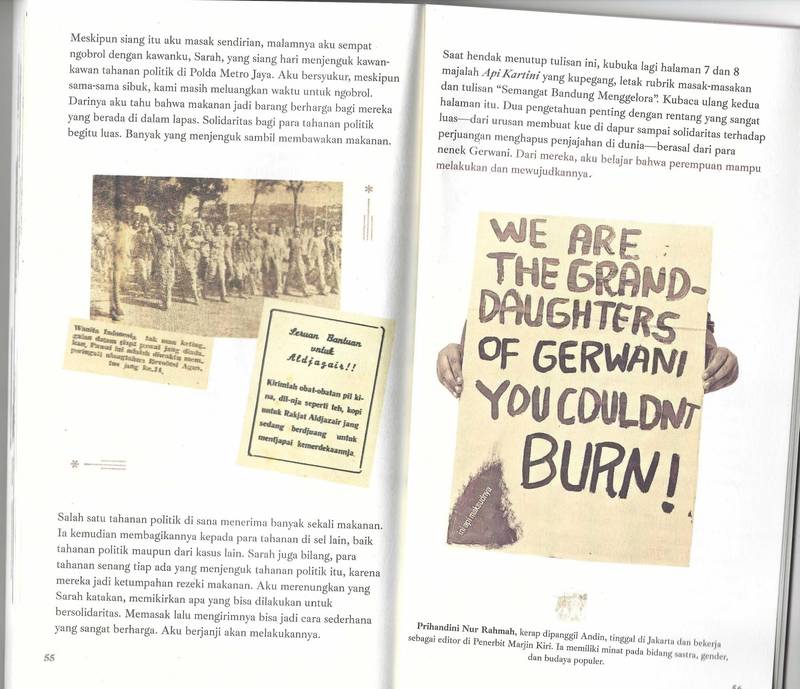
From Prihandini Nur Rahmah’s essay in Memasak Harapan.