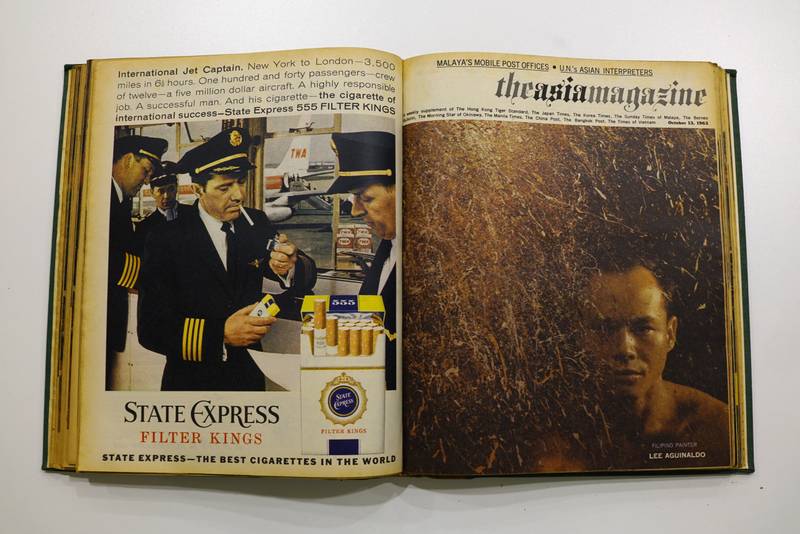
Dick Baldovino joined Asia Magazine as its staff photographer in 1963. One of his first contributions, published in the 13 October 1963 issue, was a set of photographs profiling Filipino painter Lee Aguinaldo.
Zhuang Wubin is a writer who makes photographs, publications and exhibitions. He researches photographic practices in Southeast Asia and Hong Kong.
Founding Asia Magazine
Born into a privileged family in Indonesia, Zecha started out in journalism and worked for Time magazine before branching into publishing. By the early 1970s, he had sold his publishing ventures and become a hotelier; he would establish Amanpuri in Phuket in 1988.2
Soong graduated from Yenching University and received his master’s degree from the School of Journalism, University of Missouri, in 1935. In 1937, he became staff photographer and correspondent for New York Times in the Republic of China. On 12 December 1937, Soong risked his life to photograph the sinking of USS Panay on the Yangtze by Japanese forces. Apparently, he was not compensated properly for his effort; New York Times rewarded everyone involved in delivering the images to its head office, except for Soong. In 1950, Soong established Pan-Asia Newspaper Alliance (renamed Jiji Press Photo in 2013) in Tokyo with the intention of setting up an international news agency “of Asians, by Asians, for Asians”.3
According to Henry Steiner (b. 1934, Vienna), Soong and Zecha first met at the Bandung Conference in 1955. Both shared the vision for a pan-Asian magazine that would be distributed together with the regional English newspapers, which could not carry colour advertisements then. Their reference was Parade, a popular weekend supplement in the USA. With the launch of Asia Magazine, Steiner was given the role of creative design, and he designed its logo, masthead, cover format, general interior format, house ads and promotional literature.4 His designation was upgraded to design director in the 26 November 1961 issue. Steiner only did one editorial layout during his stint as fulltime staff (until 1963).5
With its editorial office in Hong Kong (HK), Asia Magazine was printed by Toppan Printing in Tokyo to ensure its print quality. It also meant that the content was prepared several issues in advance to allow time for the magazines to be printed and distributed from Japan to the rest of Asia.
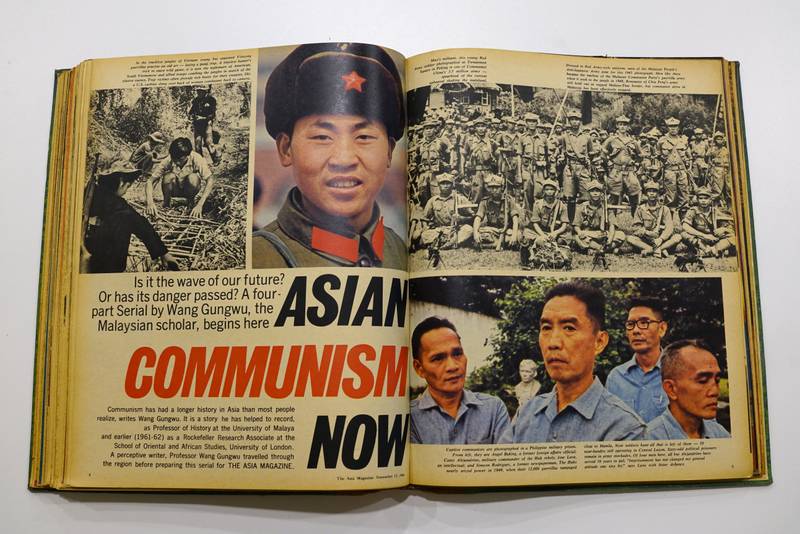
In its first decade, Asia Magazine, on several occasions, published thematic features on hot-button topics, which unfolded over several issues. The four-part series on communism, which began in the 13 November 1966 issue, was authored by historian Wang Gungwu.
Asia Magazine was distributed as a free Sunday supplement to the English newspapers—at least initially—in Southeast, East and South Asia. It featured an eclectic range of content, which included, amongst others, high-brow opinion pieces, thematic issues on hot-button topics like communism and imperialism, “softer” features on the regional film industry and the expansion of university education, profiles of artists and beautiful women, reports on emerging trends in tourism, fashion, cars and interior design, book reviews, Asian recipes, comic strips, and even poetry and short fiction.
The magazine counted film magnate Loke Wan Tho6 and the controversial Rupert Murdoch7 as its early investors. A year into its existence, it was reported that some 500,000 copies were printed for each issue.8 Because of its large print run, Asia Magazine could charge a higher advertising rate and the participating newspapers would receive a proportionate cut from ad revenue.9 The magazine quickly became profitable. Its advertising revenue for the sixth fiscal year, for instance, reached a new high of around S$4.9 million—an increase of 28.8 percent from the previous year.10 While Asia Magazine had lost access to the South Asian newspapers by October 1962, the support of English newspapers in Southeast Asia ensured its continued success in the first decade. During that period, the magazine was largely bankrolled by Manila Times, Straits Times and News Limited of Australia.11
Circulating Philippine Taste and Expertise
In Southeast Asia, the Philippines has had a rich tradition in publishing pictorial periodicals. With Life serving as their reference, Sunday Times Magazine (published by Manila Times newspaper) and This Week (later renamed Chronicle Magazine; published by Manila Chronicle newspaper) were two of the leading pictorial periodicals published since the end of World War Two.12 In this sense, it is not surprising that Asia Magazine would employ, at least in its first decade, a significant number of Filipino staffers with a background in magazine work, including F. Sionil Jose, Juan T. Gatbonton, Bert Gallardo, Blanche Gallardo and Noli C. Galang, amongst others. Their experiences in producing Philippine pictorial periodicals helped shape the look and content of Asia Magazine, which circulated from HK into the region. Their involvement also helped to circulate Philippine taste in fashion and urban living to the English-speaking middle-class of the region by profiling Filipino beauties and publishing articles spotlighting the work of interior designers and architects from the country.13
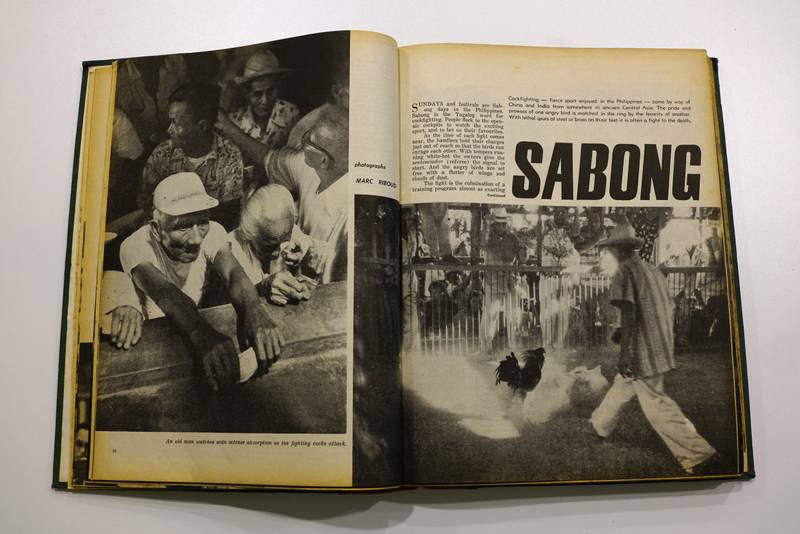
In the 13 January 1963 issue, Asia Magazine featured Magnum photographer Marc Riboud’s work on Philippine cockfighting.
The first issues of Asia Magazine already featured contributions by Filipino photographers Dominador Suba and Jose Sarmiento. In 1962, writer Nigel Cameron joined as editor, which opened doors for his then-partner, Magnum photographer Brian Brake, to contribute photographs to the magazine.14 For a short spell of several months, the magazine printed the works of Magnum photographers Henri Cartier-Bresson, Marc Riboud and René Burri, possibly through Brake’s connections. During that period, it became harder to locate the byline of Asian photographers who contributed to the magazine.
In 1963, Dick Baldovino (1937-2007, b. Manila) joined Asia Magazine as its staff photographer after working as freelance contributor to Chronicle Magazine since 1960.15 That was when Asia Magazine began to acquire an identity and consistency in terms of its photographic offerings.16 Baldovino proved to be an imaginative and accomplished portraitist, with a penchant for using elements in the foreground to frame his portraits. The magazine offered him a lot of opportunities to hone his talent. One of his first contributions, published in the 13 October 1963 issue, was a set of photographs featuring Filipino painter Lee Aguinaldo, which inaugurated the series on young Asian artists. In the 3 November 1963 issue, Baldovino produced a photo story on Filipino model Josie Padilla-Rufino, inaugurating the series on great beauties of Asia. In July 1967, Baldovino was invited to conduct a two-week workshop at the South-east Asia Press Centre at Kuala Lumpur for Malaysian press photographers, which, not surprisingly, included a model shoot in one of the sessions.17
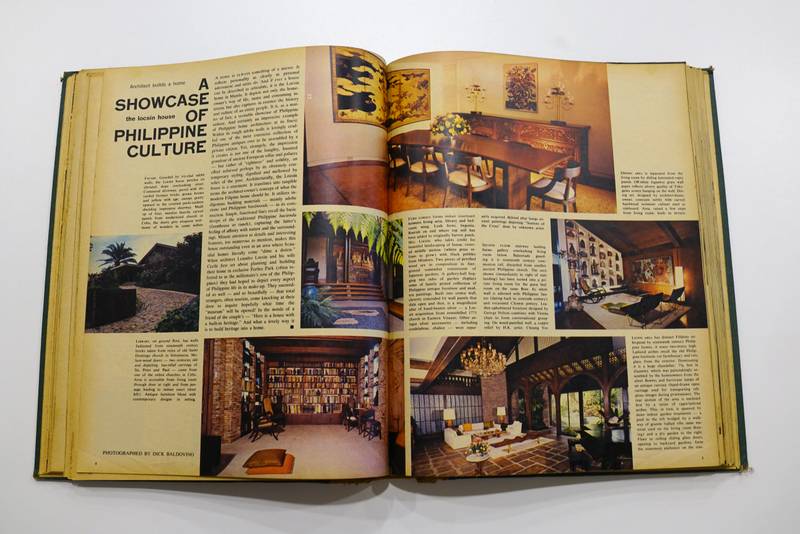
The 7 March 1965 issue of Asia Magazine focused on modern living and was produced by its women’s editor, Blanche Gallardo. In this spread, the magazine featured the house of architect Leandro Locsin at the exclusive Forbes Park, Manila. The photographs were taken by Dick Baldovino.
In one of the first thematic issues dedicated to a nation in the region, Asia Magazine featured the Philippines in its 15 December 1963 issue, heralding her youthful vitality by profiling young men and women who had come to dominate the fields of politics, commerce, industry and the arts. Zecha was keen to emphasise the fact that many of the staffers and contributors who made that issue possible were Filipinos of the younger generation, namechecking assistant editor Gatbonton who coordinated the issue and Baldovino who shot most of the photographs. Other contributing writers included essayist Carmen Guerrero-Nakpil and critic-poet Emmanuel Torres from Ateneo Art Gallery, amongst others.18 Romeo Vitug (1937—2024, b. Pampanga), who worked for Manila Chronicle and its magazine from 1957 to 1966, also contributed photographs to that issue.
Hong Kong as Reference Point for Southeast Asia
In its inaugural issue, Asia Magazine already launched a photo contest with the theme of progress, reflecting its optimism regarding the future of Asia while foregrounding the role of photography in delivering content and cultivating a sense of participation for its readers. In 1965, 1967, 1968, 1969, 1970 and 1971, Asia Magazine published a special issue on photography each year, highlighting the advances in photographic technology; it was no doubt an editorial strategy to entice camera brands to put up advertisements in the magazine. Overall, the reports reassured readers that photographic technology had become easier to master and highlighted the continued drop in prices. In the 1965 edition, for instance, Asia Magazine reported that it would only cost less than $90 to install a darkroom at home.19 For readers in Southeast Asia, these reports helped to circulate HK’s reputation as a haven for photographic supplies and equipment. By the early 1970s, newspaper reports in Singapore were predictably keen to portray the city-state as a competitor to HK for visitors looking to buy cameras at low prices.20
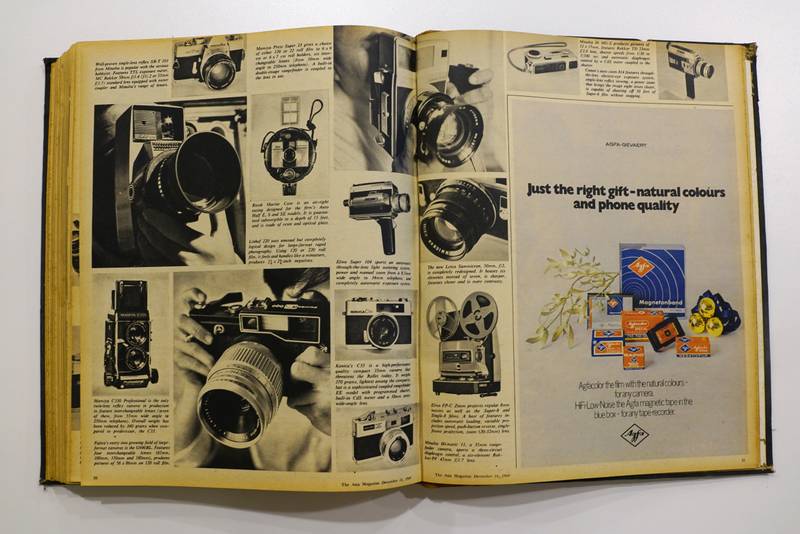
The special focus on photography in 1969 was published in the 14 December issue of Asia Magazine. As usual, it previewed the newest photographic technology in the market.
In the 1968 and 1970 special issues on photography, Asia Magazine used the opportunity to spotlight the work of its staff photographers.21 The magazine continued to organise photo contests in conjunction with a few of these special issues. Vitug won first prize in both the colour photo essay section in 1965 and the colour section in 1967. Apparently, the grand prize winner of the 1967 contest would also be offered a one-year contract as the magazine’s staff photographer.22 However, it is unclear who was awarded the grand prize that year. The statistics for the 1968 photo contest gives us a rough sense of the geographical reach of the photographers and photo enthusiasts who followed the magazine: 46 percent of the entries came from the Philippines, followed by Malaysians (19 percent) and Singaporeans (12 percent). Only 2.7 percent of the entries were submitted by women, revealing the gender imbalance in photography across Southeast Asia.23
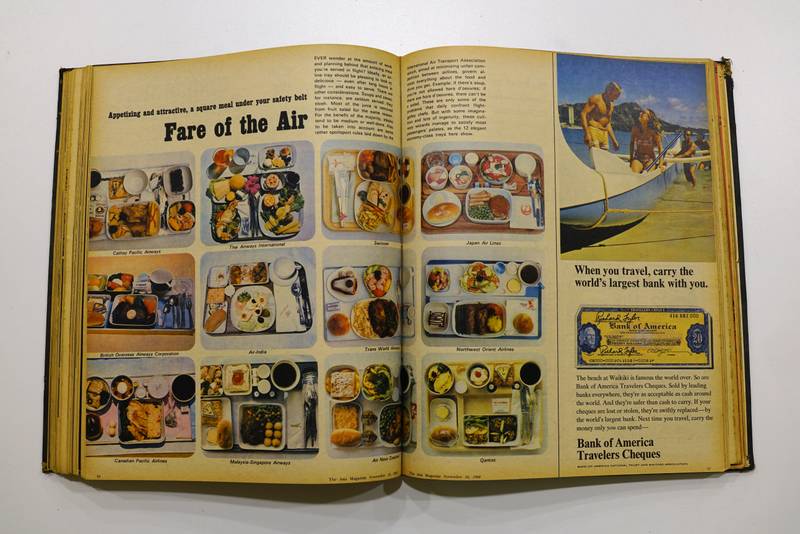
On the 10 November 1968 special issue on aviation, Asia Magazine produced a spread comparing the meals served on different airlines.
These editorial decisions vis-à-vis photography helped to install Asia Magazine as a major reference for aspirants in photojournalism and documentary photography across Southeast Asia. They included the likes of Vitug, Kouo Shang-Wei 郭尚慰 (b. 1924, Vietnam—d. 1988, Singapore), Kim Gooi (b. 1947, Penang) and Alex Baluyut (1956—2026, b. Manila), amongst others. Vitug recalled fondly the photographic reproduction that Asia Magazine offered, connecting it to the superior printing standard in HK and contrasting it with the print quality at Chronicle Magazine, which was “too black”.24 Gooi’s first attempts at reporting and photography were published in the magazine during the early 1970s, when he was working as a purchasing officer at Jurong Shipyard in Singapore before becoming a freelance writer and photographer in early 1977.25
Beyond the First Decade
On 2 April 1969, Soong passed away in HK after an illness. After the August 1969 issues, editor Gatbonton was replaced by associate editor George Liu. By the end of 1970, R.V. Pandit had become publisher and editor. The interim period coincided with the departure of Zecha, Bert (art director) and Blanche Gallardo (women’s editor), and Galang (art director). The change in personnel impacted the look of Asia Magazine. The size of the magazine was reduced from 320 (h) x 260 (w) mm to 280 x 210 mm from the 4 April 1971 issue onwards, which meant that the photographs became smaller and that the scope for playing with the layout curtailed. During Pandit’s helm, which lasted until June 1975, the place of photography in Asia Magazine became more incidental over time. Increasingly, the magazine used photographs more as illustrations rather than a way to unfold and narrate stories. Asia Magazine also began to reproduce more photo essays from Euro-American periodicals like Life and Sunday Times Magazine (UK), even though Baldovino continued to be on the books, at least for the time being.
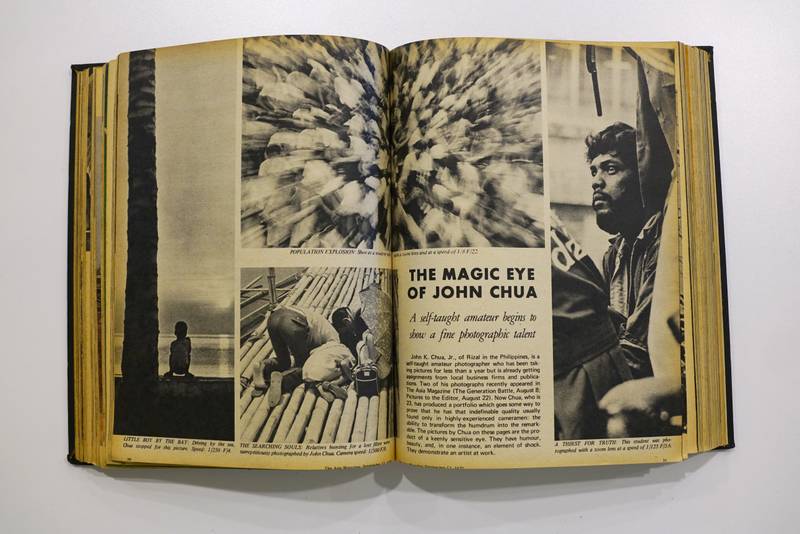
In the 12 September 1971 issue, Asia Magazine featured a selection of photographs by emerging Filipino photographer John K. Chua. It is likely that he first caught the attention of the magazine by submitting his images to its “Picture to the Editor” section.
When Pandit first became publisher, he made a call to solicit photographs from its readers with the lure of a fee.26 On 30 May 1971, the magazine started printing these contributions under a section titled “Picture to the Editor”. While the submission format favoured single shots that veered towards the weird and the exotic, it still allowed aspiring photographers like John K. Chua to test their skills and gain exposure. After two of his images were published in Asia Magazine, one of which in the aforementioned section, a selection of Chua’s images was reproduced in the 12 September 1971 issue, heralding the arrival of a new talent in Philippine photography.27
By the middle of 1975 when Pandit stepped down as editor and publisher, Asia Magazine had become more of a current affairs periodical, printed on newsprint, which aspired to be Time rather than Life. Suffice to say, its golden era as a pictorial periodical lapsed after the first decade.