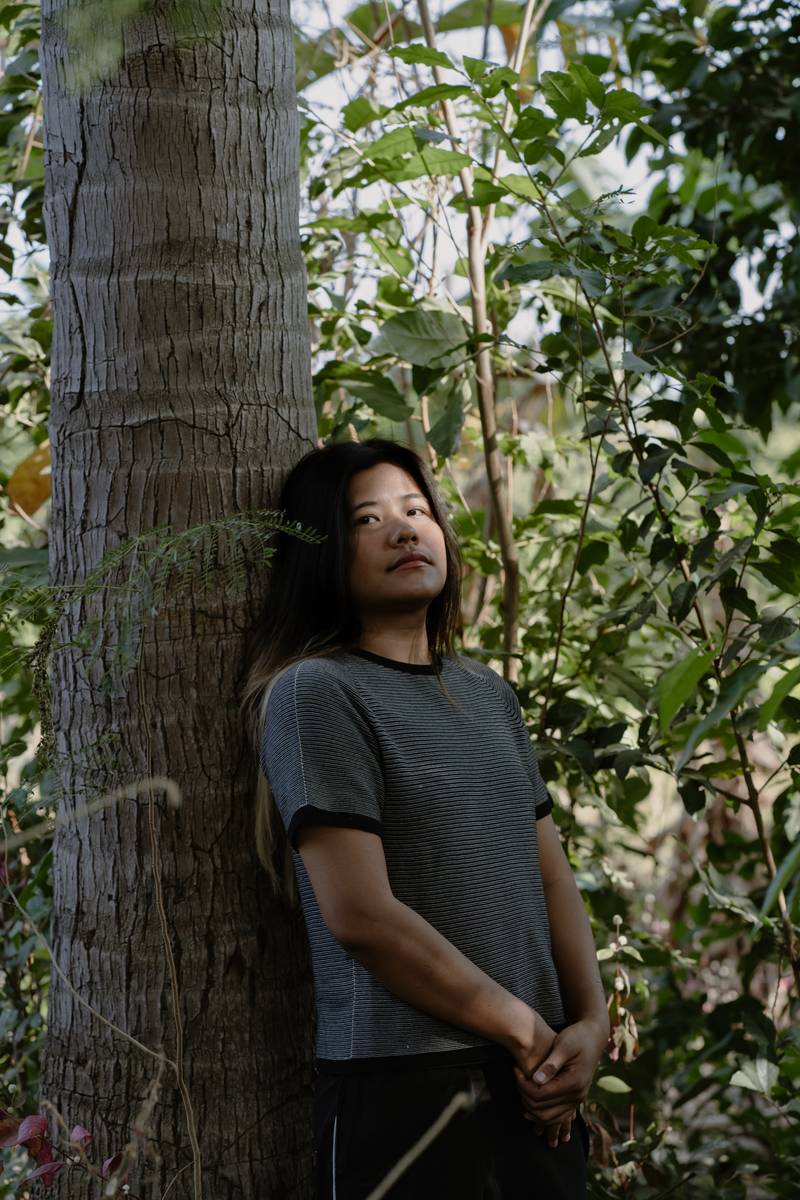
Portrait image of the artist courtesy of Marisa Srijunpleang
Fahmui Pimpakaporn Pornpeng is a Thai curator whose practice explores how contemporary art engages with both human and non-human worlds through planetary and multisensory perspectives. Alongside her curatorial work, she is interested in creating sustainable platforms for knowledge exchange through experimental workshops, collective learning, and collaborative gatherings.
FAHMUI: I am intrigued by your experimentation with the camera. Even though you have trained as a sculptor, video has been the main medium of your work. Do you combine the approaches of video and sculpture in your practice?
MARISA: I work based on personal experiences and encounters I have during my research, which leads me to think about the work through different mediums and materials, depending on what feelings I want to emphasise or communicate. Video lets me record conversations, stories, working process, human gestures and the overall atmosphere. In a sense, it is an inviting medium and allows a slow, layered experience. Sculpture works more like the texture of an experience, creating a direct physical encounter with the viewer.
In When the dust flew away (2025), I used video alongside the sculpture. This work reflected a period when my sister and I were taking care of my mother, who has dementia. We also grew up helping my mother care for my grandmother, who had dementia and PTSD. Her symptoms gradually developed after she fled from the war.
For me, caregiving involves a lot of touch. That is why I translated this experience into sculptures made from baby powder and Mon Leya, the scented powder that my grandmother loved to use. When I think about caring for someone, I think about that powder. It carries strong dimensions of smell and touch because using it requires you to be physically close to another person. You have to be physically close enough to touch them through the powder. Caring for older relatives or children is deeply sensory.
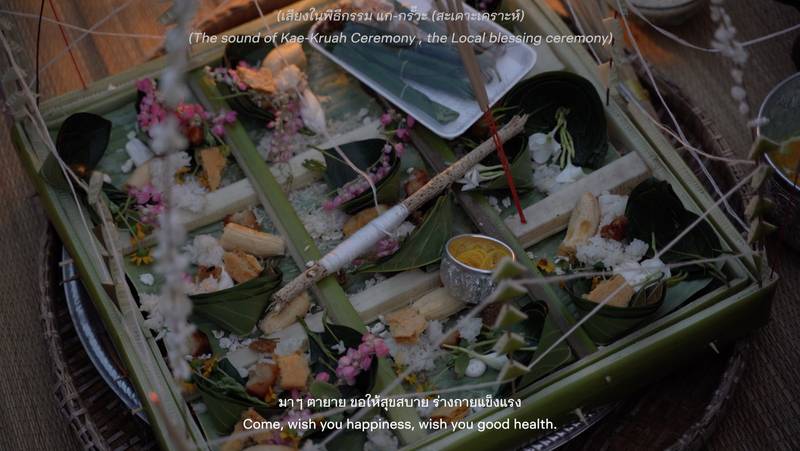
When the dust flew away (2025), single-channel video installation, 10:01 minutes
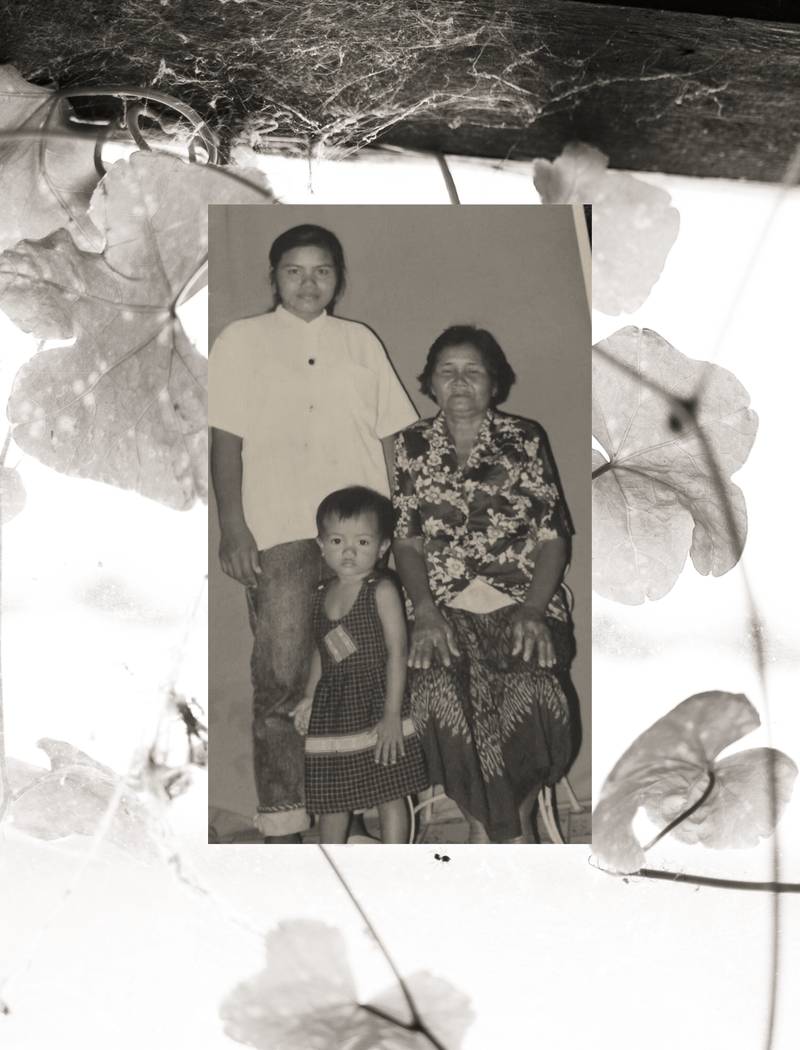
Photo of Marisa Srijunpleang’s mother, sister, and grandmother
In addition, I also refer to the Su Kwan ceremony, a traditional ritual from northeastern Thailand known in my hometown as the Kae Kruah ceremony. It is performed to ward off misfortune, restore the mind and spirit after a traumatic experience, and call a sick person’s spirit back to their family. I tell this story through the video, along with footage of my mother’s house and the process of cleaning her old home, sorting through her belongings, and drawing out the memories held within the different objects in the house. I selected these memories and imprinted them onto a baby powder sculpture. Through this process, I represent my mother’s memories of the house where she had lived her whole life, her old belongings, and the feeling of having to care for everyone in the family in the aftermath of war. Process is a crucial part of my work, and I recorded these actions on video. The video carries the story forward and communicates these experiences to the viewer.
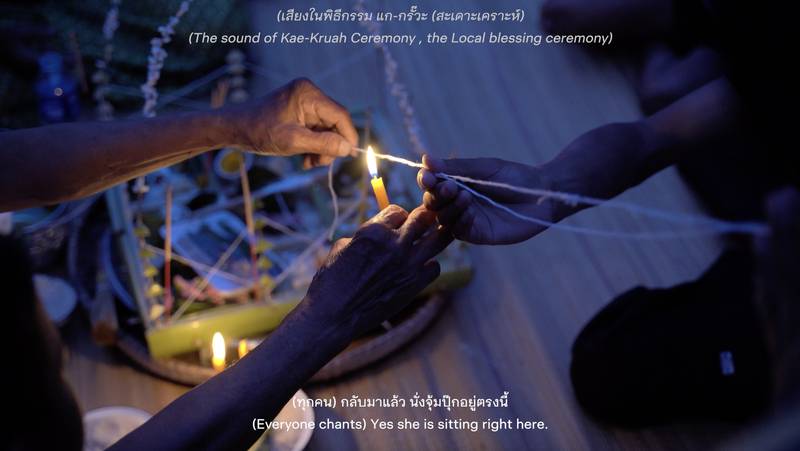
When the dust flew away, 2025, single-channel video installation, 10:01 minutes
In When the dust flew away, how did the physical handling of this powder (pressing, imprinting, forming) mirror or diverge from the daily acts of care, and what material decisions did you make so that the sculpture would hold the weight of memory without becoming illustrative or sentimental?
With this series, before I decided to clean my mother’s house, I had to return to the house itself. This was the house where I had lived since I was a child. It was surrounded by walls, with broken glass embedded along the top to protect the people inside from danger coming from outside. Metal bars also covered the windows. I think these things probably made my mother feel safe, because after my father died when I was six months old, and as the youngest of four siblings, my mother also had to take care of two children of my aunt, who had died during the war, as well as my grandmother.
When my mother became ill, we moved her to another house so that we could take care of her there, and this house was left closed. I went back into the house again. What I saw was that all the belongings were still arranged as they had been. It felt as though this person had only left the house yesterday. The brush was still in the same place, the clothes were still hanging in the corner of the room, and the curtains were still rolled up. At the same time, the house was covered in dust, and plants had slowly begun to grow through the corners of the concrete and the ventilation openings.
The materials I chose to make the imprints were connected to and selected from these things: the metal bars on the windows, the curtains in the position they had been left in, the plants growing through the concrete, as well as an old wooden window frame, which became the frame for this series of sculptures. For me, this was a way of trying to remember my mother in another way. At the same time, it was a way of gradually trying to understand the feeling of facing the loss of my mother’s memories through what remained in her house and through the feeling of care that had been passed on to my sister and me.
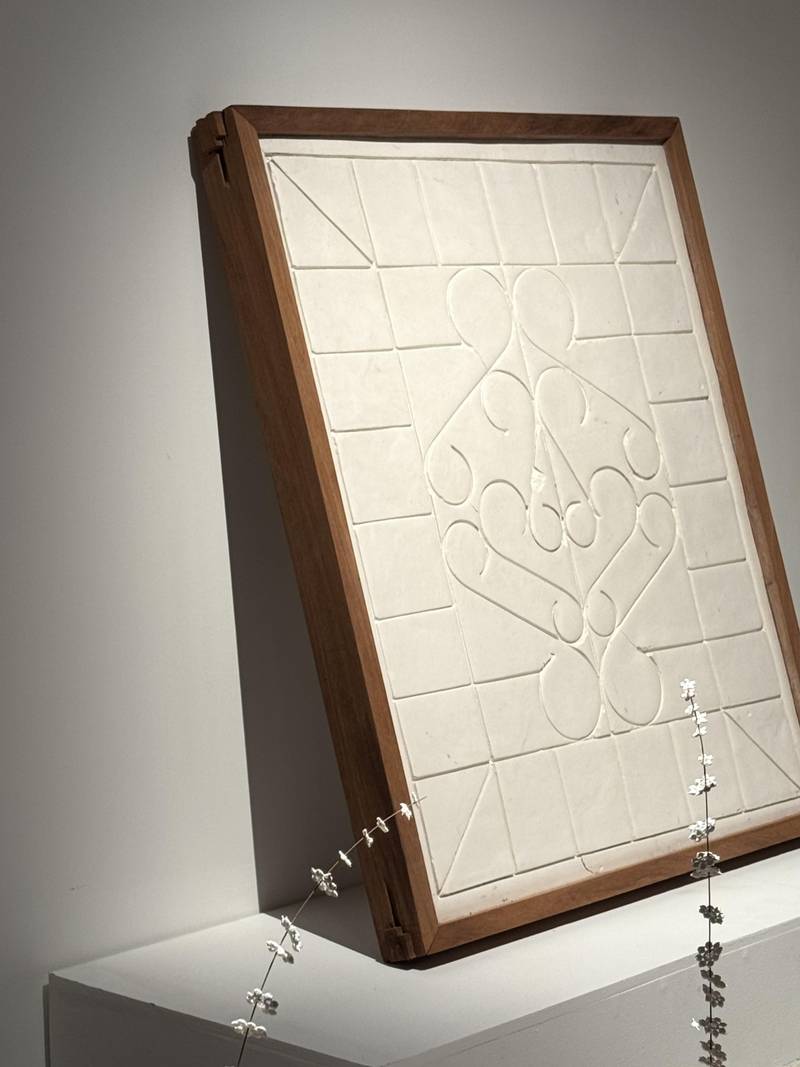
Be engraved, 2025, printing objects (wrought iron) onto powder, two-dimensional sculpture, talcum powder, scented powder, water, Makha wood window, 112 x 93 x 8.5 cm
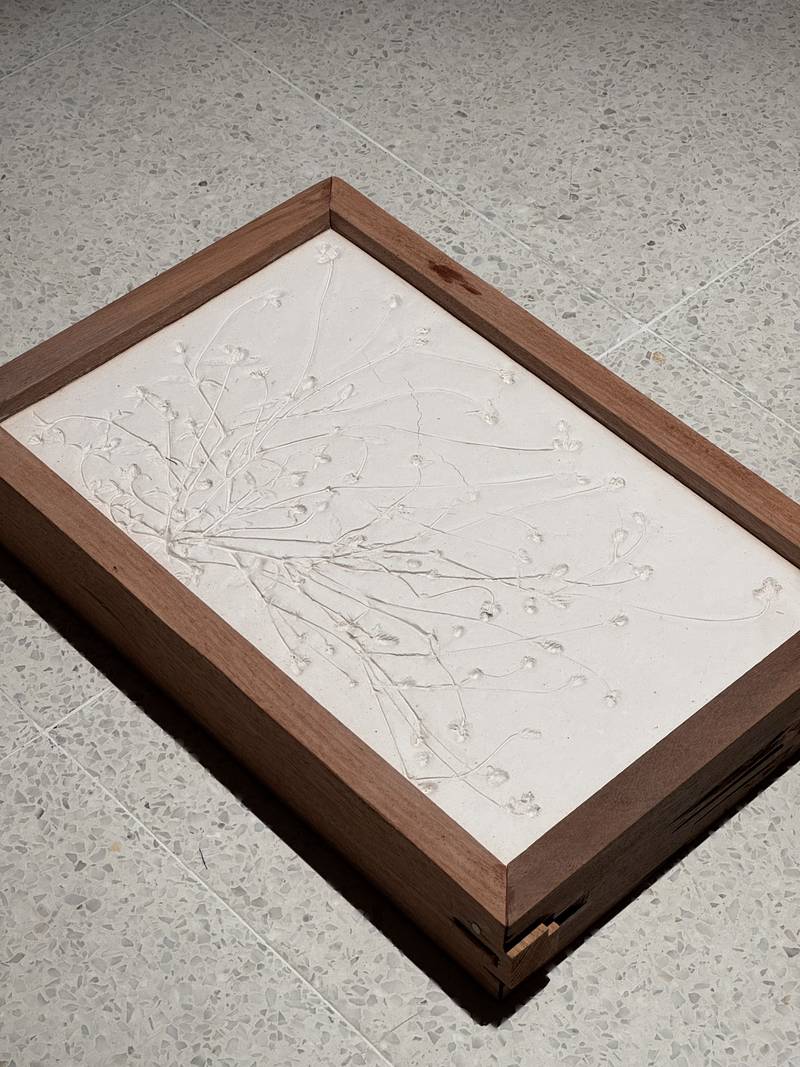
Growing by the roadside, 2025, printing objects (wild Gomphrena flowers that grow through concrete) onto powder, two-dimensional sculpture, talcum powder, scented powder, water, Makha wood window, 112 x 93 x 8.5 cm
I was also interested in what happened through the process of choosing and working with the material. I slowly sprinkled water onto the powder and kneaded it until it became damp and moist enough to receive the objects and leave their traces. I repeatedly pressed and compacted the material so that I could imprint the objects into it. Then I slowly began to make the impressions. Through pressing and covering the objects with the powder, the material temporarily takes on their volume. But when I lift the object away, only its trace remains.
I am interested in this process of imprinting because after the pressing and imprinting, only the trace of that thing is left behind. It makes me think about how something can be present through what is no longer there.
After that comes the process of caring for the work itself, I have to sprinkle water onto it gradually and carefully until it reaches the right level of moisture before I can move the sculpture. Otherwise, it can easily break apart because the material is made only from powder, water, and Mon Leya. For me, it is interesting that the finished work has a language that I did not intentionally put into it. It allows me to learn many things alongside the work itself.
I feel that this series is filled with my feelings. But it is not trying to tell about feelings that happened in the past, or something that has already happened and ended. It speaks about the feelings we are facing in the present, feelings that we do not have answers to, and instead, we are trying to understand them. It also speaks about the feeling of trying to cope with my mother’s memories as they slowly disappear.
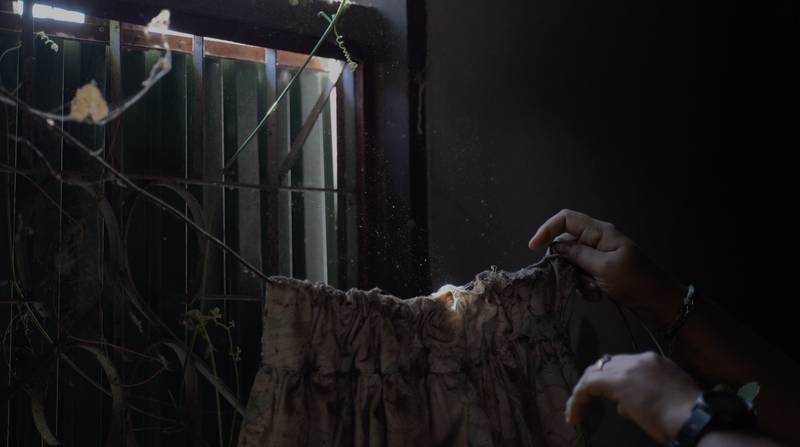
When the dust flew away (2025), 10.01 minutes, single-channel video installation
You’ve worked with your family’s memories across several bodies of work. What is your methodology in working these memories into your work? Talking about war, especially from the perspective of those who have experienced its consequences, is complex. As both a descendant and an artist, how do you engage with this subject?
For me, there is a shared experience of being a grandchild – those who came after the generation that experienced the war. I started by asking what that history means to me.
I feel a sense of guilt when I bring these stories into my work. Because I could find so little written documentation of these experiences, one of the few things I could do was return to my own family’s memories. The first time I worked with the subject of the Cambodian genocide was in T360174 (2023). For that project, I spoke with my family and with people who had been caught in the middle of the war. What I found difficult was dealing with the feeling that, by asking people about these experiences, I brought them back into painful memories. Even though they had given consent and were willing to share their stories, some people could not. Some cried as they spoke, their voices trembling with emotion.
Although I can relate to aspects of that pain, it is deeper than I can imagine. Out of respect for them, I choose not to include everything they share in my work. For example, when I ask my aunt to retell an experience, I always explain why I need to bring it up again and ask whether she feels comfortable talking about it. When I tell my grandmother’s story through my mother’s memories, I focus instead on what my grandmother was like as a person and what she enjoyed doing while she was alive. I choose to tell some stories through these tangential, ordinary memories.
There is a lot of unused footage from T360174 (2023). For example, one recording shows my aunt describing how she became trapped in the war at the age of five. After she finally returned to Thailand, her school took her on a field trip where she was shown a film about the war, which overwhelmed her and caused her to scream and cry uncontrollably. That experience remained one of her childhood memories. For me, I feel that I cannot include that part of her story in the work. I am not entirely sure why. It’s something that will always be difficult. This reminds me of a conversation I once had with another artist who also works with family trauma. She told me that, in the end, what she really wanted to tell people did not necessarily have to be about how much people had suffered. It was simply about telling people how they had tried to live, and how they wanted to live.
T360174, 2023, video installation view, exhibited at In a Cogitation, Early Year Project #6 (EYP6), Bangkok Art and Culture Center (BACC), Bangkok, Thailand.
What were your early interests in art, and what were the questions that first drew you in, before your practice developed into the exploration of family memory that you work with today?
I grew up in a rural area of Surin, a province in northeastern Thailand, close to the Cambodian border. Back then, like other children in elementary school, I was simply drawn to what was close to me. I remember the joy of using charcoal from mom’s kitchen to draw on paper, the excitement of having a pencil box with different colours, and running around the village. During my high school years, mobile phones changed from black-and-white screens to colour screens. These phones came with cameras, music players, and other features. At the same time, the arrival of the internet opened up a wider world for me. I discovered many new things. My interest in video may have grown from those experiences.
In art school, beyond learning art techniques, we were given a simple question: Why do we want to make art? My professor asked me to start by looking at my roots and asking where I came from. This became an important question that started shaping my art practice and changed how I understand the world. I started to notice the contrast between Bangkok, a highly centralised city where I moved in to study, and my hometown. I wondered how changes affected rural communities, and how local wisdom gradually disappeared with my grandparents’ generation.
That brought me back to Surin and led me to continue my art, including Wisdom Seed Storage (2015), which looks at abandoned rice barns in the neighbourhood. I reduced the scale of an actual rice barn into a small sculpture that resembles a shrine. It functions symbolically rather than serving the practical purpose it once had. Developing this body of work allowed me to think more intently about my hometown, relationships among people, rituals and the landscapes. This eventually led me toward the stories of my own family, whose lives had been connected to and affected by the Cambodian genocide in 1975. Family stories became an important way for me to explore and express personal feelings, alongside my interest in human gestures, local beliefs, rituals, and border landscapes, which have continued to shape my practice.
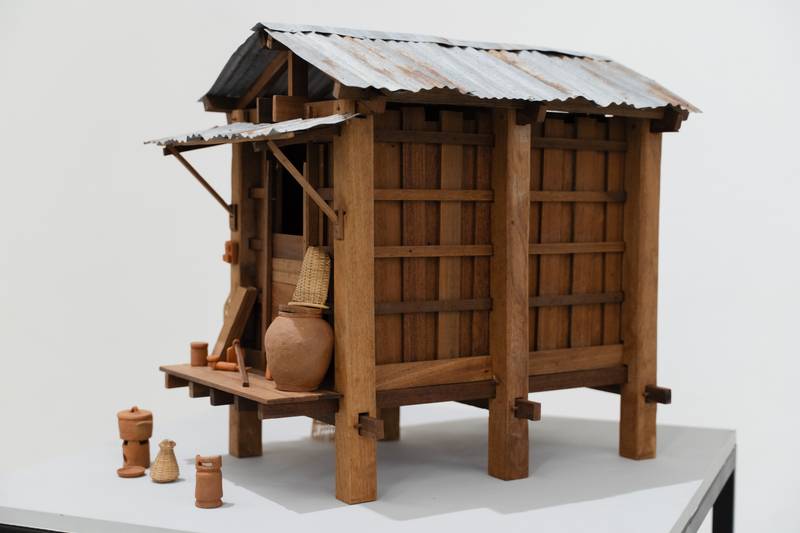
Wisdom Seed Storage, 2015, selected old woods that are more durable and match the materials of a real Thai traditional granary; galvanised iron for the roof, also from the real old material used; baked clay (terracotta) and bamboo basketwork as the miscellaneous wares.
You define ‘consent’ as a consistent ethical filter across your projects – the decision to withhold certain stories, alongside a preference for ordinary details of who people were rather than an inventory of suffering. How do you work with what is deliberately left out? Does absence become a structural element in your projects, and how do you know when a memory has been transformed enough to enter the work?
In all my work, there is usually an important sentence or feeling I want to communicate. After studying the information, talking with people, going into the field, and searching for different things, I gradually come to understand what kind of feeling I want to convey.
For me, working with these parts of history begins with listening to people’s stories and confronting the pain within those oral narratives. At first, it was very much about my family and directly encountering the pain people had experienced. I cannot deny that I always feel a personal connection to these stories because they are connected to my own family history. While working, I am also trying to understand my family’s stories.
At the same time, my way of working has gradually developed through my growing interest in traces. I am interested in the small things that remain, such as houses, objects, plants, or fragments of stories that people still remember. These ordinary things make me feel that we can understand something about a person without having to tell their entire story.
So, when I choose not to tell certain memories related to their suffering, it may simply be part of my way of working – not choosing those experiences of suffering as something that the work needs to speak about directly.
For me, the way these things eventually resolve into a work also comes from the different elements of the journey throughout the process. Sometimes memories and stories can be the starting point of a work, while in other works they may simply be one part of what allows me to see or understand something else more clearly. It depends on each work and on what I want to communicate.
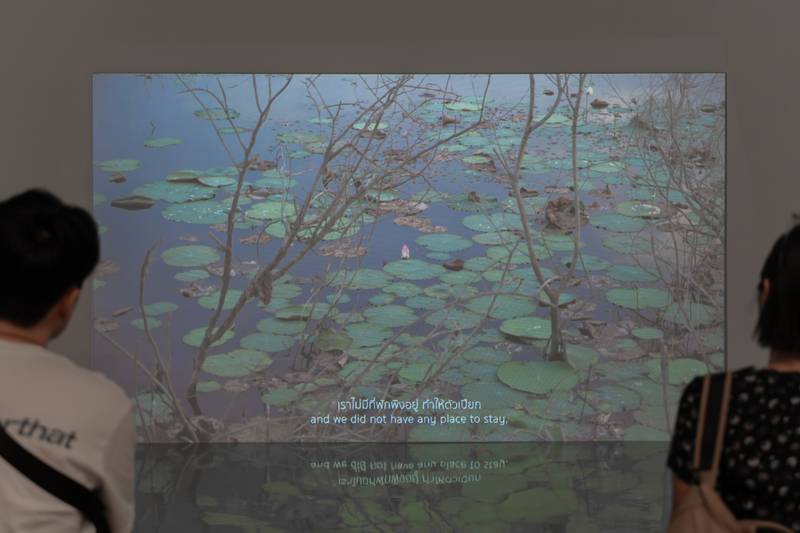
T360174 (2023), video installation view, exhibited at In a Cogitation, Early Year Project #6 (EYP6), Bangkok Art and Culture Center (BACC), Bangkok, Thailand
In a way, you’re seeking clarity, rather than showing the audience how much you have suffered?
Suffering is not the only thing I want to communicate through my work, nor do I want to avoid pain completely.
War is devastating, and even though I did not experience the pain directly, it is part of who I am. Growing up, I saw photographs of relatives hanging on the walls of my house, not knowing what they were like, what they enjoyed doing, or what food they liked. Eventually, I learned that they were killed during the war. Their deaths were tragic, unjust and untimely.
War always takes away people’s everyday lives. That loss remains. Over time, my work has become more focused on the experience of losing family members through war and remembering who they were through personal stories, loss, love, and my desire to comfort both those who are gone and those who are still here.
My work became a way to explore the things I encounter and come into contact with. That is why the experiences of the grandchildren’s generation continue to appear in several of my works.
T360174 (2023) and When the dust flew away (2025) deal directly with people’s memories. They are memories with a physical presence and weight, and we can clearly feel your attempt to work with both the stories and the pain of the people telling them. I think Blooms with The Wind Blows (2024) approaches storytelling differently. Could you tell us how this work developed?
While T360174 focuses on lives and memories in the aftermath of war, Blooms with The Wind Blows translates my longing for the people who died because of war. It is about searching for the memories of my grandparents across landscapes shaped by war, from our present home, through border areas and refugee camps, to my grandparents’ former home in Cambodia. Once I learned more about my family’s history and stories through making T360174, I began to question my family’s past and how it continues into the present. This led me to explore Phka Bayben further, the flower central to the Sandon Ta ritual. From my research, I discovered that while a specific flower is traditionally used, records of it are scarce and vague. It has no formal identification but is described as a fragrant, white, grass-like flower, somewhat resembling jasmine, that blooms only in the tenth month and withers soon after the ceremony.
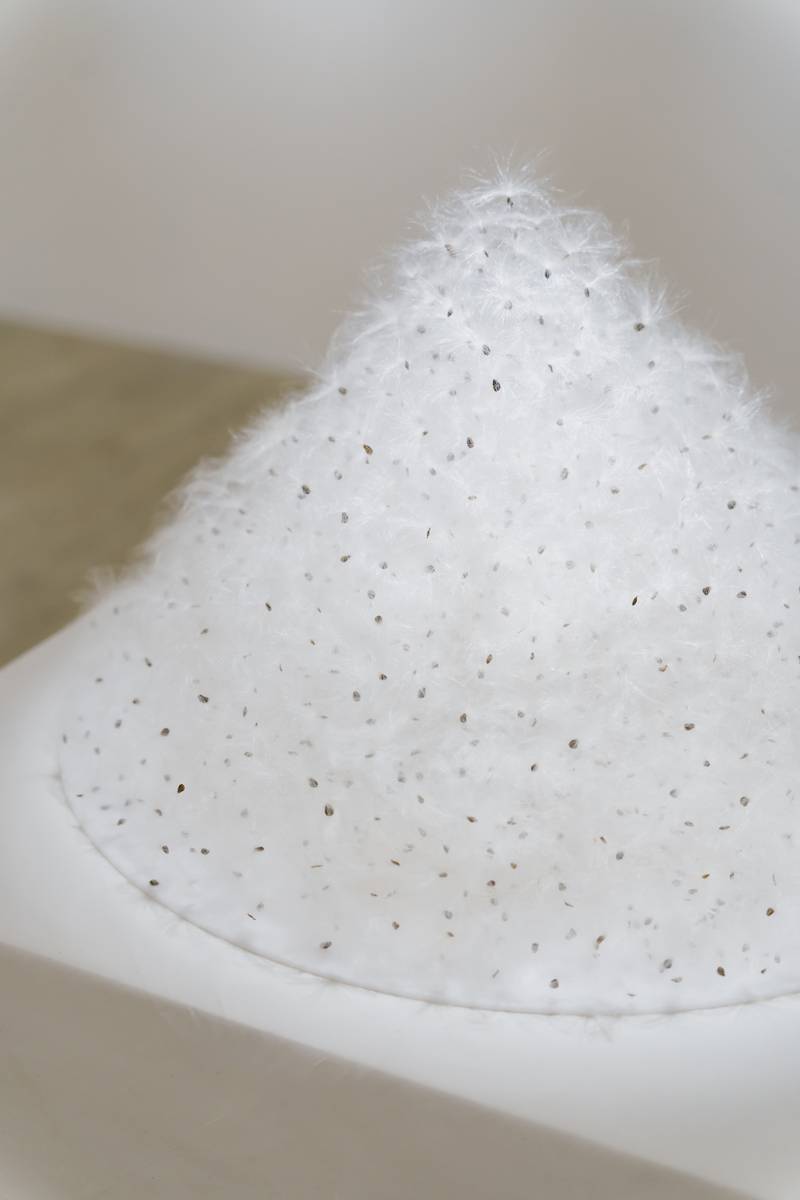
Blooms with The Wind Blows (2024), crown flower seeds (dok rak) on a flat acrylic base, 60 x 60 x 45 cm. Photo courtesy of HOP – Hub Of Photography
The disappearance of this flower, along with the uncertainty surrounding its name and identity, remains connected to a sense of absence for me. It reminds me of the feeling of losing family members without ever having all the answers about what happened to them. I expressed these feelings through the journey of searching for the flower and other plants connected to it. During this journey, I encountered Little Ironweed (Vernonia cinerea), Coat Buttons (Tridax procumbens), and other plants that appear in the photographic series. I collected crown flower seeds (Calotropis gigantea) from our home in Thailand, along the border path to my grandparents’ former home in Cambodia, and transformed them into a sculpture that echoes the shape of the banana-leaf cones used in the Sandon Ta ritual.
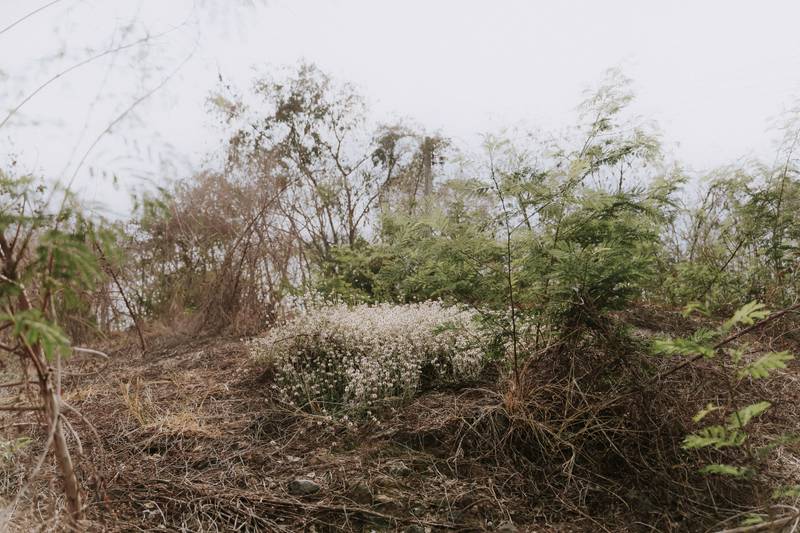
Re Intertwine, 2024, photograph, from the exhibition Blooms with The Wind Blows (2024)
Visiting Khao I-Dang refugee camp in Sa Kaeo Province became an important turning point in my search for my grandfather’s memories. As I walked through the former camp, I found notebooks filled with messages from visitors. Some had returned because they were born or raised there as refugees after the war; some came to remember family members who had lived and died there; and others came searching for missing relatives and loved ones. Beside the notebooks were lists of former camp residents, kept for people still searching for missing relatives. Reading these messages made me realise that I had come there for the same reason. I, too, had come to search for someone in my family and to piece together the fragmented memories of my grandfather.
Khao I-Dang refugee camp, 2024
In 2025, you made, I heard you once walked this way, long ago, a work we did together. When we were developing it, we talked a lot about sensitivity and the feelings embedded in storytelling. It also connects to your interest in how environments or ecosystems affect people. I believe that small stories, such as personal experiences or family histories, can always become part of a much larger narrative. Could you share more about this work and how you think you moved away from or developed beyond your previous works?
There is no narrative or interview in this work in the way there was in my previous projects. There is almost no family story in it at all – or at least not in anything that we can immediately see. When you first encounter the work, you don’t necessarily know what it is about. You have to watch and spend time with it, and then I hope the feeling gradually emerges. It is a little like watching a film where the climax slowly reveals itself. I think it grew out of my growing interest in borders, which began with Blooms with The Wind Blows (2024). I find borders interesting because they are often closely connected to war. It makes me question what exactly a border divides and how borders create this sense of “us” and “them.” That is why I became interested in how border lines are created and represented on maps.
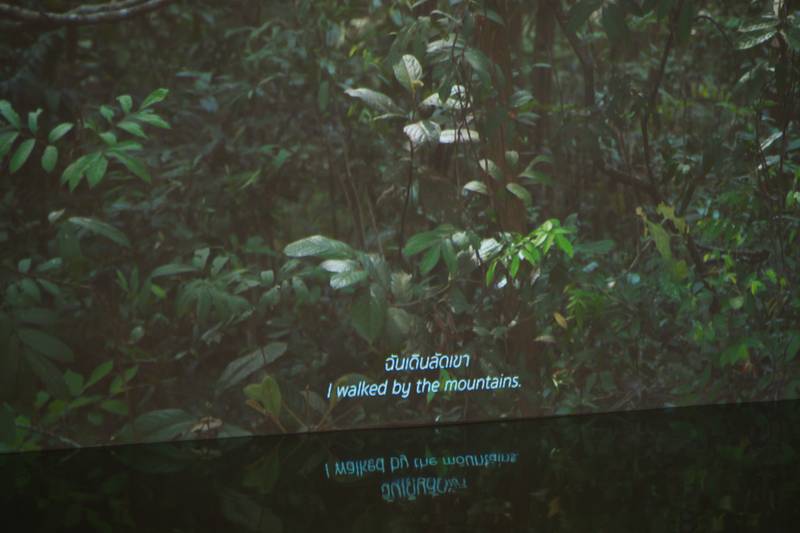
For this project, I worked with a neighbour who makes a living by foraging wild mushrooms. During the rainy season, she goes into a forest that is right along the border. I became interested in this condition – how a border operates at the level of the individual and the community in so many different ways. This part of the work comes from my aunt. She told me about trying to escape from Cambodia. As she walked through these forests along the border, she had to be as quiet as possible. At certain points, everyone would gather and arrange for the family members to cross into Thailand together. They had to stop the children from crying because soldiers would come at night with flashlights, and any sound could put their lives in danger. So I explored my family histories in a different way here; I tried to create the sensations as I contemplated the experiences they carried. This is why I translated this work through the sounds of footsteps on leaves, the sounds of bodies moving through and parting the plants, as well as the sounds of people searching for mushrooms in the forest, the sounds of their effort and persistence as they search.
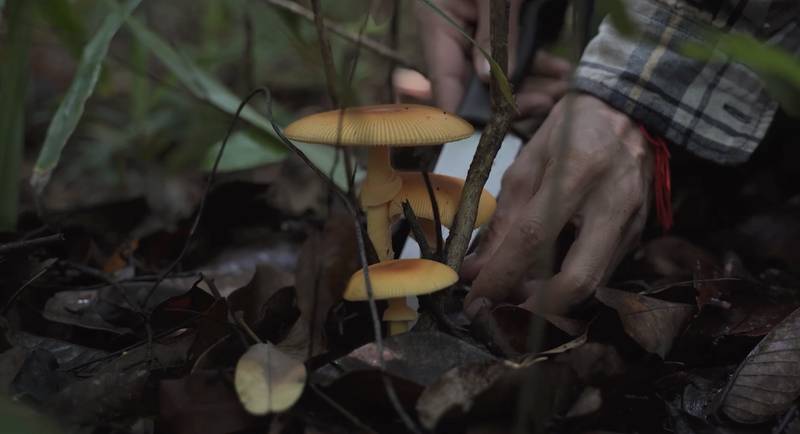
I heard you once walked this way, long ago (2025), single-channel video installation, 20:50 minutes
In I heard you once walked this way, long ago (2025), narrative and direct testimony recede in favour of footsteps, foraging sounds, plant forms, and the lived porosity of the border. How has your research method changed as the work moves from family interviews and house interiors into ecosystems and cartographic lines? What specific sensations or material traces are you now treating as primary “carriers” of intergenerational memory, and how do you decide what the viewer needs to know versus what they need only to feel?
This work also begins with my aunt’s memory from when my whole family was trying to escape the war. My aunt described that it was around June, during heavy rains. The ground was soaked with water. Everyone had to walk as quietly as possible, slowly listening to the sounds around them and watching for lights that might be shone on them and lead to them being captured and taken back again.
Another thing that interests me deeply is the idea of “Khwan.” In my family’s belief, when a person goes through an experience that deeply affects them, their Khwan can leave the body and drift into the mountains and forests. So, returning to the forest and foraging for mushrooms means more to me than simply returning to a place where my family once passed through. It feels like returning to search for the Khwan of my family again – through walking, through listening, and through what is still alive in that place.
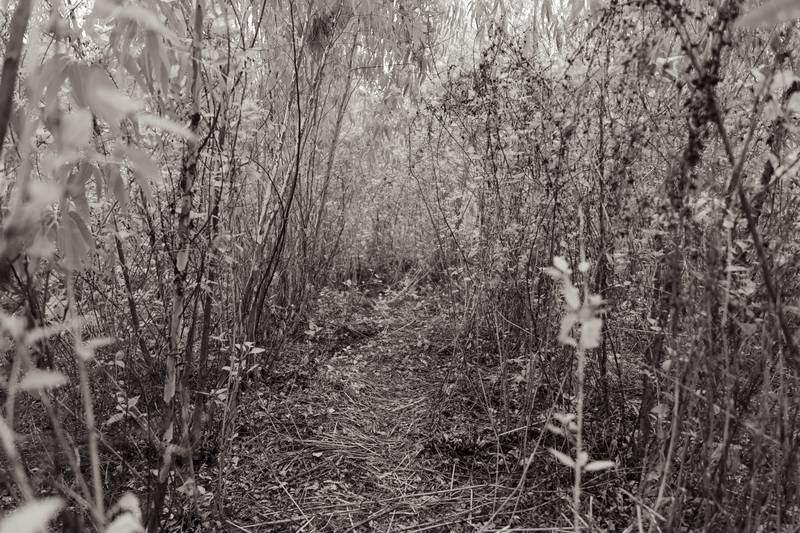
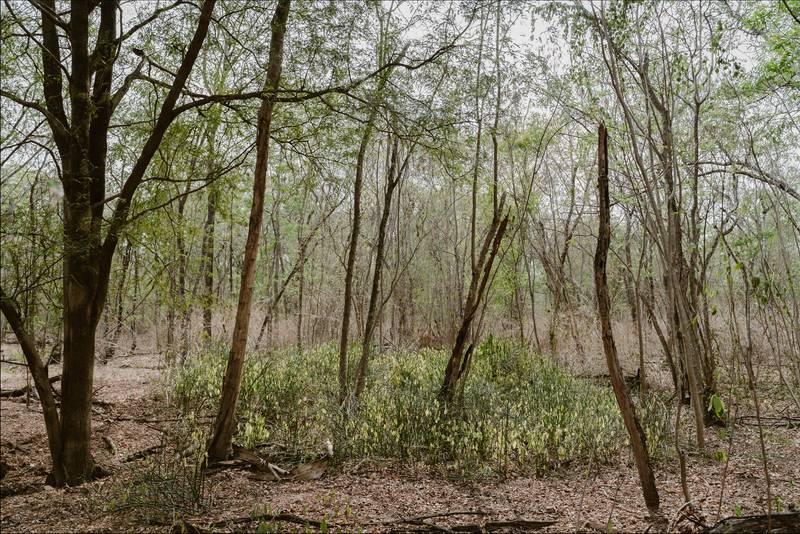
The forest between the borders of Thailand and Cambodia, a process photo of I heard you once walked this way, long ago, 2025
This is still my way of bringing myself back to that place, which is the forest that my family travelled through while escaping from the war. But what allows me to return to this forest is going there to forage for mushrooms. In June, when the rain begins to make the forest wet and abundant, I am interested in how mushroom foraging also takes me across the border between the two sides. At the same time, it involves a process that requires silence, listening for footsteps, walking slowly, and even shouting with joy when we find a mushroom.
While the story comes from my aunt, who may never return to this forest again, the work also speaks about the people who continue to live with the forest. These are friends from the old village where my family once lived, who still carry knowledge passed down through generations about identifying mushrooms, searching for them, and their relationship with the forest. At the same time, I think this work is also an experiment in developing my practice formally.
Previously, people’s voices and stories were an important part of my work. Now I am experimenting with allowing the voice of the place, the movement of the body, and what exists within the ecosystem to speak more in their place. I’m interested in continuing to follow it.
Looking ahead to your work this year, where do you hope your research will take you next?
I want to make work that further explores themes and narratives through the frameworks of borders. While borders separate lands and their inhabitants, they simultaneously blur and connect people through rituals and ecology. I am thinking alongside grass, for example, because grasses grow strongly and freely, trespassing borders. I am interested in how the effects of war might have brought them to these places, how they have become part of people’s lives, how their given names differ from one community to another, and how they grow along the border itself, or how they cross from one side to the other. Grass remains a companion in finding the next story. Following the grasses might lead me to languages and stories I have not encountered before.
With the recent tensions between Thailand and Cambodia, nationalism has grown increasingly intense, causing deaths, injuries, and the loss of homes. Borders make the boundaries between nations seem very definite. Yet people, rituals, and plants continue to exist and move through these places despite them. I am interested in these connections and hope my work can imagine crossing these borderlines while holding space for lives that were lost and lives that continue to be affected by war.