KC 鄭康君 (b. 1995) is a Taiwanese-American photojournalist based in Nairobi, Kenya, for six years, covering environmental change, cultural continuity, foreign interventions, and outdoor adventure. Her work began in the Arctic and extends globally.
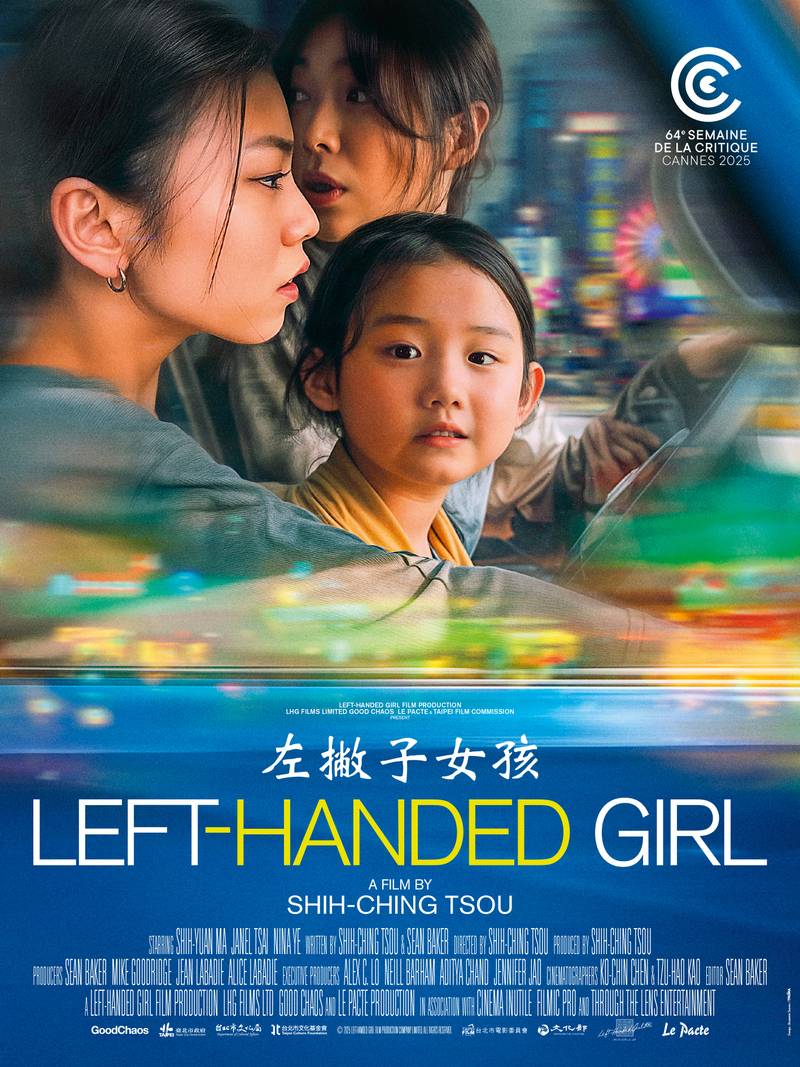
Left-Handed Girl | Directed by Tsou Shih-Ching | Duration: 1h 49min | Language: Mandarin
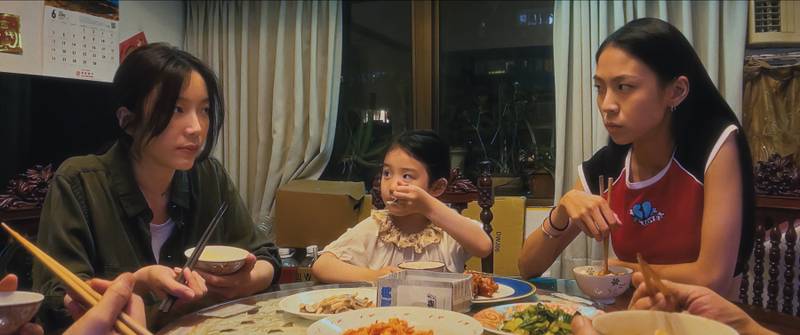
The concept of being guai (‘well-behaved’) – keeping one’s head down to produce work dutifully – remains a strong undercurrent in the Taiwanese family dynamics the film portrays. The characters of Taiwanese-American writer and director Shih-Ching Tsou’s (鄒時擎) debut film, Left-Handed Girl, certainly try: the mother, Shu-Fen (played by Janet Tsai) as she tries her hand at running a noodle stand, the elder daughter I-Ann (played by Shih-Yuan Ma) finding a job preparing bing lang (betel nut) at one of the ubiquitous small shops peppering Taipei. But due to a misunderstanding about left-handedness, five-year-old I-Jing (played by Nina Ye), the younger daughter, starts behaving uncharacteristically bu guai (bad).
The family has recently moved from the countryside to the cosmopolitan capital of Taipei, thus having the opportunity to reconnect with Shu-Fen’s parents. Between family meals, the grandmother reveals that she is caught in the middle of a muddled racketeering scheme involving large stacks of cash and foreign passports. As she scrutinizes how Shu-Fen and I-Ann are settling into life in Taipei, the superstitious grandfather fixates on I-Jing’s left-handedness. He pulls the impressionable young girl aside, telling her to refrain from using her ‘devil hand.’
The grandfather likely grew up in a setting where lefties were forced to switch to using their right hand for ‘proper’ activities such as writing and using chopsticks, something that my father – who grew up in Taiwan in the 1960s – vividly recalls.
With her mother and sister preoccupied with their jobs, I-Jing is frequently left to her own devices. She hangs out around the noodle stand, where I-Ann stops by to help with serving and washing dishes – but it doesn’t take long before she gets bored and ventures further. An adorable presence, I-Jing easily befriends other vendors, assisting one with his hawking of kitchen appliances. But she concurrently begins shoplifting knick-knacks on the regular, always using her left ‘devil’ hand.
“Where did you go?” I-Ann asks her one time, as the girl returns to the noodle stand after one shoplifting rendezvous. “I was just around,” I-Jing replies vaguely, and there the conversation ended.
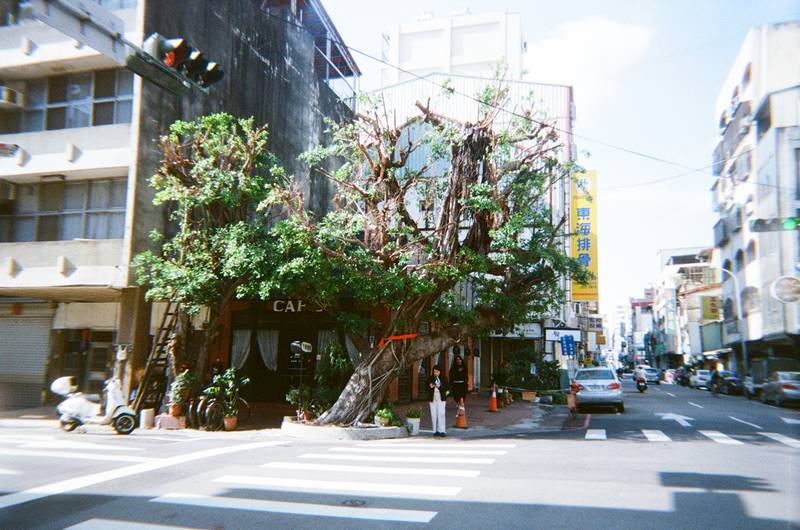
A view of the streets of Taichung in central Taiwan. Photo: Kang-Chun Cheng
In Left-Handed Girl, every character is on an individual journey. The paths and decisions of the family of three barely overlap; each return comes with its own challenges. Beyond the logistics of finding an apartment, making it feel like a home, setting up shop, and creating a routine, there is the emotional journey. For Shu-Fen and I-Ann in particular, this means carving out their places in society: sizing up their neighbours and colleagues, and ideally not making too big of a splash as they ease into new surroundings. The biggest faux pas would be to do anything that is diu lian – losing face, embarrassing. But no one emerges from life unscathed.
Shu-Fen takes on the classic role of an overwhelmed mother pulled in too many directions, making decisions out of necessity––sometimes to the disapproval of her older daughter and friends. She has a complicated relationship with an ex, who has been hospitalized and requires vast shares of her savings, much to the chagrin of her friends and the eye-rolls of her teenage daughter. With this cash-strapped deficit, she starts her new business. Her insolvency leads to a very diu lian confrontation when the night market owner demands overdue rent.
Concurrently, I-Ann’s high school dropout-coded decision to sleep with her new boss complicates matters with his wife. Acceptance is part of the equation of settling into a new home.
It doesn’t take long for each character to be confronted by the complex tradeoffs between doing what is socially expected and what she wants.
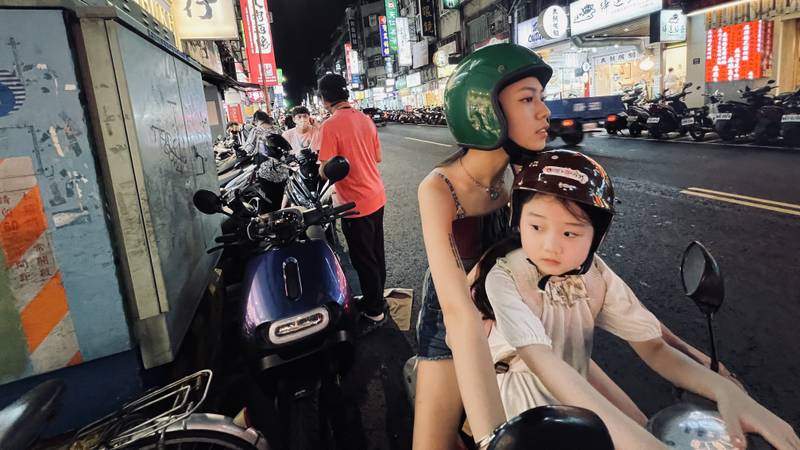
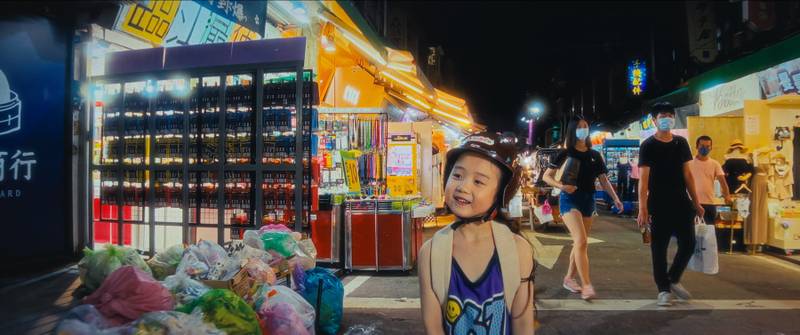
Shot on location, the innate chaos of the night market – incessant energy, a mosaic of smells ranging from deep-frying stinky tofu (a Taiwanese classic) to oyster omelettes, hawkers promoting their goods – seeps into the film’s psyche, mirroring each individual’s internal turmoil. In one scene, the camera follows I-Jing as she ducks and dodges through the cramped, crowded spaces of the night market, passing arcade games, bubble tea stalls, vendors selling luggage––items as random as the ones she starts pilfering. The choice of setting amplifies the unavoidable destabilization and layers that come with transition.
While searching for ways to watch this movie online, I read that Tsou shot the entire film on the same iPhone 13 she uses today. The shots and transitions were smooth and beautiful, with that particular thin depth of field that comes with smartphone footage. Throughout the film, we see atmospheric scenes of I-Ann whizzing down the streets of Taipei on her scooter, sometimes with I-Jing in tow – on several occasions to abandon dramas she had initiated. But had it not been for that knowledge, we probably wouldn’t have noticed it.
When the grandfather berates I-Jing for using her ‘devil hand,’ she takes his comment without question. This starkly reminds us how some comments can carry inordinate weight, particularly for children. She begins to view her left hand from a wholly new perspective: that it does bad things, which she is not entirely responsible for.
This is a conclusion she keeps to herself.
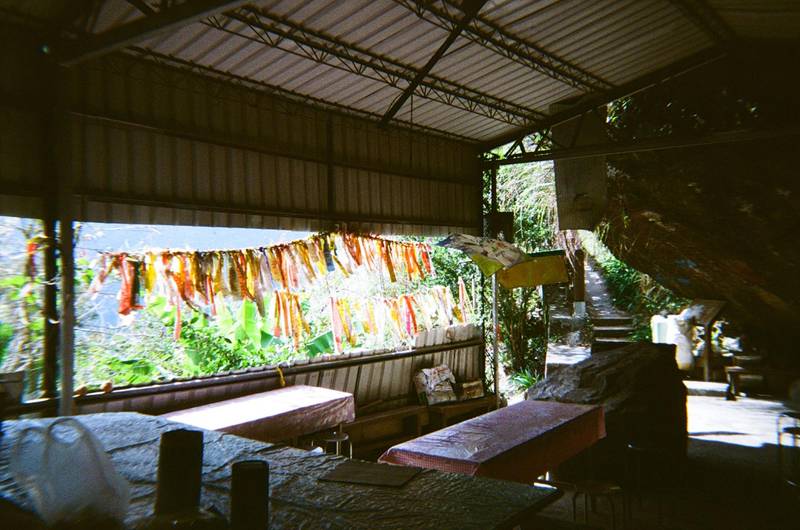
Buddhist temple in Taiwan’s Yushan mountains. Photo: Kang-Chun Cheng
Across the globe, deviations from societal conventions are often met with forceful pressure to conform. Left-handedness is a commonly suppressed trait around the world, from African to Asian cultures. Growing up in Taiwan’s Yangminshan National Park in the 1960s, my father says that he never saw any classmates who wrote or used chopsticks with their left hand. Enforcement of right-handedness happened at home––before children entered school––since it was treated as an act of disobedience.
French anthropologist Robert Hertz, writing in the early 20th century, famously examined the symbolic opposition between right and left. He argues that societies don’t merely notice that most people are right-handed, and accommodate those who are left-handed (who constitute roughly 10% of populations). Hertz traced how some societies, dating back to Ancient Greeks, have extended handedness into a moral and symbolic asymmetry: right becomes associated with good, proper, strong, and legitimate; left with improper, dangerous, impure, or inferior.
While watching Left-Handed Girl, I thought about the legacy of beliefs, particularly prominent in certain non-Western cultures, that may serve as charms to protect identities and beliefs amid unpredictable change. Yet they have the potential to incur harm or misunderstandings when invoked without context, as was the case with I-Jing.
After years of close and frequent collaborations with American filmmaker Sean Baker (Tangerine, The Florida Project), Tsou premiered Left-Handed Girl at the Cannes Film Festival in 2025; it was Taiwan’s official submission to the Oscars’ foreign language category. The film has been acquired by Netflix and is Taiwan’s Academy International Feature Award candidate for 2026.
Oscar submissions have an interesting political aspect, says Ochieng Oneko, a filmmaker from Nairobi, Kenya. “When it comes to the cinema consumed all across the world, there is no direct relationship between film-goers and filmmakers – it’s mediated through these institutions, such as large film festivals and institutions like the Oscars that grant awards. There’s this cultural imperialism – the power to control what everyone across the world sees – belongs to Americans.”
Then there becomes a local political aspect for films from outside the imperial core, Oneko continues. “Each eligible [non-USA] country nominates one film as their submission for best international film. They are mostly American, sometimes European, rarely Asian (like Parasite). For the most part, everything is open to Americans. Each country has only one slot to fill, which creates these internal politics within the country for the spotlight.”
Since more people are making more films because more technology is available, more films compete for these positions, Oneko says. “But there’s also more independent infrastructure that’s growing. The chokehold that the Oscars and European institutions have [on the film industry] is crumbling. It used to be a technological monopoly, but now because of social media, we can see that there is infrastructure everywhere for people to screen; we can see everybody is making good work, and these limited spaces are not enough for everyone.”
“The fact that we rely so much on the Oscars and festivals, and streaming platforms like Netflix, it’s really a cultural or branding monopoly that they have – not a tangible infrastructural issue as it had been in the 20th century.”
Watching the film, how delicate the moments are between the mother and her two daughters – knowing that the most difficult moments of their life are fleeting as well – made me feel nostalgic for a version of a life that could have been mine. Writing this review made me reflect on my own, shifting relationship with my immigrant mother.
I asked my parents about their experiences with left-handedness – whether it was something they noticed growing up in Taipei in the 1960s. “We were taught how to hold a pencil properly when we entered kindergarten, before learning how to write,” my mom told me. She had never seen anyone write using their left hand in all her years in school. She added that she wasn’t sure if this was the same case in Taichung or Tainan, other major cities further south.
My father chimed in: “Recalling what we experienced 60 years ago, left-handed people were not seen as being bad at all. But as children, those who were left-handed were forced to use their right hand to write and use chopsticks.”
“We didn’t see any signs of discrimination or ridicule against [left-handed individuals],” he continued. “In fact, left-handed pitchers were considered more powerful and desirable in baseball games.” Nevertheless, culture still demanded conformity from the children of that era.
“By the way, your 爺爺 [paternal grandfather] was left-handed,” my father added. “But he wrote and ate with his right hand, simply because great-grandpa forced him to do so. 爺爺 used his left hand for everything else.”
Around the 1970s, Taiwanese society at large began accepting data from medical research showing that it was better to accept children’s natural left-handedness. Parents stopped treating it as an act of disobedience and began to see that forcing children to switch hands might be harmful. “Acceptance of the natural became the norm,” my father explained to me. “Parents’ attitude toward education also transformed. Before it was going by the rules, rote memorization. People became more open to individuality.”
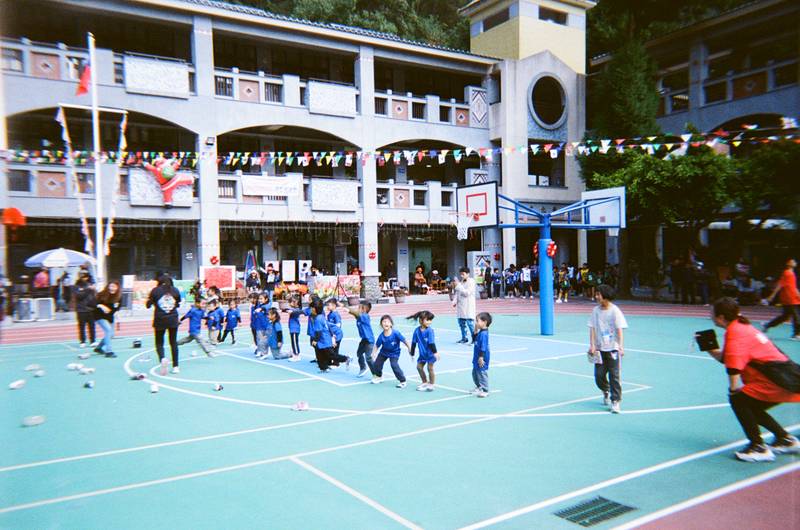
New Year’s Day celebration in Dongpu, in Taiwan’s Xinyi Township. Photo: Kang-Chun Cheng
My parents were born and raised in Taiwan, their parents having successfully fled mainland China as the Communist Party overpowered the Kuomintang Nationalist Party. The aftermath of the Second Sino-Japanese War (1937-1945), fought between the Republic of China and the Japanese Empire, shaped generations to come. My paternal grandfather, serving as an officer in the Nationalist Army, met my grandmother after the Japanese surrendered and retreated from Manchuria.
The Republic of China (Taiwan’s official name, although only 12 countries in the world recognize it as separate from China) was ruled by President Chiang Kai-shek from 1949 to 1975. Chiang was a revolutionary, military commander, and head of the Nationalist government in China from 1928 to 1949, fleeing to Taiwan upon defeat by the Communist Party.
Taiwan’s 38 years of martial law lasted until 1987 – four years after my parents emigrated to Rhode Island in the United States. My parents recount their upbringings in Taiwan as relatively simple, unfettered by smartphones or internet black holes. Martial law meant that life was strictly controlled: those with previous political affiliations, as my grandfather did, had to report to Chiang Kai Shek. Many folks, including my parents, saw this as a worthy trade-off for democracy and liberation from the Chinese Communist Party.
Upon arrival in the US, my parents tried their best to assimilate with American ways: learning not just the language but also absorbing cultural practices such as going to Thanksgiving celebrations. To this day, both of my parents insist that there was no friction adjusting to life in the US, that everyone they came in contact with was friendly.
Life in America was a far cry from expectations in Taiwan, where the culture was much more conservative and traditional: children never questioned elders or talked back and were expected to be quiet, disciplined, and studious. “Our lives revolved around school, helping out with chores at home, and church,” my aunt has recounted to me many times.
Girls in particular were expected to be docile and feminine. Speaking about or dissecting emotions, particularly between parent and child, was not the norm.
My maternal grandfather remarried while my mother was a young child; she had a fraught relationship with her stepmother up until her death. Four decades later, in a diametric environment with opposing ideologies (e.g., the American interpretation of independence clashing with the East Asian way of understanding one’s place within a generational collective), it was no small wonder that we butted heads.
I was a tomboy who fell out of trees, slammed drawers and doors, and didn’t see inherent moral badness in talking back – especially when my parents made coded comments about how unladylike I was behaving. At the same time, they were reasonably supportive and laissez-faire in their parenting. For instance, they didn’t mind that I would get a deep tan every summer from playing outside all day, although skin lightness remains a desired trait for East Asians.
But at the end of the day, my mother, an immigrant who attempted to uphold highly specific standards for a pre-teen daughter in rural New Hampshire, had no exposure to prototypical expectations of females in 1960s Taiwan.
Growing up, I struggled to understand why my mother expected me to behave in a very ‘Asian’ manner when I was immersed in an extremely Caucasian environment. In the public schools of West Lebanon, New Hampshire, our teachers did not teach us moral values or how to be model citizens the same way my parents were inculcated in Taiwan. Like I-Ann, I needed space to make my own mistakes and figure out my own values before I could appreciate the beauty behind rules that evolved from more traditional beliefs.
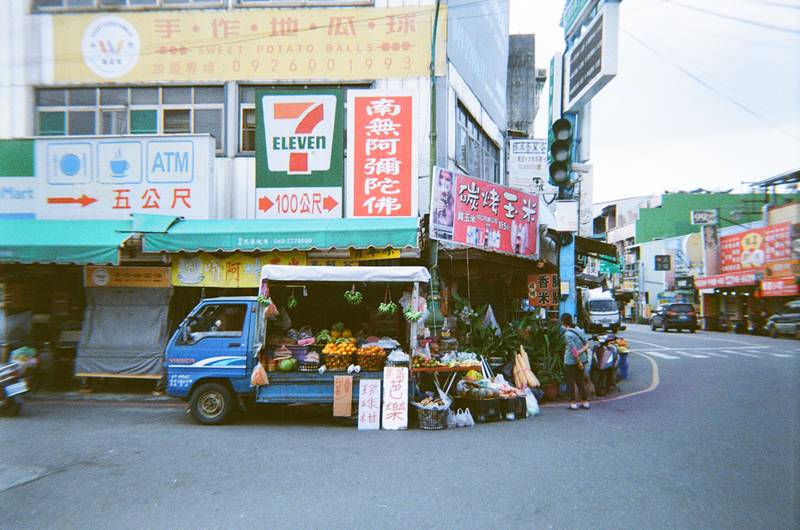
A roadside market in Taiwan’s central Nantou County. December, 2025. Photo: Kang-Chun Cheng